Friday, October 23, 2020

Tollesbury


 A glorious autumn day, so after lunch we headed south towards the coast.  At this point in Essex you reach mud and marsh before you reach open water, but it made a change from our daily woodland walks.

Through Tiptree with its famous jam factory, Tolleshunt Knights, with its monastery, and Tolleshunt D'Arcy, once the home of Marjorie Allingham, and then straight on to Tollesbury, a small settlement with a marina and a row of pristine sail-lofts.


Heading along the raised path out towards the saltings, all kinds of craft are moored up.  Owners reach their boats along these duckboard paths.


Many of the boats are clearly beyond sailing ever again - some look like shabby weekend boltholes and some are just the bare bones of craft.
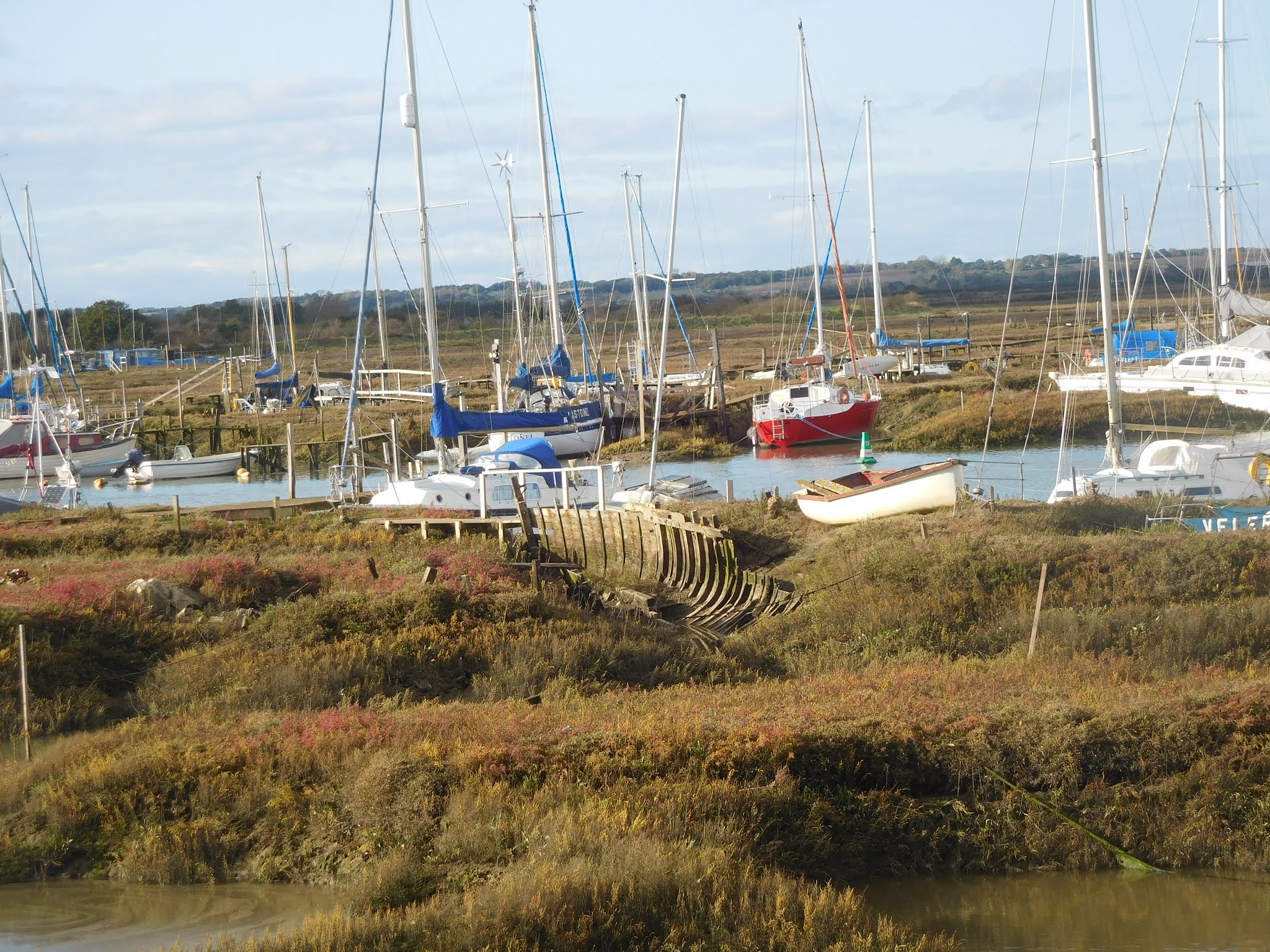


Looks peaceful, but imagine this at high tide with a storm brewing.


Looking to the east, we saw a huge flock of avocets rise and head off seawards, something we have never seen before.  Back towards Tollesbury, this was the view.


Sunday, October 11, 2020

Fungi


 This has been a year without precedent in so many ways.  With our normal volunteering closed to us, and the gym not exactly an inviting prospect, we have kept up our programme of woodland walking.  Consequently, things which probably happen every year without us even noticing have been a constant source of interest this year.

Fungi - who knew that there were so many kinds?

Edited to add:  It turns out one of you is an expert! -See Comments.  I am so impressed by your identification of all these species.  Turkey Tails certainly make sense for number five.  Thank you for sharing.

Sunday, September 27, 2020

Green Letter Day

This is Red Letter Day by Fiona Ellis.  I've knitted it before in bright blue.  The braided cables have a suggestion of elaborate military uniform about them.  I could see it in a dark green, perhaps worn with a tartan skirt or kilt. 

I did check out a few ranges of yarn, but bottle green seemed to have disappeared off the spectrum.  But then this cone turned up in the charity shop across the road, at a cost of £4.00. I wound it into balls and there was enough.  

I started by knitting the sleeves separately to remind myself of the pattern.  Once the body was complete, I tacked it together and it needed some adjustments.  The yarn was quite solid and had worked up larger than needed.  What to do?

In fact, I unravelled the sleeves and knitted them again in the smallest size.  Then I took out two inches at the top of the side seam of the body just by tapering off the seam.  The new sleeves fitted in easily and looked much neater.

So, what about buttons?  I decided on only three this time, placed to fit with the frogging at the centre front.  I don't want to buy buttons when I have so many in stock, so in fact I have used two which match and one of a similar type and size.  I doubt that anyone would notice.


Friday, August 28, 2020

Cabled Gilet.

Remember this?  I showed the lower back of this in my last post.


After about six inches, I realised that the piece was too wide for me, so I cast off some stitches at each side.  I was making it up as I went along.  I worked the rest of the back.  as I got near the neckline I realised that it would be good if the rope cable fitted into the shoulder, so I shifted the inside ones over by a couple of stitches to make this happen.


On to the fronts.  I knitted these both together.  Only when I was blocking the pieces did I notice that one of the cables had been mis-twisted pretty near the end.  This was an easy one:  I just raveled it back and reknit it.  Less easy to solve was the pronounced stocking stitch curl on the front edges.


Now I have seen people stitch ribbon to the fronts to give stability to an edge, but I have never done it before.  But I do have a hoard of antique textiles.  In it I found this: I had no idea it was there.  It was not very firm, so I cut a narrow strip of linen to go under it.  There was literally just enough to reinforce the two front edges.


The lower edges had started with ribbing, but this was pulling in so I took the ribbing off and knitted on applied i-cord.  I made the flaps from the back into little vents at each side.  Then I applied i-cord to the armholes and neck edging.  It took a little time but looks really neat.

Then, for the fastenings, I persuaded my husband to turn up some beechwood toggles.  Another length of applied i-cord up the front, incorporating buttonholes, and it was done.
I love it.  It's a great fit and a really wearable garment.


Tuesday, August 04, 2020

Hello deer


With the weather continuing fine we have been able to head out each morning for our constitutional - good for exercise but also for keeping us sane in these troubled times.  We have explored all over the woodlands to the north of our village. 

As stated in the last post we are attended by flights of butterflies, Meadow Browns and Hedge Browns mostly, with so many Whites I am amazed there is a cabbage left intact anywhere.  Today we saw a Fritillary and also a Speckled Wood.  At last, a chance of a decent photo.


We often get a sighting of deer in these woodlands - often a muntjac, just slipping away.  But we have seen far more Fallow Deer this year than ever before, often just a doe or two, sometimes with fawns.  Last week we happened upon a herd - upwards of thirty animals grazing, including four full-antlered stags.  They were at some distance and we have only simple cameras.


Today a different grouping, closer to. Interesting to see the many possible colorations in the group.


Later we saw the antlered stags moving as a group through dense undergrowth.

Just working on a cabled waistcoat in Aran weight, not that it is the weather for it just now.


Friday, July 24, 2020

Butterfly summer.

In June this year it seemed like the year of the rose.  Continuous weeks of dry weather meant that there were spectacular displays of roses around the village.


Recently, however, we have been amazed by the quantities of butterflies we have seen out on our walks. Peacocks, in greater numbers than Red Admirals, although we have seen both.

 Commas.


Ringlets


Hedge Browns and Meadow Browns


Skippers

And, most spectacular of all, Silver-washed Fritillaries, these last so energetic in flight that it is very hard to capture pictures of them at all.


Just this last week, a small, dull-looking insect turned out to be a rare Purple Hairstreak, basking on an oak sapling in the hedge.


And a brown butterfly, the female of the Common Blue.


All identifications courtesy of my husband, who turns out to be an expert.

A little charity knitting. These are small dolls using up oddments, just the right size for a child to clutch.


Saturday, June 06, 2020

Coins


One of the wonderful things about Fair Isle knitting using Shetland yarn is that you never run out of wool.  Each time you make an item you might buy a few new shades, but there will always be some to use up and even more left at the end.  Then there was that visit to the woollen mill on Shetland in 2000 - and the cones picked up on the Sales table at Spinners and Weavers and the remains of that charity shop jumper I unravelled....  so I have a large plastic box full of it.

This is Coins by Kaffe Fassett, one of those patterns which is so simple you can easily memorise it but creates a dramatic effect.  In its original form it is a cowl, knitted in the round as a tube and then joined.  I don't like knitting in the round, so I made the piece wide enough to be a scarf.  Stocking stitch has a natural tendency to curl and Shetland can be a bit scratchy, so I planned on lining it in silk.  

Choosing the colours was fun.  There needed to be enough contrast for the coin to show up.  Then the next strip along had to sit nicely with its neighbour.  I tended to alternate light and dark as the background colours.  Too dark, or worse, too light and it did not look right. After about eight stripes, I thought perhaps I could use different colours for every one.  In the end I managed this for the first half and then used a single stripe which would not be repeated before reversing the colours on the second half.  Only one stripe remained the same as the coin colour was too light for a background.  

Once finished, it was washed and pinned out flat to dry.  Then came the search for silk..  I have a large box of off-cuts from the silk mills in Sudbury, but nothing seemed quite right.  Although this is multi-colour, brown and green predominate.  So then I rifled through my wardrobe.  There was an olive green top which I no longer wear, in a smooth cotton jersey.  Just the ticket.  It took a bit of finagling to work out how best to use the pieces but at last I had it pinned to the reverse of the scarf.  I reclaimed thread from the top to complete the hand-sewing, slip-stitching the lining in place.


I love it.

I've added a picture of the lining just for you, Carol.  I used the hem of the tee shirt sleeves for each end.


Sunday, May 03, 2020

Out through the fields and the woods...

It's a particular delight this year to be able to access field paths running through woodland and open countryside.  We did meet a fair few people walking and cycling on this route, but all at a safe distance.


Leaving the village by the Tilkey road running north, we passed the little hamlet of Tilkey, once the site of brick-making.  Some of the earliest bricks made in Britain, after the Romans, were made in this little hamlet.


Along by thick hawthorn hedges and through the underpass, taking us under the 120 - predictably graffitied.


Through an area of woodland, the paths slippery after recent rain, even though the first three weeks of April were bone-dry here.


Past this house with its elaborate plasterwork and Strawberry Hill gothic windows.


The road leads on towards the Marks Hall arboretum, one of our favourite paces, now closed for the duration.  An avenue of mixed chestnut and oak leads along to where the mansion once stood.


On a regular Saturday in early May the place would be bustling with family groups, but not this year.  this view was taken through the fence around the Arboretum.  We, of course, are on the public footpath.


Land under the plough and a row of beehives at the field's edge.  We are in deep countryside here.

Then, emerging on to a lane, we follow the very muddy track through the woods and down the minor roads back to base.