Tuesday, July 16, 2019

Foxglove summer


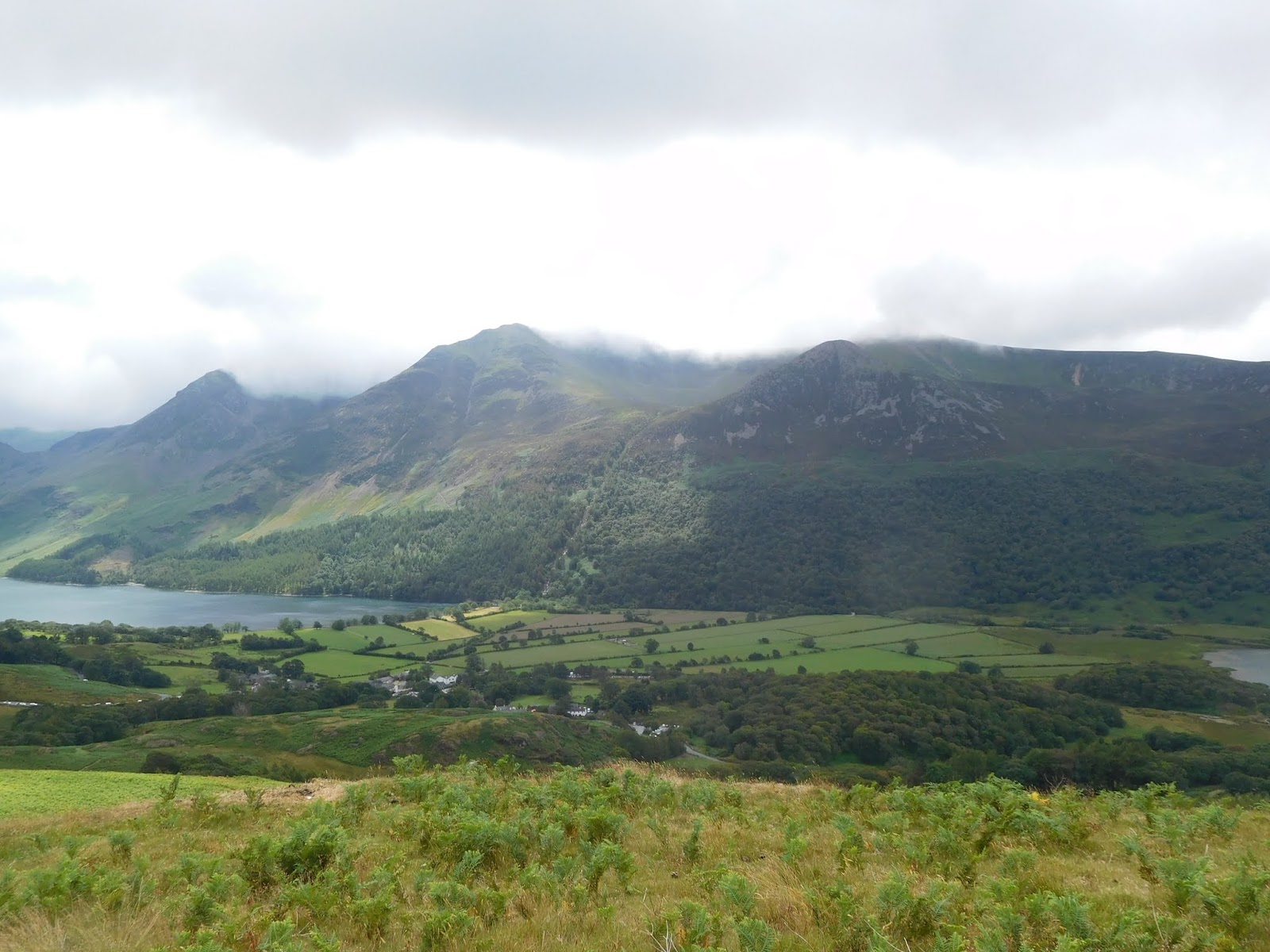
To Cumbria, by train, for a week of rest and relaxation.  From what? I hear you ask.  Some weeks recently have seen me serving up the cream teas on five days out of seven, and the thought of a few days of being out on the fells or along the shore was very tempting.


The forecast was not promising: rain, light rain and flood warnings after thunderstorms were on the cards.  We began by getting very wet indeed around the ankles because the growth of grass was quite different to last year when everything was burnt out.  We booked a leisurely lunch for ourselves on the day where the most rain was threatened.  But then we found that the weather smiled on us for once, so all our planned walks were possible.


A new footpath has opened up to the top of Brackenthwaite Fell, so we had to try it out.  We parked at Lanthwaite woods and enjoyed a stroll along the river bank and through the woods.  The ascent of the fell was a gentle slope, unlike the descent where the path seemed to be steps cut into a cliff.  We felt for those who had been lured to this point by the gentle approach.


The views from the top were very rewarding, given the low level of the hill. We will be doing this walk again.


Another day took us up Rannerdale Knotts, with its long slow incline up the valley.  Sitting at the top here, eating our sandwiches, is one of the great pleasures in life.


To vary things we cycled up the coast towards Silloth.  It was a dull day when we set off.  Just a dab of suncream on the nose, I thought.  Big mistake!  The day brightened and I caught the sun.


On our last day we drove over the fell to Caldbeck, back of Skiddaw.  There is a lovely little walk along a river gorge through limestone cliffs to a mill now in ruins.  Once it used water power to drive the lathes for wood-turning, making bobbins for the textile industry.


And that evening we took a stroll along the cycle path up the coast, the low evening light catching the colours of a sequence of yellow-hammers displaying from their perches, trilling their distinctive song: "A little bit of bread and no cheeeese."  Magical.


Wednesday, June 19, 2019


To Southwark, for the Preview of an exhibition of quilts.  A friend of mine is a quilt maker of international repute and she had invited me as she had work in the exhibition.  So this is Southwark Cathedral, just a minute or two from London Bridge and the Shard.


The memorial to Shakespeare.  The tomb of John Gower, the medieval poet, is here too.


A beautiful stained glass window from 1921.


And a curious panel of encaustic tile and ancient pavement.


Outside, more historic buildings, juxtaposed with the hustle and bustle of modern London.  This is the Hop Exchange.


And this, a dealership in hops, so this must have been an area related to the brewing industry.


Thursday, May 30, 2019

Work in Progress


Browsing though the many projects on Ravelry which feature cables I came across a jumper knitted in 2015 as a Rhinebeck sweater.  Rhinebeck is the big wool festival in the US and people wear their own most spectacular creations to it. This particular sweater had been knitted by copying a picture of a commercially produced sweater.

Now, I like a challenge and the picture of the original was there, so I thought that I would  give it a go.

I chose the yarn - Stylecraft Bellissima in Double Denim - because I liked the colour.  It has just a hint of denimyness about it in the variegation of tone. It cost less than twenty pounds.

Scanning the original picture threw up some mysteries as the ribbing is 2x2 but the cables are three stitch cables.  But that was easily solved.  I could have counted every row from the picture but decided to wing it and make it up as I went along.

The back and sleeves are in a simple pattern just involving a regular knit row instead of a purl, creating a ridged effect.  This matches the sides of the front.

Zooming in on the original picture revealed that the design was by Derek Lam, from 2013.  From his website it would have cost over six hundred pounds. I'm sure it was a lovely thing, as I hope my copy will be too.


Tuesday, May 28, 2019

Lone and level sands


After our week in Hawkshead, we moved on to our own cottage in Maryport.  It was ideal weather for walking and cycling.  This is the Solway coast with sand as far as the eye can see while the tide is out.  It comes in faster than a galloping horse, but we stay on the shingle banks and dunes.


I took a bag and collected up as much plastic debris as I could: tangles of fishing net, the sole of a very large shoe, two single gloves and endless small pieces of cord and twine - very little food packaging.


Cycling back down the cycle path we were struck by how many birds were displaying - like this yellow-hammer singing its heart out at the top of a bush.


The bottom end of Crummock water, one of the most photogenic places.


Layer upon layer of higher fells stacked up.


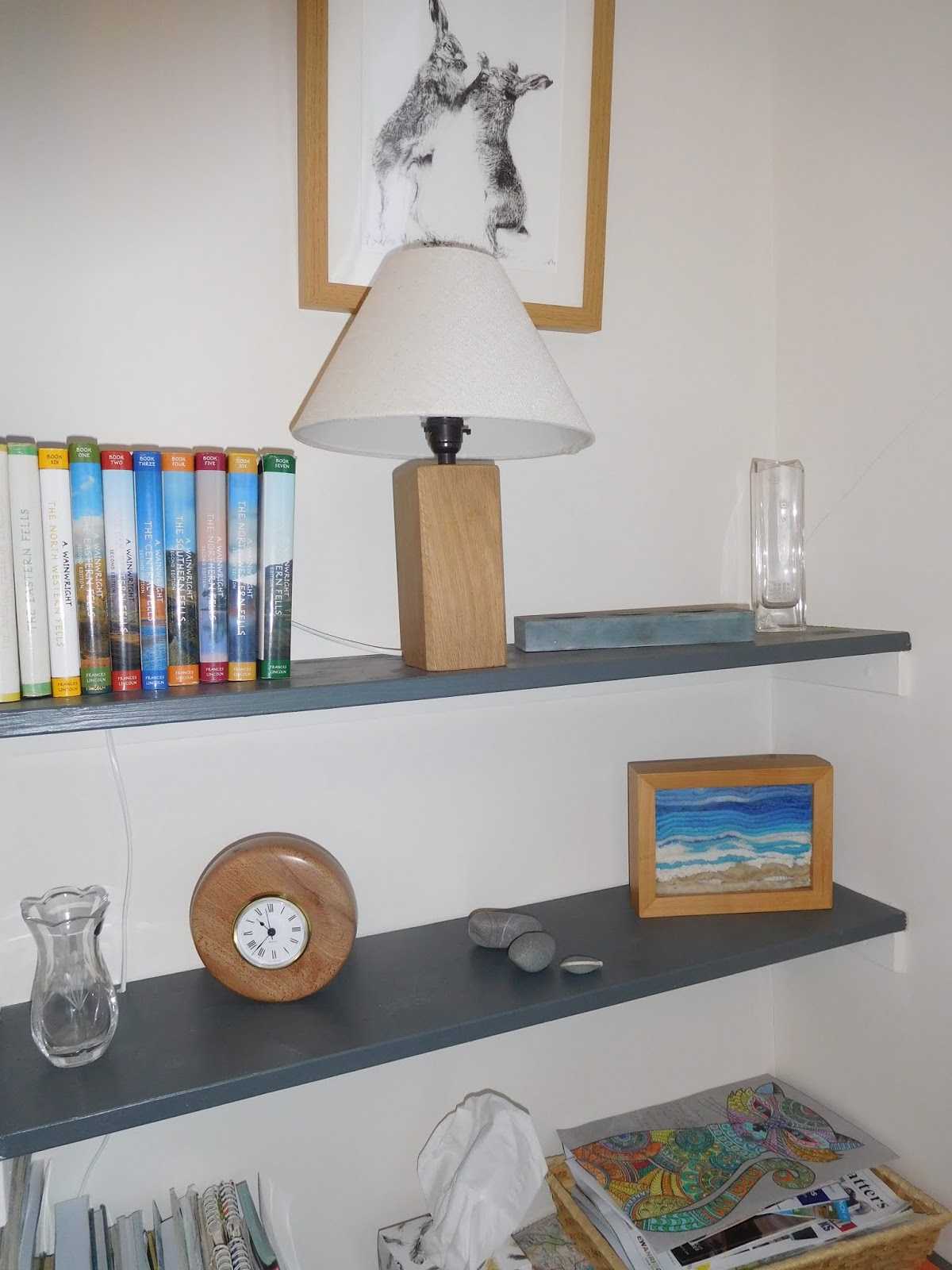
And this is our most recent nest-feathering: one of a pair of table lamps made by my husband from recycled oak.  They fit right in to our front room.


Monday, May 27, 2019

Three Lakes


From our cottage outside Hawkshead we were within easy reach of the central lakes.  One walk took us through bluebell woods to the Gothic pile which is Wray Castle on the shores of Windermere.  This was built by a Manchester cotton manufacturer, and what a monstrosity it is.


Ice-creams on the terrace made a great turning-point for our walk, however.

Another day we drove to Torver near Lake Coniston.  Here the walk took us past two very different tarns with views of the Langdales beyond.


On Coniston itself we were able to see the Gondola plying its trade.


On another day we drove over Kirkstone Pass from Ambleside to Glenridding.  We had been given a voucher for the Inn on the Lake so we enjoyed a civilised lunch for once and then took the steamer for a cruise around Ullswater.  It was quite a breezy day and the yachts were out.


 Back to Ambleside for tea where we saw the heron fishing for his supper.


Sunday, May 26, 2019

Hawkshead, again.


A week in the old farmhouse just outside Hawkshead, with our friends.  We were blessed with the most beautiful weather, unlike March when we never saw the sun.  The property is set in extensive gardens running up against woodland, so we were surrounded by birdsong.  Each evening we were able to sit out on the terrace overlooking the valley and eat our evening meal.  We enjoyed it all the more for its rarity.

Bluebells were out in force in the woodlands and we did many low level walks to tarns and beside lakes.

On the Monday we drove through Sawrey to the ferry across Windermere, and on, via a garage where our car needed some attention, to Blackwell, the Arts and Crafts house.


 We had seen that the current exhibition is of furniture made by The Rusland Movement.  My husband has made a bit of furniture himself, so we were interested to be able to hear their designer explaining some of the processes involved.  


Some of their pieces are just the sort of thing one could find room for.


Their clients commission pieces to fit specific spaces.  I don't seem to have a picture of the cocktail cabinet, with slate shelves and quilted lime-green leather interior but if you had a spare eighteen thousand you could order one.


This settle was made specifically for the exhibition, for the white drawing room. The back is not one piece of wood, but twenty layers of sycamore veneer glued together and bent in a jig to form that lovely curve.  Such ingenuity.  

Friday, May 03, 2019

Red Letter Day

This is Red Letter Day by Fiona Ellis.  Curiously, there are only three projects up on Ravelry for this design, although it is relatively straightforward for quite a spectacular effect.

It begins like Geiger with some ribbing.  I shortened this by six inches because I am short and it would have been coat length.  There is only one chart for the cables and it is repeated up the back to a certain point and then only the simpler element used above the armholes.

Exactly the same cable is split across the fronts, adding to the impression of military style braiding.

I went for bronze buttons with a crest because brassy ones distracted from the cables themselves. The only technique I added was to use a two stitch I-cord bind-off on the front edges, which worked really well.  

This is a budget yarn, designed I think for toddlers, but I was drawn to the strong colour.  I'm now imagining it done in a pure wool, perhaps in a deep green, and worn with a tartan skirt with a suggestion of kilt about it.  If one went to events where that sort of thing could be worn, that is.


Wednesday, May 01, 2019

Tulip Time


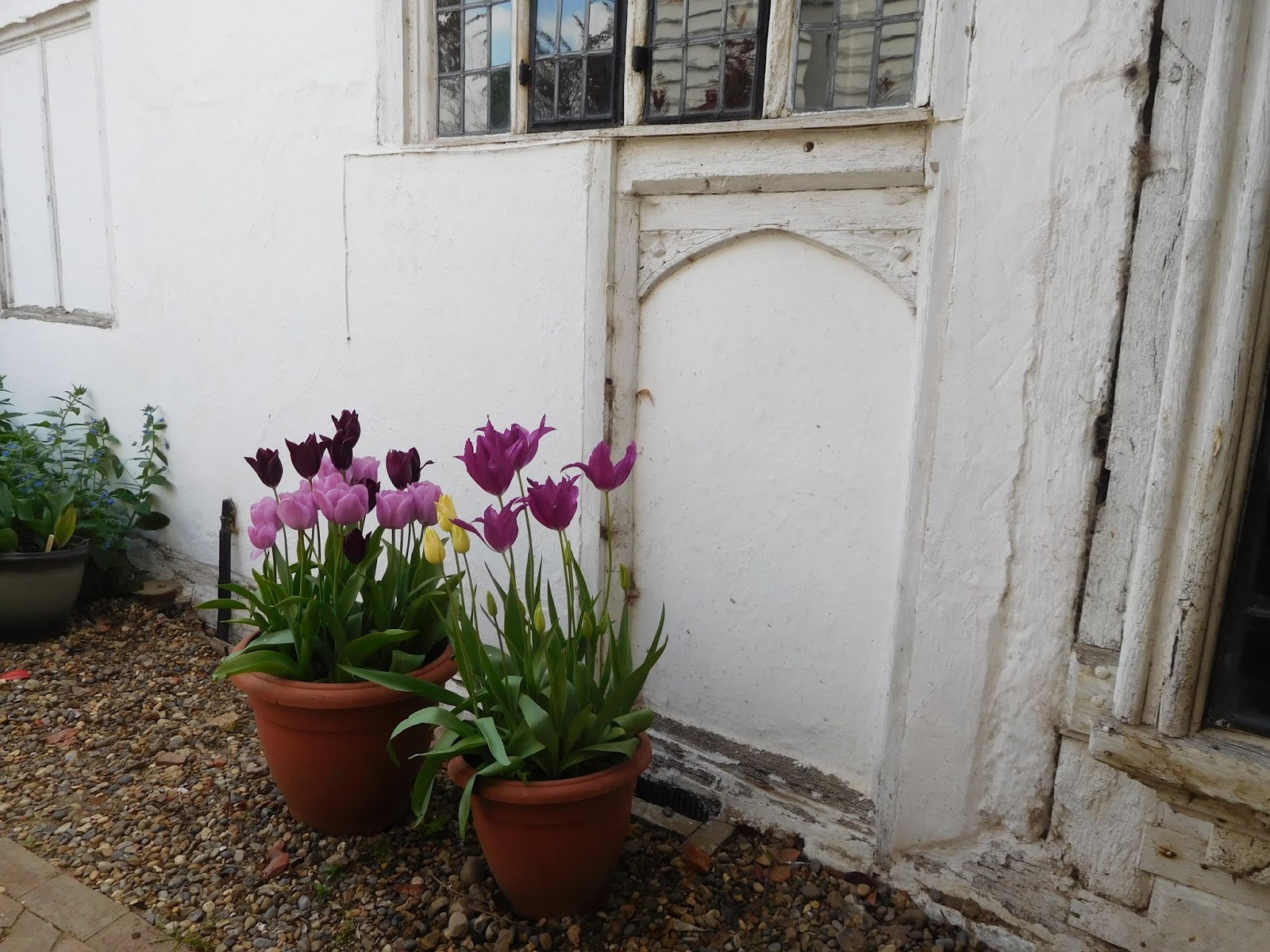
Ready for a visit to Paycocke's House?  You enter by the cartway at the side.


Multicoloured tulips set alongside old entranceways.


The wisteria in full swing above the door to Reception.


Tubs of tulips against the backdrop of the garden.


And my most recent finished item.


This is a pattern called Red Letter Day, and I could see this being worn for a special event.  Complex closed loop cables run down the sleeves and the back, so that the whole effect has the air of a dress uniform ornamented with braids.  It was curiously straightforward to knit, and is a great fit.


Monday, April 01, 2019

Memorial


To Cumbria for the memorial service for my aunt, the last of her generation.  When someone dies at ninety-five, full of years, there is a sense of completeness.


This is St Mungo's church, Bromfield.  There has been a church here since Norman times and possibly earlier.  My mother's family went to primary school at Bromfield, walking the couple of miles from their farm.  Whether they actually attended this church is less certain, as in those days you were "church or chapel" and I think that they were "chapel".


My cousins had prepared a summary of the key events of my aunt's early life: losing her mother at eleven and having to leave the grammar school at fourteen since the family moved to a more remote farm.


At nineteen she joined the ATS.  World War Two was in progress but she was a cook in barracks at Edinburgh, so it was a positive change for her. After the war ended she continued to work as a cook, moving from job to job as the fancy took her.


In this same churchyard is buried my cousin Betty, whose death from polio at the age of eighteen plunged her family into tragedy.  My aunt returned home to care for her elder sister. It was a devastating loss.


The churchyard is full of early nineteenth century tombstones, moved over and ranked in rows.  They tell of families in which every child died in infancy, or of sisters dying in their twenties, perhaps of TB.  

The wind sweeps through this churchyard, across open farmland from the Solway Firth, but these memorials are remarkably well-preserved, dignified as standing stones.