Friday, June 03, 2011

Allonby


Just five miles north of Maryport is the little seaside village of Allonby, one of my favourite places for an evening stroll.  This dream-like view of Criffel across the Solway Firth is the result of sea mist, and, on a bad day, the Scotch Hills can be invisible.  With the tide out, the bay stretches for miles of golden sand, graded gravel and shingle banks.

Like many places along this Cumbrian coastline, its heyday seems to have been in the late eighteenth and early nineteenth century.  Now there are at least five caravan parks stretching back from the street frontage.  Then, it seems to have been a fishing village and a spa, with some elegant buildings.  Here we have The Baths:


Front and rear views, now a private house.  The upper room was used as a ball-room.  The side with the columns faces into The Square, but this cobbled area was once also the main road through the village.


This lovely house, with its charming inscription over the lintel, also speaks of better days.

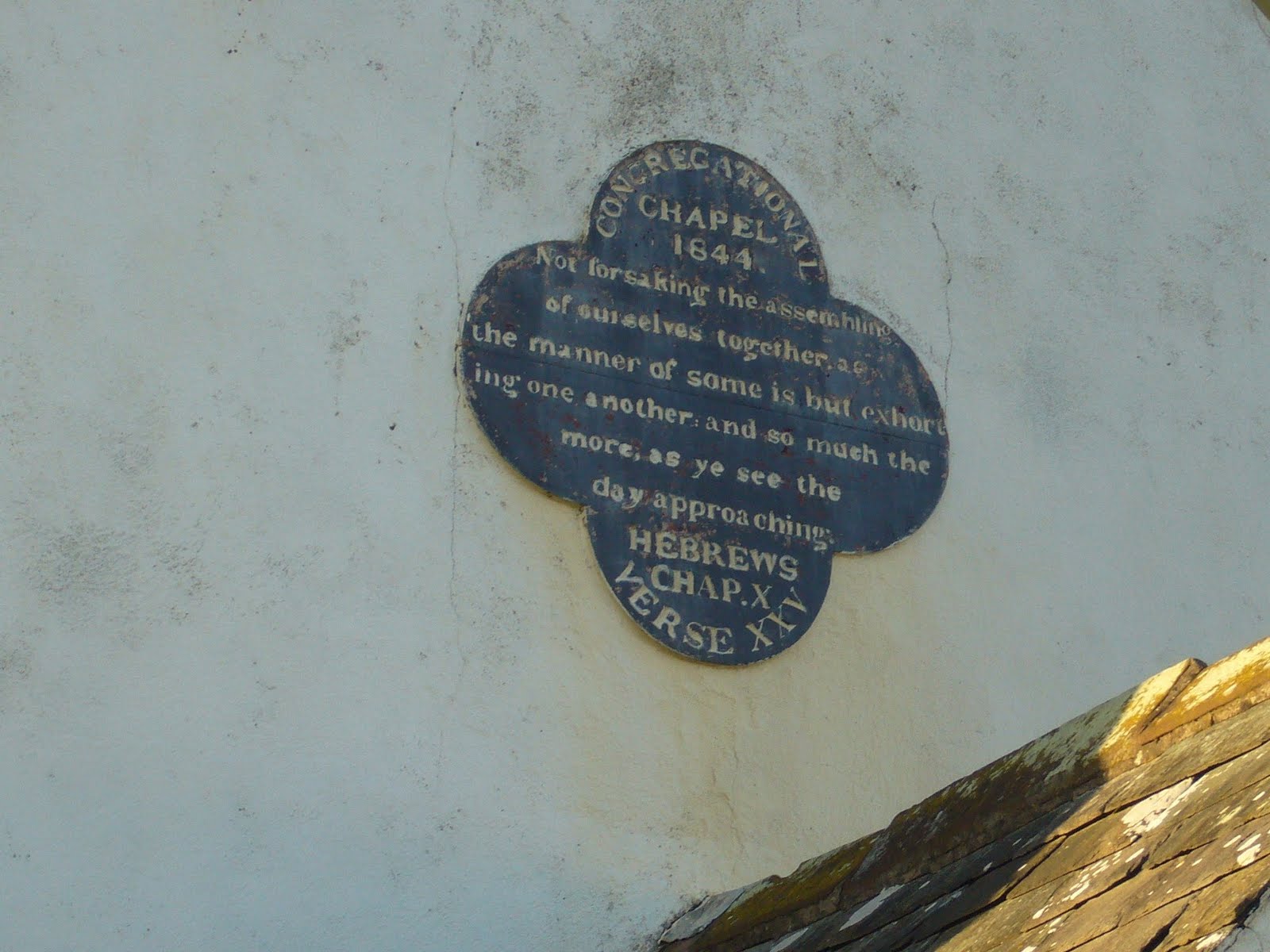
Even earlier is this non-conformist chapel.


With its inscription:
It stands right next to a former Quaker meeting house.

More prominent, and for many years a distressing ruin, is the old Reading Room, designed by the architect who designed the Natural History Museum, and built after a fund-raising effort in the 1860s.  The story goes that the most recent owner owned the building but not the access across a stip of land about four feet wide to the road.  This delayed matters while the building fell into decay.  Now, it has been made weather-proof but never seems to move any further.  The unimpeded views from its huge windows must be superb.


Finally, a nest of eggs - possibly an oyster-catcher's?  They were hidden in plain sight right out on the shingle beach.

Wednesday, May 25, 2011

Chimneys


Continuing the theme of the longer walk, my husband and I set out to walk to Stisted, a nearby village.  First we walked along the River Blackwater to Dick Nunn's Bridge.  This was, until recently, the turning point on our longest walk.

 Dick Nunn was a local blacksmith, in the nineteenth century.  He was stout-hearted and possessed of a sense of social justice, to the extent that, seeing tumbledown cottage up near the church, he helped it to tumble down completely, thus shaming the landlord into action.  Which was fortunate as, otherwise, the tenant would have been homeless.  The bridge has an iron frame - made by Dick himself? - and wooden slats.

We walked along the ridge then dropped to the river again.  Here we were amazed to find boggy sections even in this unprecedented dry spell.  Borage, alive with bees, towers over the presumed path. 

Passing a trout farm and Blackwater Alpacas, where eight fine animals were sunning themselves, we came to the gravel extraction pits.  All this while the noise of heavy traffic on the A120 was in our ears, but nothing prepares you for the experience of walking on the path alongside the road.  Fortunately, this stretch did not last and we were soon through a hedge into quiet fields.


And this is where we were headed: Stisted.  This is an ancient village much developed in the nineteenth century.  Note the ornamental brickwork on the chimneys.


We stopped for lunch on a bench outside the Montefiore Reading Room and my husband was able to sample the beer from the Onley Arms.  Unlike our village, Stisted has no shops, even for basic supplies.  It has only a tea-shop and a pub.

Then we headed home over the fields, including crossing an interminable field of oilseed rape where the crop was as tall as I am.  It was like walking through the bristles of a broom, although, at ground level, the path was perfectly clear.

Saturday was the meeting of the Mid Essex Guild of Spinners and Weavers.  Somehow I find myself in possession of a spinning wheel, without being able to spin.  I am poring over Sue Macniven's You-Tube videos, and have learned a lot already.


This is an absolutely standard Ashford wheel, which means that spare bobbins should be easy to come by.

Finally, a swatch of a four-ply Shetland yarn from sheep grazing on a local nature reserve.  someone at the Guild processes the fleece and sends it off to be spun in Devon.  The result is a lovely cosy sample - lofty is the term, I believe.  I am contemplating a jumper for my husband's birthday in August and this looks just the ticket.

Thursday, May 19, 2011

Great Monk's Wood


In a normal year, we would consider walking the field paths or a stretch of the Essex Way and we would be stymied by the sticky mud, the long, wet grass and the occasional downright quagmire.  But not this year.  This is the year of the drought as far as Essex is concerned.  Six weeks without significant rain; a few millimetres in April.  The field paths are bone-dry and those across arable land have fissures two inches wide running along them.  The crops will be early and meagre.  Like the snow in December, it is a situation beyond our control.

My husband and I, not being farmers, have been able to enjoy longer walks this year.  Last week we set out for Greenstead Green, a village with a farm shop and cafe, some four miles distant.  To get there meant traversing Great Monk's Wood, something I have wanted to do for some time.  In fact, stretches of coppiced woodland characterise this part of Essex.  Last week we came across charcoal burning in a clearing.

  Once the whole of Essex was designated as Royal hunting forest.  My husband informs me that when Charles the First was unable to raise taxes as he had suspended parliament, he tried to tax those who had encroached on crown lands.  I wonder what he would think of some of the palatial converted farmhouses here now.  One has a sizable private fishing lake where we actually saw cormorants circling.

Knitting:


This is the progress so far on the Mitred Crosses throw, knit in 4-ply Shetland and scraps of sock yarn.  I am pondering whether to put solid squares as spacers, and, if so, whether to knit them in bright sock yarn or a faded blue Shetland.  Alternatively, I could just knit twenty-five of these squares: there is probably enough cream for that.

Thursday, May 12, 2011

Fans

Last week to the "Cult of Beauty" exhibition at the V & A.  Maybe it was just me, but there was a lack of something to the whole event.  How many pictures of Janey Morris does one need to see?  As I went round, I was struck bythe indolence of the whole thing.  Endless paintings of women looking very bored and half-asleep.  The Twentieth Century couldn't come soon enough for these girls.  Some  Whistler drawings of quayside warehouses were a positive relief.  And there were a couple of absolutely lovely costume items: a cape and a medieval style velvet dress - which were pure Annabelinda c.1970

"Antiques Roadshow" - I suddenly remembered how awful my last experience of this was.  When you see the queues waiting patiently, you don't realise that they can be there for three hours before being seen.  So what would I have taken?

Many years ago I was given an antique white fan for my birthday, by my first serious boyfriend.  How romantic, you might be thinking, and, indeed, this is what I thought too.  That was until I realised that he expected me to buy him a car radio for his birthday, in return.  I learned a great deal from that relationship, all of it useful in the long run.


Some years later, I bought myself a black lace fan which was sold in this fan box, but is not necessarily by the maker on the box.  You may be able to see the dragonfly outlined in sequins in the second picture.  This one cost fifteen pounds, no strings attached.


We have taken to extending the range of our walks locally.  This is feasible this year because of the dryness of the season. 
It is a disaster for arable farmers, but it does mean that the footpaths are dry, where they can be ankle deep in mud.

  We walked North, towards Great Monk Wood.  We went behind Holfield grange where the map had us cross a meadow.  Here we were surprsed to see the remnant of an ancient tree, almost eight feet in diameter, looking like a small henge.  It will have been an oak like the one in the picture following.  At this size it must have been hundreds of years old.  The dendrochronologists told us that the oak for the historic houses of our village - including our house - came from Monks' Wood.  One can't help wondering whether this tree was already standing in 1635.


Finally, some dogroses seen alongide the path.


Thursday, May 05, 2011

Lanthwaite woods.

Our second walk this Easter began in Lanthwaite woods, a lovely, shady patch of mixed woodlands.  From there we walked through lanes and across fields to the foot of Crummock water where there is a pebble beach. 


We happily ate an early lunch here, basking in the sunshine and remembering other visits when it was windy and cold.  It was hazy in the distance, but the views were spectacular.


Round the end of the lake, past some sluices where we saw these elegant dogs chilling out.  Back up through woodland and out on to the road to the car.  We followed this by a trip to the tearooms in Lorton where my husband indulged in ginger cake and cream.


More progress on the Mitred Crosses squares.  I love the way that the cream shetland makes these saturated colours sing.


I am trying not to think how many squares will be needed for a throw which will be a useful size - twenty, perhaps?  All these so far are blues and turquoises but I plan to mix in some other colours to give that scrappy quilt look. 


Tomorrow to the V & A for the Aesthetic Movement exhibition.  Next week, Antiques Roadshow is filming near to us on a Thursday: my day off.  Do I go, and if so, what do I take?

Thursday, April 28, 2011

Walk in the park

My new knitting project: a throw based on Mitred Crosses for Japan by Mason-Dixon Knitting.  This is in sock yarn on a cream Wendy Shetland base.  I do not have the pattern so have made up what I think must be the numbers needed.

It is ideal travel knitting - interesting enough but not too fussy.


We were blessed with glorious weather on our trip to Cumbria.  Our favourite valley walk is a circuit around Low Lorton and Boonbeck.  We prefer to be away from the crowds.  This walk offers  little streams and shady bridges


It passes interesting houses - here, one is for sale.  What can be the purpose of the steps?


We saw mamy sheep with lambs at foot, and drystone walls.


Spring flowers - primroses and wood violets - were just everwhere.


And all along the way, the accompaniment of birdsong.  My husband saw a redpoll, a pied flycatcher, a reed bunting...and many others.

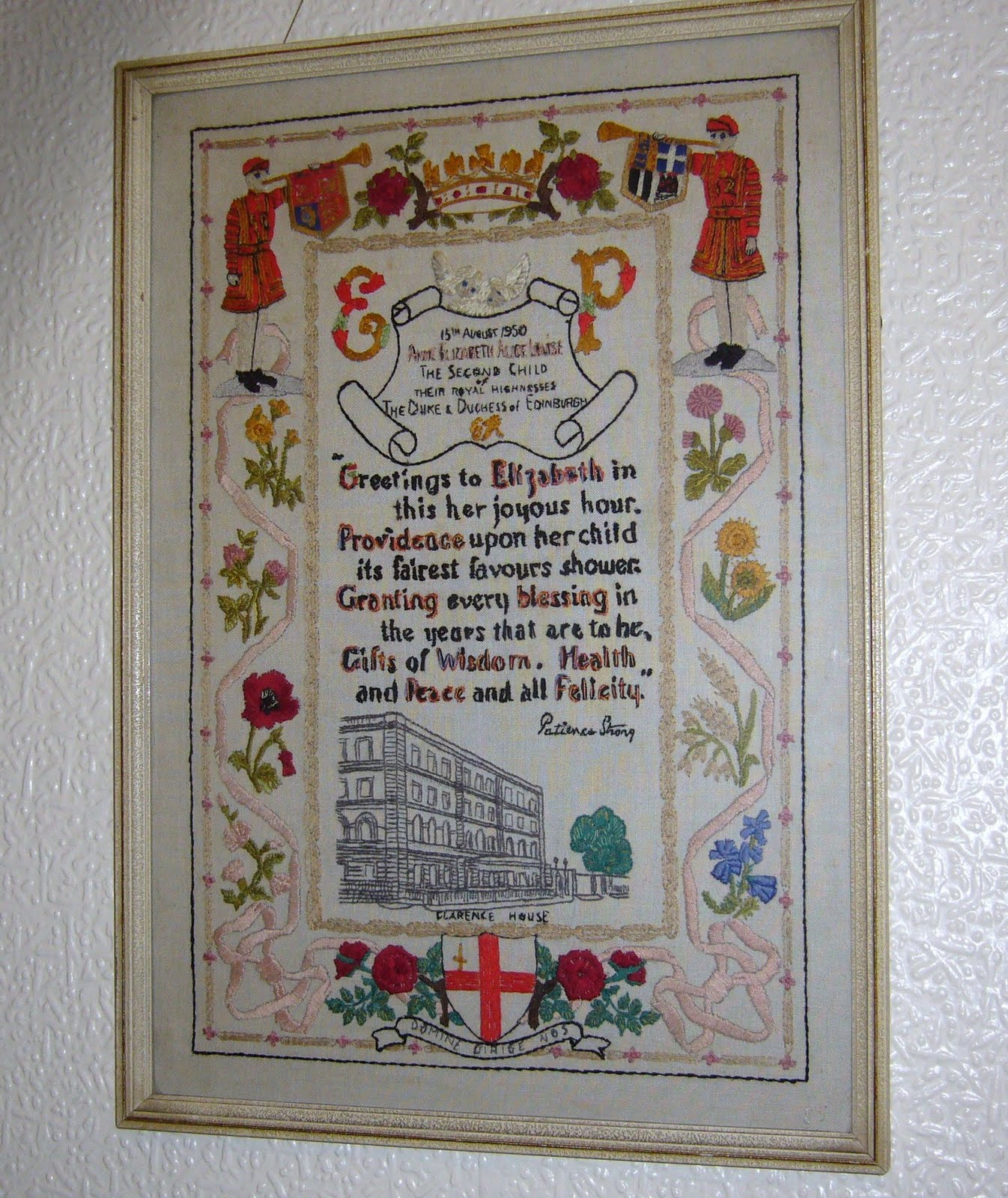
Finally, my commemorative sampler for the birth of the Princess Royal.  The atttribution of the verse to Patience Strong suggests the source of the design.


Sunday, April 24, 2011

Macclesfield Silks

En route for Cumbria, we spend two days visiting Macclesfield, known by locals as "Macc".  Macclesfield began as a centre for the production of silk covered buttons and from there developed "Throwing" mills for silk - "throwing" meaning plying to make thread.  With French silk no longer available, the early 1800s were boom years for Macclesfield.


  From the Town centre, the hills leading up to the Cat and Fiddle Inn and Wildboarclough are constantly in view.  Wonderful Venetian windows remain on buildings in the town centre. 


Once there were 120 silk mills in Macclesfield; now there is only one, although the mill buildings are everywhere, being used as offices and kitchen showrooms and apartments.  We visited the Heritage Centre, once a Sunday School for 2000 children, and built on exactly the same lines as a mill.


We had a guided tour of Paradise Mill, with Jaquard weaving looms for woven silk.  We were shown how the silk fibre is produced and the various processes preparing it for weaving.  Children as young as three would wind the little spools, or perns, which fit into the shuttles, using this wheel. I had only ever seen that word in Yeats' poetry, and I had no idea what it meant.


Winding a pern

Once the pern was in the shuttle, the thread was sucked though an aperture, hence the name "kissing shuttle".  Later, we would learn how this process spread tuberculosis and meant that cotton weavers inhaled the fibres. 

We were shown the design sheets, coloured in blocks of eight so that the holes could be punched on the Jacquard machine.  All that ingenuity to produce motifs on woven silk.  We also saw the Design school where students learnt their trade.  What we did not see were the four two up, two down cottages which were found to be housing 140 people - perhaps on a shift system - with only "the remains of a privy" between them.  That would be in the mid-nineteenth century.  We did hear a lot about how weavers rented their looms from the factory owner often paying over most of their earnings, and how five was the starting age but a tall three year old might be set on to work. 

All in all, it was a fascinating place to visit.

Sunday, April 10, 2011

Forget me nots


After my father's death, sixteen years ago, I was helping my mother to tidy the garden.  I dug up a clump of forget me nots and brought them south to my own garden.  Never was a flower better named.  For several springs after that, they engulfed the whole garden.  Now, I have them tamed to specific areas, where they drown out all rivals.


This is certainly an amazing season for blossom.  Here, the two espaliered pears facing each other in our walled garden.  At the base of this one a clematis, Madame Grange, is making another bid for life.  The harsh winter seems to have kick-started everything rather than killing it off.


A viburnum in full flower, threaded through with a clematis Montana.  the second picture shows some of the many insects attracted by its heady scent.

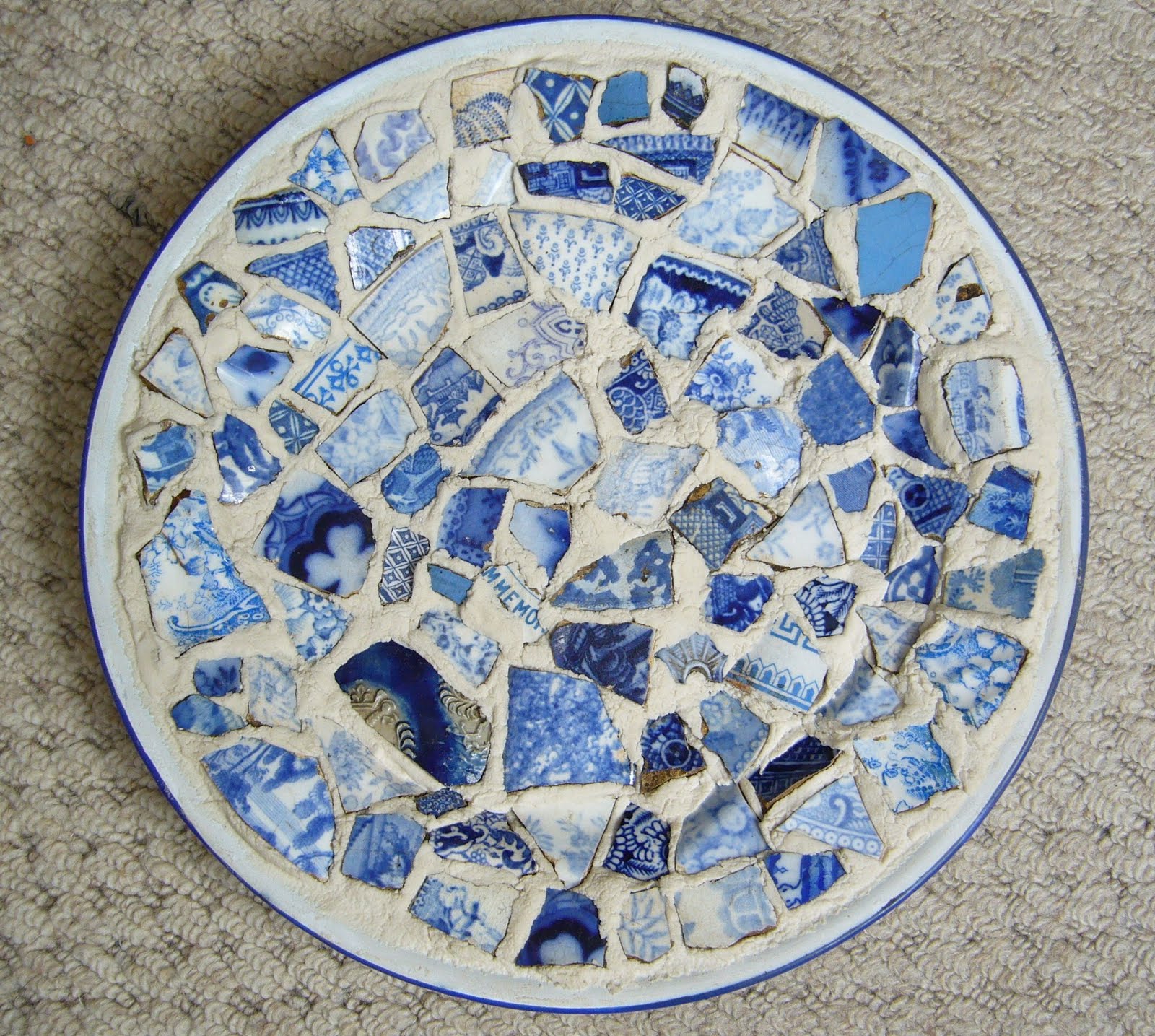
Finally, an image of our allotment plate. As a child, I lived in a farmhouse which had been in my father's family for more than one generation.  My great-grandfather, who was described in his obituary as a "dalesman of the old school," was  bookish, perhaps because he had crippled himself as a yourng man. The story was that he was scything the grass in the orchard when he cut his own Achilles' tendon.  There being no doctor to hand, his mother sewed him up with a sewing needle and thread.  Thereafter he walked with two sticks.   The attic at our farm was full of books which he had collected, and which amazed us as children. 

Also up there were two plates made by embedding fragments of broken china into cement on a tin plate base.  When we kept finding pieces on our allotment, it occurred to me that I could make such a plate myself - this is the result.


Tuesday, April 05, 2011

Stately Home


Last weekend to the Cotswolds to visit my father-in-law's widow.  We try to stay over in Stratford as it's a long day's driving otherwise.  This, the revamped Shakespeare Memorial theatre, with the curious tower, somewhat like a medieval Italian city state.  In the foreground, a glorious magnolia, dripping with blooms.


A further sample of my husband's craft,  this tea caddy was made for his mother's sixtieth birthday, more than twenty years ago.  He was very pleased to be able to shade the marquetry using hot sand heated in a metal tray to singe the individual  pieces.


On our way, we called at Upton house, home of the Samuels family, of Shell Oil.  The ambience is that of a house party in the thirties, although the collection of pictures is quite impressive, and worth millions.  We were able to view the paintings without the inevitable press of people in the National Galleries.

In the billiard room, we were surprised to see an item of "kit" that we recognised: we have one in our dining-room.  I asked if we could see the interior and we were very entertained to see the room steward don a pair of white gloves before opening it up for us.  We will have to get a pair to use with ours!


This is a "Star" record cabinet - ours.  Note the Art Deco shaping to the lower edge.  My husband inherited it and set about converting it to hold a tuner and a turntable on which he plays his 78s.  The lid lifts up on a hinge to allow this.   Who knew it was the choice of millionaires?


Pansies and pear blossom in the garden.  Such cheerful flowers, pansies, with their curious markings, and in such brilliant combinations of colours.  We encouraged the buying and planting of trays of these in the Cotswold garden too.