Sunday, February 22, 2015

Midwinter Spring...


To Cumbria for half-term, my one day a week tuition meaning we are still following school terms.


February 14th - what could one expect?  A low sky? Drizzle?  But instead we were blessed by the first of two glorious days, not of winter sunshine, but of the real thing - full-on blue skies, high wispy cloud, and just a bit of haze to take the edge off the views.


Last year we climbed Dodd for the first time, and now it looks like entering our regular rotation of walks.  We climbed up through woodlands already alive with birdsong, on paths which are so well maintained that you don't have to pick your way.  Opposite, the flank of Skiddaw still bore streaks of snow; the summit of Lower Man intermittently wreathed in cloud.


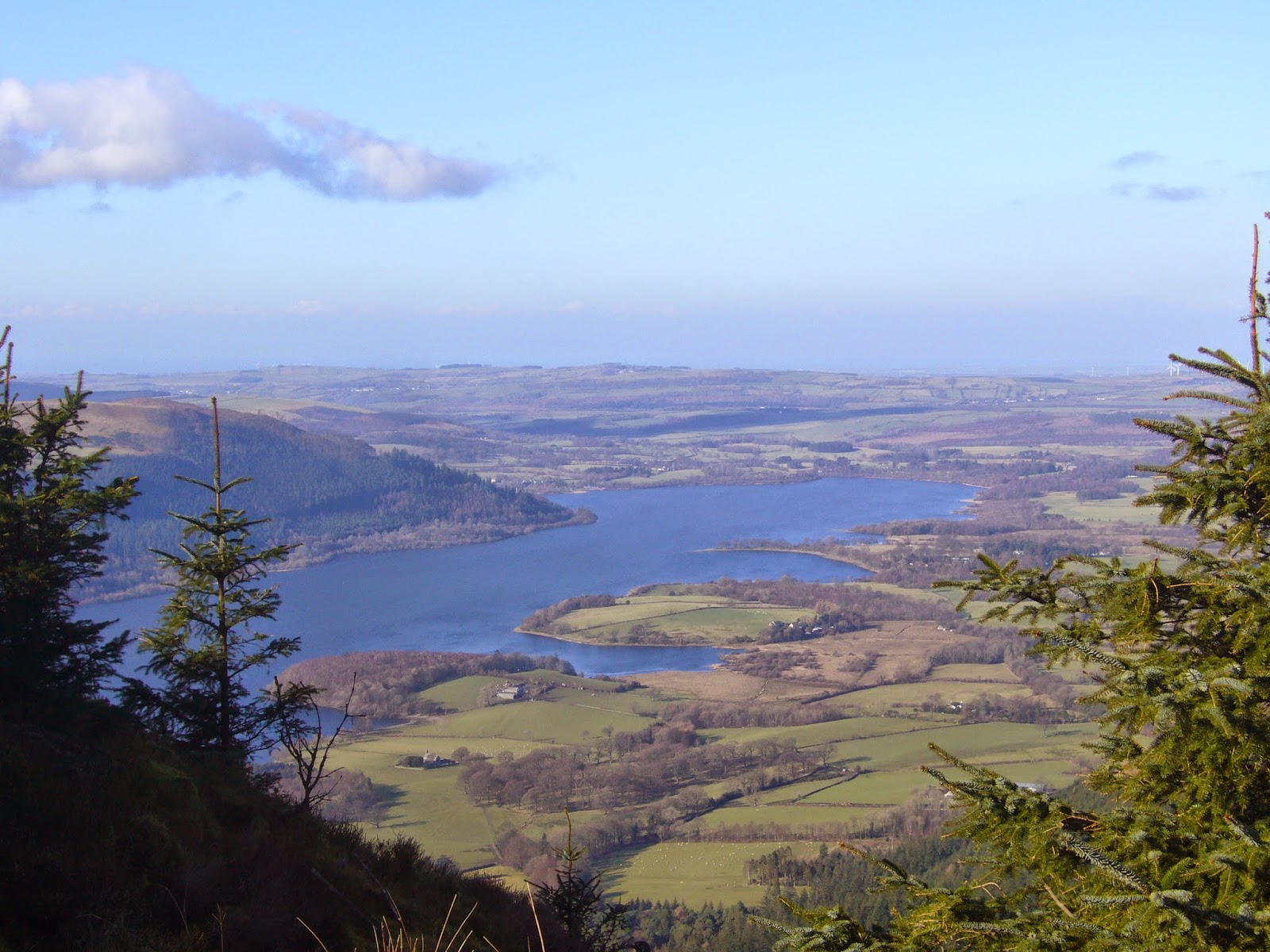
We emerged from the woodland; suddenly, there was the view - right down Derwentwater to Lodore, the lake glistening in the haze. 


A little higher, and the view to the west opened up: Bassenthwaite, with all the land down to the Solway beyond.

By now a brisk wind had got up, as often on even a small top.  We ate lunch sitting on a rock and then made our way down the terraced paths to the Sawmill tearoom at the bottom.  Three miles, but, like last time, it took three hours as it is quite a stiff climb.


And so to Sunday: another clear, bright day.  We took out our bikes and headed up the coast.  Once, you had to compete with boy racers testing their engines on the coastal road to Silloth, but now a very useful track has been laid, for cycling and walking, and it is much used.  We were able to take our time, stopping to survey the foreshore which was alive with birdlife: redshanks, oystercatchers, curlew, their wavering, trilling calls unmistakable.


A little further and we saw stonechats sunning themselves, perched out atop exposed stalks.


We went on through Allonby and up to Beckfoot, where we ate lunch sitting on the beach - in February.

The last day of good weather saw us taking the route above Loweswater, leading to High Nook Tarn.  On our way we crossed a sheltered field in which many birds were foraging.  first we saw a songthrush, now increasingly rare for us.  But then we saw both redwings and fieldfares, which are winter thrushes.  Two bullfinches were perched in a bush and I was delighted to spot a treecreeper.  I am not a birder, but it is good to be able to name the species, just as we are increasingly able to identify individual hilltops in the Lakes.


Work continues on my latest project: the Skye cardigan.  The chart for this is available free on
Ravelry, where it was used on the front of socks.  Here, I am using a maroon Shetland
heathered with ginger and rust, paired with the Katia Ole sock yarn in a pinkish colourway.
The challenge here was to find a way of mirroring the chart for the two fronts.  What do you know?  It turns out that holding the chart up to a mirror, and taking a photo of it in the mirror, gives a good enough image to use for the second front.


Sunday, February 08, 2015

Cowled


I've been having issues uploading pictures - still not resolved.  Warning: heavy knitting content.

Over the Christmas break I found myself knitting the sleeves of Signild for the second time after picking up the stitches around the arm hole.  There is a tutorial on how to do this posted by  Bygumbygolly - I've no idea why this is the name of the site.  It does make it very clear, with masses of pictures, exactly what to do.  The writer explains that it is all based on Barbara Walker's "Knitting from the Top down", so of course I had to order that too.

 Essentially, you work out how many stitches are going to be needed for the widest part of the sleeve across the upper arm.  Then you pick up that many stitches around the armhole using a shortish circular.   You knit across the top third of the stitches for the top of the sleeve. Then you begin to work short rows across the upper part of the sleeve head, picking up one stitch each row and wrapping and turning.  It is all much clearer with pictures.

A website I am devoted to is Ravelry, and it never ceases to amaze me when I talk to keen knitters who have never heard of it.  What I love most about it is the world wide reach of its membership.  When I posted images of the Whithorn Celtic pullover on Ravelry, the first comment I received was from someone in the Falkland Islands, and the second from someone in a hill-station in India.  Knitting as an international language?

 
More recently, I've been working on some cowls.  The first was this very useful moss-stitch cowl in a Noro yarn  This is very snug when wrapped around twice close to the face, and the silk yarn makes it bearable against the skin.  The subtle colour shifts of Noro make this a special item.


Next, was this mustard cowl using a lace and bobble stitch from another stitch directory.   I have been struck by how mustard and a number of different acid greens have been to the fore in recent seasons.  This one picks up the mustardy flecks in my tweed Lavenham jacket.


Finally, this purple cowl, using a complex stitch pattern from Barbara Walker's "Third Treasury of Knitting Patterns".  This is a Drops yarn, Nepal, a mix of wool and alpaca.  I'm pleased with the stitch definition and colour.  This year, I found myself stuck for a Secret Santa gift at the last minute.  I'm thinking that this might go in my bottom drawer for just such an event.

Saturday, January 10, 2015

Signild


This is Signild by Elsebeth Lavold, which has also reached completion over the Christmas break.
 
I have admired the work of Lavold for some time: all those wonderful designs in "Viking Knits" - but I've never actually knitted one.  This one appeared in the September issue of "The Knitter", and I loved the Celtic, or Viking, knotwork.  This is an exceptionally simple design, with the simplest ribs and the button bands knitted as  the edge stitches of the fronts.  A beginner could knit it.
 
I used a yarn I have had for some time, but have not found  a pattern to suit .  I bought it on a cone from Coldharbour Mills, which specialised in remaindered yarns.  It was unbranded, but not cheap, and the smooth handle suggests that it is a high-end Merino.  However, it knits at somewhere between a DK and an Aran, so I ended up making the largest size, to be sure that it would fit.
 
Then there were the sleeve heads.  The shoulders are slightly dropped, with a shallow sleeve head.  I tried simply sewing these in, in the usual manner, but was not happy with the result.  The yarn is very smooth and reveals any flaws.  Eventually I decided to knit the sleeves again, using a top-down method, picking up stitches around the armhole.  Someone has very helpfully provided a free tutorial on this technique on their web-site.  It gives a much better result.
 
 
Maureen asked about the edging used on the Fair Isle pullover.  This is a really simple combination of garter stitch and single rib, which gives a neat effect. 
 
Knit two rows
K.1 P1 two rows
Knit two rows
 
I first used this on my Summer Isles waistcoat, where I was making up the pattern as I went along.  Because the bottom ribs were curling and flaring I took them off and reknitted then upside down,.  This had the effect of making the cast -off edge the same at the bottom of the waitcoat as on the front edgings, almost like a braid.


I used it again on the Windfalls waistcoat, but not on Jewels as it is knitted in Shetland style wool, and I just used single rib for that.


Wednesday, January 07, 2015

Works in progress

Just before Christmas we made our duty visit to the Cotswolds, where, fortunately, all was well with my husband's step-mother.  While there we did a little pootling in Stratford, passing this wrapped, or yarn-bombed, tree. 


I can understand the idea behind this practice, but only to a degree.  It's a bit like those giant art-works involving wrapping whole buildings in cloth.  Several of the qualities of knitted or crocheted fabric are negated by this process: it's not keeping anything warm,  it's not waterproof, it will get dirty..  I do think that this one looks cute though, like an illustration in a child's book.


A friend recently attempted to log her wips on Ravelry.  She gave up the attempt when she realised that there were more than twenty items on the needles around her house.  I have not counted how many unfinished items I have, but it will be a few.


I generally like to work on one item at a time, but have been persuaded
by Jean Miles' practice of having several items of varying complexity on the go, for different purposes: waiting-rooms, car journeys, quiet afternoons.


Top of this list is the Pierowall pullover.  I'm now working on the last section, involving decreasing through those complex charts.  This is knitting which demands my full attention.  I retreat to the dining room, where I can have the chart laid out on the table in front of me.  It's taking some time, but I am pleased with the effect.

Edited to add:  After ten hours of the Radio 4 production of "War and Peace", I am happy to announce that the Pierowall Pullover has now moved to Finished Object status. 


In the original, the designer, Liz Lovick, used sixteen different yarns, swapping one yarn in each row to give a subtle shaded effect.  It was knitted in the round, with steeks, and had patterns front and back. I'd love to see it in wear.

  In my simplified version (!!) I used a speckled sock yarn by Katia with a 4ply merino in jade for the front, which I knitted back and forth.  This may have been a mistake.  For the back I used a 150 gm ball of a sock yarn by Regia, in a remarkably similar colour, using a plain single rib. 


For the edgings, I used that combination of garter stitch and rib which I have used before, which just gives a neat edge.  Wet blocking the front made all the difference to the set of the stitches on the front.  It has a luxurious handle from the Merino 4-ply.  Incredibly, it took only one ball of the Katia speckled sock yarn.

I love it.


.

Friday, December 12, 2014

Photo tourism


So where was I off to today?


Was I catching the Hogwarts' Express?

In fact, I was meeting an old friend at Peterborough, which is about midway between our homes.  I'd never been before, and I must say that I was impressed. 

Those of you who imagine these trips as a sequence of visual delights might bear in mind that on the journey out my train was cancelled.  No problem, as Peterborough featured on a number of routes. 

But on the way back the same thing: train cancelled and the alternative a stopping train, doubling the length of the journey, delivering me to London for the rush hour.  Then we were held at an intermediate station while the police rounded up someone who had decided to trespass on the line and run around to avoid arrest.  It took four hours to get home.

But in Peterborough the cathedral is an absolute gem.  The West Front is early 13th century; the only Gothic part of the building.


Elsewhere,  rank upon rank of Norman arches with delicate columns decorate the exterior.


The cathedral has housed the tomb of Katharine of Aragon, since her death at Kimbolton in 1536.


Everywhere, history is layered into the fabric of the building.


The centre of the city is a giant modern mall, but we had a choice of eateries: Carluccio's is housed in a former almshouse bearing this plaque. 


 Instead we chose Pizza Express, with this Arts and Crafts facade.


On the needles, or rather just off them, was a pair of fingerless mittens bearing  cabled owls, gifted in a secret Santa without being photographed.  Meanwhile. I am ploughing on with Signild, a cardigan by Elsebeth Lavold, in September's edition of "The Knitter".


Monday, December 01, 2014

Late Rembrandt


Last Friday to Trafalgar Square, to meet up with my younger sister and take in the Rembrandt exhibition.  Arriving early, my husband and I popped into the Portrait Gallery to look at Tudor portraits, and specifically the picture of Thomas Cromwell referred to by Hilary Mantel in "Wolf Hall."    After several failed attempts to get started on this novel, which I now think is a masterpiece, I made it past the confusing opening and enjoyed its wonderfully rich texture.  In the second volume, Mantel is much clearer as to exactly who is speaking at any particular point and this simple technique helps a lot. 

Standing in front of what is in fact a copy of the Holbein portrait, I related the story Mantel tells of how Cromwell felt it made him look like a murderer and said so to his son - who paused, then asked him "Did you not know?"  I recounted the story, then turned -  to find a total stranger standing at my shoulder, just where I had thought my husband to be!  So now I have turned into the sort of confused old person who rambles on to bystanders in galleries.


Trafalgar Square is completely transformed by the pedestrianisation of the section outside the National Gallery. There was a holiday atmosphere, buskers, bagpipers, mime artists and all.


Within, the Rembrandt exhibition was the usual victim of its own success.  Entering on a timed ticket we found the crowd already twenty deep.  Those telling self-portraits and the bigger pieces full of movement and energy were still impressive even with the overcrowding, but the tiny etchings were difficult to appreciate in this setting.  It appears that the gallery allow half an hour for each visit, and this is nowhere near enough. 

On the knitting front, I am making slow progress on the Pierowall pullover, largely because it is too complex to knit on while doing something else, such as watching tv.  This, on the other hand, has been ideal.  It is a seed stitch cowl, using two balls of Noro Silk Garden.  I used the first ball as it came, but used the second from the middle out.  This reversed the colour sequence.  Not all balls of Noro are identical, but these two were.


Monday, November 17, 2014

Challenge

 
Those of you who enjoy a challenge in your knitting will find all that you need in Liz Lovick's Pierowall pullover.  I bought mine from her Ravelry page, but it is also available on Etsy, apparently.  In her version, many different yarns are used for both the background and the pattern, swapping one shade on each round.  I have taken a much simpler approach in using only one colour for each.  This is a dark green merino paired with a speckled sock yarn which I am hoping will give an idea of carved stone.  I'm thinking of the Northumbrian crosses at Whithorn.


I'm knitting mine flat, not in the round.  This does mean that I have to knit purl rows, but the rows are half the length.  I'm knitting the back in ribbing which seems to give a good fit.


The real challenge comes in following the charts on motifs which are not symmetrical.  Unlike horizontal Fair Isle bands there are no easy rows here. I have to give it my full attention.  Still to come is the matter of continuing the pattern while decreasing for the armholes and neck.  I'm thinking that I will draw the line on to a copy of the chart.  We'll see.

Thursday, November 06, 2014

Long weekend

Lest you should imagine it is all knitting, all the time here.... About a month ago my husband's stepmother fell and broke her leg.  At eighty-six, this is no small matter, but the current practice is to operate, insert a metal pin, and have the patient back on her feet the next day.  Fortunately all has gone well.


 As her immediate family, we have been much engaged in supporting her return to home - those of you who have been through it will know what this entails. The journey takes three and a half hours, which complicates matters - although I  am aware that for The Sock Lady in BC this would be a routine shopping trip.  Everything is relative.


As my birthday weekend approached, we planned to travel north, calling to visit the patient and do good works before continuing to our Cumbrian cottage.  We drove towards the Lakes in glorious sunshine, our first port of call Blackwell, the Arts and Crafts house on Lake Windermere.  This has to be one of the most beautiful places on earth.  The light-filled white drawing room, with its elegant columns and panelled ceiling, simply takes the breath away.


We lunched on a duck salad and English Lakes ice-cream and visited the exhibition of Glasgow School artefacts - huge chargers with Celtic knotwork and cabuchons.  Female artists very well represented - the whole thing was a delight.


Among my birthday gifts was a voucher for lunch at a local coffee-shop where great-nieces  have part-time jobs.  We enjoyed a traditional roast beef dinner; the girls were fully stretched serving the huge crowd.  Those of you touching base in Australia (!!) thank you.


 It was a day of dramatic weather: "showers and sunny intervals" does not begin to describe a landscape in which, to the left, the skies are blue with white cotton clouds, to the centre is a huge dark storm cloud, while, over to the right, the sun bursts though again.  We drove on to Caldbeck, and the Wool Clip, where I bought the new book by Felicity Ford, "The Stranded Colourwork Sourcebook". This is lovely to look at and interesting to read. She is clearly an enthusiast; I wonder if she is offering workshops?


On Monday we set off to get some exercise on a favourite walk above Loweswater, enjoying the rich colours of the woodland.  More surprising was the colour of wet bracken in sunshine: glorious.  But the highlights of the day were the rainbows, arching across the valley, both ends visible.  Of course, we got wet, very wet, even eating our sandwiches in rain.  However, the rain had also meant that others were deterred.  For the first time we saw a red squirrel in the woodlands by the lake.


On our last day we went up the coast to Wolsty Banks and walked towards Silloth.  The weather could hardly have been more different: a low grey sky, and total calm, the sea air lowering the temperature.  First, we saw skeins of cormorants beating up the shore.  More heart-stopping were the huge flocks of much smaller birds - we think, dunlin, - settling on the sand bars and then rising with a sound as of hundreds of fans clicking, and wheeling in great smoky clouds.  We had a memorable walk.

As for knitting, Maureen Takoma asks about the patterns used in Jewels.  I took them all from page 99 of Sheila MacGregors's book on traditional Fair Isle knitting.  They are all thirteen row patterns, but are all different.  I chose to use plainer bands between to give some unity to the design.  It certainly holds the interest to use different patterns and colours.

My next project is already under way: Liz Lovick's Peirowall pullover.  I'm simplifying this hugely by using only two colours, and only knitting the front in pattern.  Even so it is a challenging knit.


Thursday, October 30, 2014

Jewels 2

Completed my waistcoat in 2ply jumper weight.  Even while this was still on the needles it felt like an old favourite jumper.  It is the third waistcoat in a row for me, but the others felt quite different, probably because of the yarn. 


You can see how the rust yarn looks.  As always with this kind of yarn, once it is knitted and blocked it looks as if it was always like that because the tweediness of the blend makes the yarns work together.

Something about this design reminds me of old Afghan rugs  -  maybe it's the colours or the similar but not identical patterns. This is the reverse:


I sifted through my button tin and found some which were brown with a marbling of blue, which seemed appropriate.


I am not a perfectionist and can usually live quite happily with little flaws in my knitting.  However, I'd forgotten how crucial it is to pick up the right number of stitches on the front bands.  What that number is may not be clear until the piece is complete, especially if you are making up the pattern as you go along.  So I found myself ravelling the bands back and doing them again.  They sit much more easily this time.


Wednesday, October 29, 2014

The last Lap

Thank you for the encouraging comments on the Jewels waistcoat.  If you are thinking of trying some Fair Isle my advice would be: just choose a background colour and assemble three or four contasting colours in the same weight of yarn. ( You could order a small selection from Jamieson and Smith in Lerwick - they have a website.)  Cast on twenty stitches of background colour and try out a few simple patterns.  If you use the tweedy, heathered yarns you often find that even unlikely combinations work well together.  Because Fair Isle only involves two colours per row, it is relatively easy to learn the repeats for each row eg 3 background, 3 contrast. 

On the Jewels waistcoat I am not attempting any shading or blending, so each section uses just two yarns.  Your sample piece will show you how many stitches you are achieving per inch.  That then shows you how many to cast on for your size - eg For a waistcoat measuring forty inches, each front will need to be about ten inches.  Say that you are getting eight stitches per inch  - that's just eight times ten = eighty.  Alternatively, you could let someone else do the maths, and just use a published Fair Isle waistcoat pattern, substituting your own yarn choices.

Some of you have spotted that blog time is more elastic than real time.  Of course I was not working on the waistcoat while on our cycling holiday, and we in fact returned some weeks ago.  It was such an interesting trip that I had enough material for several entries; this will probably be the last of them.


Leaving the Saline Royale, we took it steady back along the banks of the River Loue, looking for a shady spot to rest up.  My husband remarked that it was just the sort of  place for kingfishers, and we settled down to enjoy the shade.  We did see several quite sizeable fish hanging in the current, feeding on the weed.  After half an hour we got up to cycle on and, just at that moment, there was the flash of brilliant colour and we saw the kingfisher.


In Port Lesney we were staying at a rather quirky hotel - not the one where Raymond Blanc dines when back in the Franche Comte.  French breakfasts can be very elaborate affairs, featuring every combination of cheese and charcuterie.  Here we had oped for a lighter selection.  The chap in charge nevertheless brought us some little samples to try: pear jam, conserve made from peches a la vigne, and the most delicious heather honey, thick and fudgy.  Little lines of bee-hives can be seen all over the Jura.


The following day was our final day's cycling: across country to the valley of the Doubs and then following the river and the canal path all the way back to Besancon.  Mist was just clearing as we began the journey. Overhead we could hear the calling of buzzards which had been a constant feature throughout the trip.  In the fields, the last of the grazing herds of Montbelliard cattle, their cow-bells chiming.  We noted once again the predominance of walnut trees, just beginning to pour their crop down on to the roads, and everywhere orchards laden with fruit. 


Soon we were into more populated areas with much evidence of how the river was once used to power small factories, using weirs.  On the canal path we suddenly saw another kingfisher - and then a second one following it up the stream - something we have never seen before.


About ten kilometres out of Besancon it began to spot with rain - the first of our trip.  We put on anoraks and went on.  Just as we reached the only bistro on the route, the heavens opened.  We hurried inside.  This was certainly where the locals ate, with every table full of people on their lunch hours eating the plat du jour of pork chops in a curry sauce, followed by the ubiquitous creme brulee.   I ordered a friture and ate the most delicious fried sandre, apparently a river fish, with firm white flesh.  We missed the only downpour of our trip and were able to to cycle back into Besancon, through that tunnel under the Citadel Rock which we had been through on the boat trip of the first day.

Was this the perfect trip?  We certainly saw some very spectacular  and memorable scenery and felt justified in eating well after our exertions.  We were not knocked out by the cycling, because we had improved our fitness during the year, but it was on the strenuous side at times.  We enjoyed visiting such museums and galleries as there were, but in general the landscape we passed through was deeply rural.  And  we seemed always to miss the vide-greniers and foires de brocantes by a day or two, so I was not able to add to my collection of vintage textiles.  It's an area which is pretty much unvisited by the English., although popular with German motorcyclists.  The fact that I have placed an order for a rather snazzy new bicycle ( My present one was bought in the late 70s) kind of suggests that there may be more cycling to come.