Tuesday, November 26, 2013

Crafted


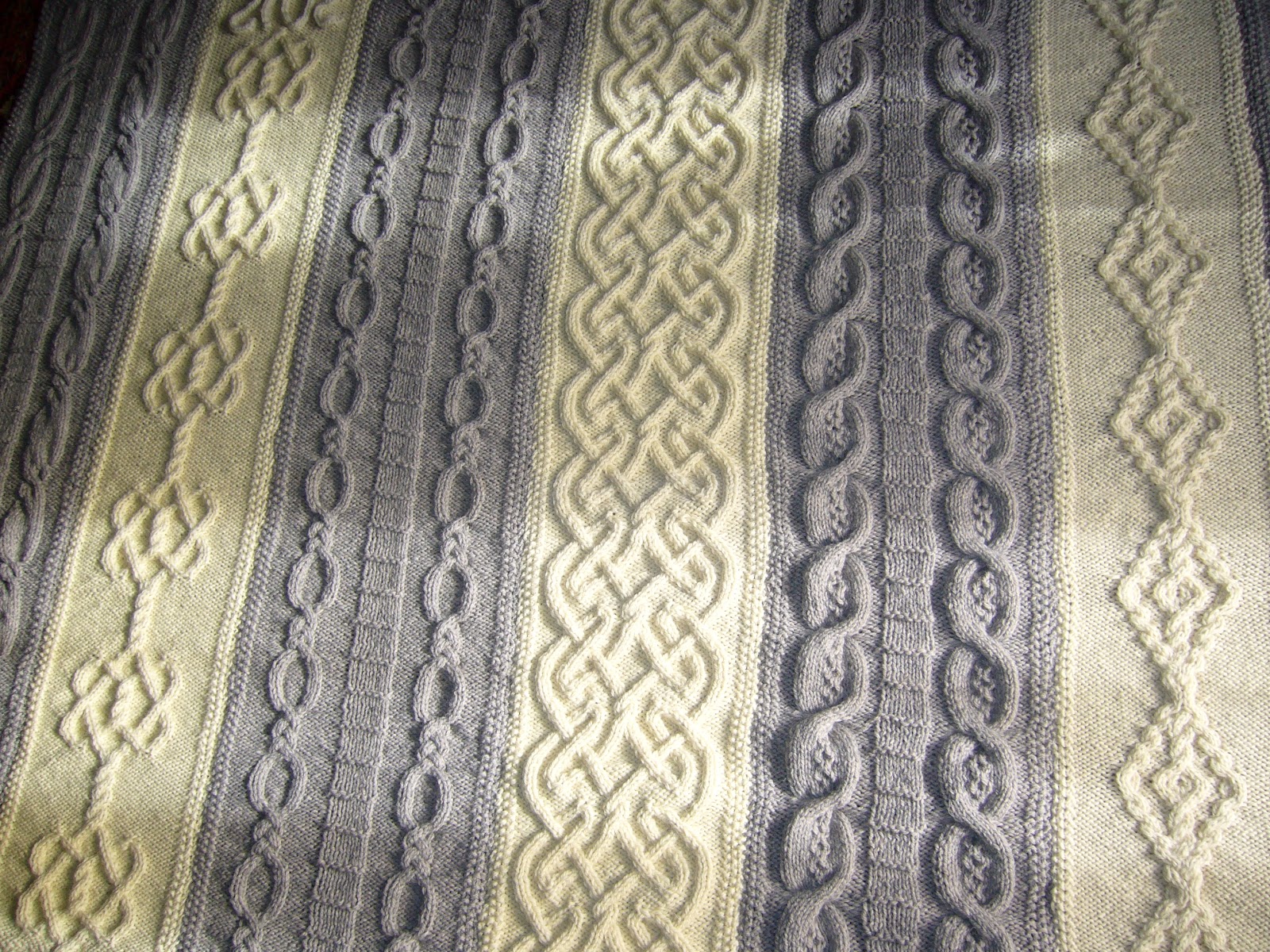
I've been working for some time now on a throw using cable patterns from Barbara Walker's "Third Treasury of Knitting Patterns".   In 2003, I dropped into the Oxfam shop in Penrith and snapped up a full pack of Rowan Cork for £4.99.  It's been waiting for the right project to come along.


 Last year I decided to reclaim the yarn from an aran jumper knitted for my husband, but about two sizes too big for him.  I used some of this on an earlier throw, but there was still plenty left.


My idea was to knit strips of random widths in a variety of neutral tones, but this turned out to be more of a challenge for me than I had imagined.  I actually prefer symmetry.  I bought 100gms of another greyish yarn, but was surprised to find that it read as a dull green against the grey and beige of the completed stripes.  I decided that this did not matter as it was such a muted tone, not really a colour.  I bought another ball to make a second stripe.

 
So, then, how to arrange the finished strips?  One of the Cork stripes was a little wider, and had a more complex pattern.  This would be the central strip, with the other Cork stripes forming the end pieces.  The green looked better next to beige, and there were four beige strips, so that organised itself.


As I was assembling the strips it became obvious that there was some variation in length, which could not be fixed by blocking.  I added some moss stitch or took away a motif in some cases.  This was the most fiddly part of the process.
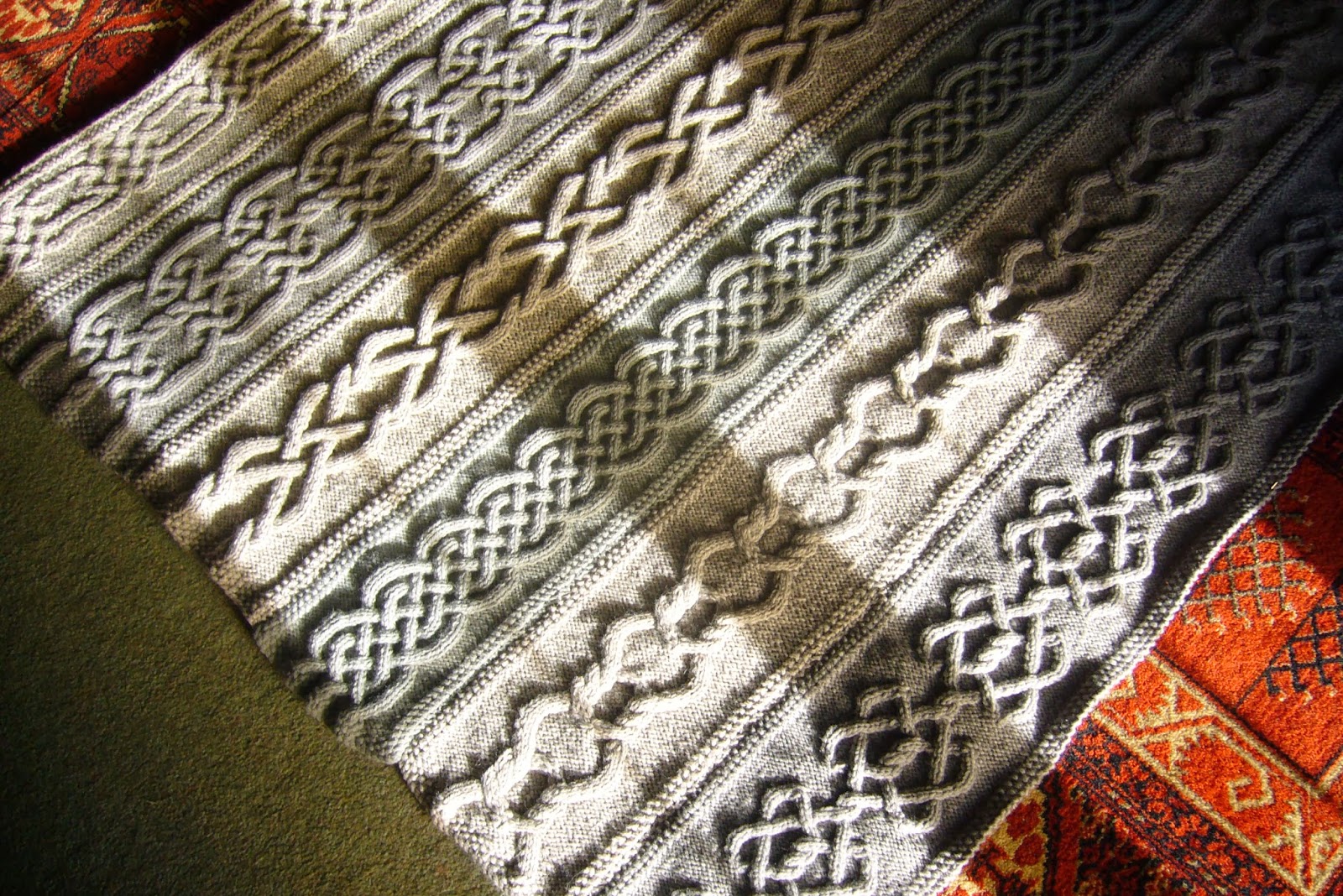

Finally, I also reknitted the opening rows of some pieces where the moss stitch needed fewer stitches because the cables pull in so dramatically.  This was quick to do and made a huge difference to the neatness of the finish.
One last ingredient: sunshine!  With side lighting the sculptural qualities of the cables really come alive.  I love the complexity of the finished item and the muted tones of the yarns.


Tuesday, November 19, 2013

Nieces

Last week to the wedding of my brother's daughter, at Brownsover Hall Hotel in Rugby.  As a family we are spread the length and breadth of England, so the wedding involved a gathering of the clan, a rare event these days. My niece looked lovely and all went according to plan.


Like many weddings these days, the ceremony celebrated an established partnership, rather than the beginning of a shared life together.  I always feel that this is a social change of some magnitude - and that it has happened quite quickly, within fifty years.  Oddly, the traditions built up around weddings have not kept pace with the realities of people's lives - the rituals seem to me to be even more formulaic than they once were.


Then, my other niece, daughter of my elder sister, invited me to join her for lunch in Buckden.  In this small Cambridgeshire village is Buckden Towers, once the seat of the Bishops of Lincoln.  Here, Henry the Eighth confined Catherine of Aragon in 1533.  Now, it is a retreat and study centre for priests.


After lunch, we visited an avid quilter and textile collector in the village.  We spent a very enjoyable afternoon inspecting a huge and varied collection.


Finally, I am assembling my Farrow and Ball throw.  The grey Rowan Cork has a velvety handle and a dense texture.  Apparently, it does felt rather easily, although I am not planning on washing this any time soon.  The last strips are just being knitted - there will be nine in all, and each is the length of a respectable scarf.  All of the patterns are taken directly from the Barbara Walker "Treasury".


Tuesday, November 12, 2013

Inside Out

Much discussion recently on vintage Fair Isle garments.  My favourite winter cardigan was made by a now-defunct company called In Stitches, on a knitting machine.  I was lucky enough to find it in Oxfam in a pristine state, perhaps because the fastenings suggest a male garment, while the colourway, while not girly, is rather pretty.


I have worn it to the point where major repairs are needed to cuffs and elbows.  I'm thinking brown leather patches.

Secondly, a more recent purchase, again from a charity shop.  This is an oversized cardigan from In Stitches, which was brand new with tags.  The level of detail on this one is very appealing: picot edgings and little cables incorporated into the ribs and cuffs.  In the summer, when I bought it, I wondered whether it would be too big to wear comfortably, but the first cold snap made it seem snug and cosy.

Finally, a Per Una cardigan from the M&S Outlet store.  This has a pleasing denimy look to it, but the surprise is that the design is worked as a standard colourwork pattern - but the inside, stranded side is the right side in wear.  Interesting how this makes it more modern as a design.


Sunday, November 03, 2013

Pick up sticks

About this time last year we were shown how to warp up our rigid heddle looms at the meeting of the guild of Weavers, spinners and dyers.  Following on from that, I was able to weave quite convincing lengths of fabric.  It had got us started, but I felt that the two expert weavers who had led the session had more to teach us. 


At the last meeting we were given a quick rundown on how to use an extra loom stick to introduce simple surface texture.  Once we had grasped the principle, we were away.  About twenty people took the class and there were twenty very different outcomes, because the yarn combinations were so varied.  I had picked up a ball of tan acrylic on my way out of the house, thinking it was unlikely to be needed any time soon for another project, so I was surprised to see how it produced a successful fabric.

This image shows the heddle in place and, behind it, the loom stick picking up the warp to create the pattern.  Once the pattern row is woven, the stick is turned on its side and pushed back so that the heddle can be used in the normal way.  This is much easier than it sounds.Newspaper is used to separate the layers of warp on the loom.
 
It was my birthday this week, and we went to Norwich to have lunch at Jamie's Italian for a treat.  We also looked around the fifteenth century Dragon Hall - a merchant's trading hall which had been hidden within a row of houses for centuries.  Its position, between the river Wensum and a main trading street gave a good idea of how life was lived in those times.  We really enjoyed the exhibition.
 
 
One of my gifts was this fascinating book, recommended to me by the people at Gawthorpe.  On the cover, behind the main images, is the white quilt from Gawthorpe which I examined on my study visit.  Inside the book the writer, who had worked at Gawthorpe, analyses a large number of costume items, focusing on how the embroidery was carried out.  I don't think that I have ever seen this done in such detail before.  This, and the many quotations from eighteenth century sources, make it a delight.


Monday, October 21, 2013

Gawthorpe Hall


Some time ago I booked a study visit to the textile collection at Gawthorpe Hall, in Lancashire.  This is the second largest collection of embroidery in the country and was established by Rachel Kay-Shuttleworth, whose family owned the hall.  Now the hall is administered by the National Trust and the local council, but the textile collection is a separate enterprise.  I went on Wednesday of last week.  Rachel Terry, the Curator, and her team had already chosen relevant items for me to examine.  They were very helpful in suggesting further leads.


So what was it that made me embark on this trip - after all, I live in Essex and it is a five-hour journey there, involving four trains and a taxi.  Well, in 1991 my husband and I holidayed in Brittany, in a gite.  One day we drove to Vannes, a sea-port, to take the boat out to one of the islands in the gulf of Morbihan.  As we wandered through the town I spotted a brocante with some textile items for sale.  I had in mind one of those lace coifs traditional to the area.  However, these were eye-wateringly expensive.  A much larger item was bundled up on an outside table.  The shopkeeper seemed keen to sell it to me at a discount, but we were about to go on a boat-trip so I hesitated. 

What would you have done?

The reverse of a section of my coverlet


As we sat eating lunch at the harbour, I just knew that I had to have the item so I rushed back to the shop, bought it and parked it in the car.  That evening I unfolded it in the gite.  It was very large, and covered all over in very elaborate embroidery.  It was so large that it was difficult to take in, and the embroidery was white on white, so it needed close study.

Over the years I have gathered expert opinions on the piece.  It is a double bed size quilt, constructed without any wadding but with cording outlining the flower motifs.  It is very densely embroidered and of a very high standard of workmanship.  It is clearly an early piece - but how early?


Copyright Cheviots.blogspot.com.

This is a motif from the very edge: you can see the rows of backstitch forming channels for the cording outlining the flower. It is photographed larger than life-size.  Filling each segment are French knots and pulled thread work.  Now imagine this kind of embroidery all over a coverlet ninety inches square.


I visited Gawthorpe in order to examine other examples of corded quilting.  I was able to spend some time looking closely at a wonderful piece edged in heavy lace.  This was said to have been a panel for a quilted petticoat in the eighteenth century, reused as a table cover.  I was intrigued to see how much it had in common with my item, and how it differed.  I would like to thank Rachel and her team for all the help that they gave me.


Copyright:Gawthorpe Textile Collection.

After a fascinating afternoon examining the Gawthorpe items with a magnifying glass, it was back to the taxi and the four trains to get home again. 
 
My plan is to try replicating a very small motif from my item to understand the technique better.  I'll be planning a visit to the new study collection at Olympia to see what the V&A has in store.  And I will be taking my time, because the coverlet itself is not in a hurry.

Monday, October 07, 2013

On the Needles 1

As usual, I have a number of different projects on the needles at the same time.  Some are easy to continue while chatting, watching tv or riding in the car.  Some demand every bit of concentration and good light.

One of the projects is a throw, knitted in strips about forty stitches wide.  I'm using cable patterns from a Barbara Walker Treasury. 

Assembling a throw like this brings up a number of design decisions.  Many of these can be seen in my previous throws.

 
This one, from 2003, had a colour scheme based on the regency striped wallpaper of the room where it was to be used.  It has some reference to a strippy quilt though those were mostly done in red and white.  However, I also decided that complex patterns look best set against simpler textures, so I knitted the strips alternating a complex cable with a simpler texture.  Assembling the throw was quite challenging as the textural stitches threw the size of the blocks out. 

 
My next throw was intended as an experiment in Celtic and/or Viking knitting as I was visiting Sweden and had been much impressed by Elsebeth Lavold's Viking designs.  I certainly knitted some of this on the ferry to Gotland.  However, almost everything on this throw is drawn from Alice Starmore jumper patterns  Only the animals facing each other is my own idea. 
 
Again, a strip construction, alternating cream and blue, but this time using a plainer, simpler cable and ladder design for the cream strips.  


So then, here, Celtic designs on the cream strips and a range of cables on the taupe strips.  I had already bought the Barbara Walker Treasury, but Alice Starmore is still in evidence.  I gave this to my younger sister for a significant birthday.  Putting the more complex patterns on the cream stripes gives a lighter, prettier look to the whole thing.  Or perhaps that is just the sunlight?
 
 
The question is: Is contrast necessary for a successful effect?  Contrast of colour , or of textures?
 
 
The strips I have so far on this current project would fit nicely on the Farrow and Ball paint chart.  In fact, the grey is Rowan Cork, and the taupe the same as used in the throw above.

 
  Setting them side by side reveals that there is a subtle contrast there already - it's more muted but it is there. 


I have four strips already, so perhaps I should continue in the same two shades, resisting the urge to insert cream strips between? So, perhaps a wider central panel?  I'm wondering how much of each yarn I actually have left and whether this will force the design decision.
 

Tuesday, October 01, 2013

Aix en Provence

After Avignon, we moved on to Aix.  Those visiting need to be aware that TGV stations are remote from the towns they serve, not quite on the scale of London Stansted, but still some distance.  It is barely half an hour on the train from Avignon to Aix, yet there is no direct train there.  Instead,  you have to use a combination of shuttle buses and taxis which makes the journey much more of a hassle - or an adventure if you like.


Central Aix is mediaeval in its pattern, with cavernous ancient streets and many squares with fountains.  The streets are narrow and still have a centrally placed gutter, which must once have been the case elsewhere too.


 On a Sunday, with a jazz combo entertaining the passing crowds, a street market in full swing, pavement cafes doing good trade and classic car owners raising money for charity by giving tourists a ride around the block, Aix is full of bonhomie.  It would be a great place to be a student or to take a term's course.


While we were there it was the Heritage open weekend - or Patrimoine.  Outside the cathedral, various artisans and conservation studios had their stands.  I was much taken with this textile belonging to one Herve Hornoy who runs a textile conservation business, Memoires-Tissees.  This is Chinese canvaswork which he explained was used as a 'prentice piece before they moved on to embroidery on satin.


We must have visited more art galleries on this trip than we have done in the previous ten years.  In Aix we were able to catch the exhibition at the Musee Granet, exploring the way the area was a breeding ground for artists in the early twentieth century.  In their basement they had not only a Rembrandt  self-portrait, but also some very strange pre-Roman sculpture showing dismembered heads.

On a hot afternoon we visited this lovely little House, set in well-kept gardens.  Inside, in pretty rooms with some antique furniture, was an exhibition of very modern and very ugly artwork, somehow trying to make a textile link with the past.  It was the kind of exhibition where the room steward has to tell visitors not to step on the carpet as it is actually a work of art.  One room in particular lingers in the mind's eye: it was decked out in red with structures mimicking carcases in an abattoir hanging from the ceiling.


Our best visit took us up the hill to Cezanne's studio.  We climbed the steps not knowing what to expect but there was the single room painted in a soft grey.  On the shelf were recognisable coffeepots and pottery, coats still hanging on the rack, and a giant step ladder centrally placed.   Can this really be a survival from 1912 or is it a reconstruction?   I asked about the curious long slot-like window and was told that Cezanne used this to slide big canvases out to see what they looked like in daylight. Amazing.

From there it was a short walk up the hill to the Garden of the Painters, where I took this photo.

Thursday, September 26, 2013

Retrospective

Reading Jean and Kristie's posts about their trip to Shetland sets me thinking.  Jamieson and Smith.  How much this name has meant to me over the years. 

I first came across their yarn in Whitby, in a wonderful shop called "The Shepherd's Purse".  They had the full spectrum of 2ply jumper weight hanging on a line across the shop - a glorious sight.  You could buy yarn there or you could order it by mail.  It took me a while to realise that it was possible to order direct from Lerwick.  I bought some bright tones of purples and used a cone of navy to make a cheery striped pullover.  This would have been about 1980.

Then I discovered Sasha Kagan.  Her designs used the 2ply jumper weight alongside touches of lurex and mohair.  Now, Sasha's designs tend to feature flowers and leaves, but in her first book - "The Sasha Kagan Seater Book" -  variety was key  - lots of dynamic movement in the placing of images.  I knitted two of the Ribbons cardigan, buying the yarn from the Art Needlework shop in Oxford.  This was by far the most successful colourway.


Then I knitted Pansies.  This had bands of white mohair and silver lurex.


For myself I knitted a very striking waistcoat with dachshunds running up and down on it.  It was backed with three colours of brown used alternately in a ribbed fabric.  I was very fond of it but eventually it no longer fitted.

 
This is the image from the book, as I sent my waistcoat to the collection of the Knitter's guild.


Making these projects made me see how inevitably a stock of spare yarn is built up.  When I knitted this Kaffe Fassett waistcoat for my younger sister, I bought in only a few new yarns.  Similarly when I reprised the design for my mother.  Using some blues in a brown mix gave it a lift.  I inherited this waistcoat when my mother no longer needed it.


This waistcoat from the mid-80s is very much of its time.  I had one myself which read "Plus ca change, plus c'est la meme chose", which I was very pleased to find fitted the space without much fudging.  For my mother, who lived near the sea, I chose appropriate imagery .


Somewhere in the 90s I remember travelling north on the train with a J&S shadecard.  Their yarns were so cheap, and the colours so lovely, that it was a real pleasure to pick out a selection of new yarns.  However, when the yarn arrived it was different somehow - the blends a little muddy and the colours in some of them forming slubs rather than blended fibres.  It was many years before I used these yarns. 

In 2000, we visited Shetland and Orkney just after our wedding.  It was at a time when the woolcrop was not in big demand.  There was talk of wool being dumped in the sea:  we certainly saw someone in Cumbria burning wool in an old quarry.  Along the road we saw signs to independent designers and we pulled over to visit.  I bought scarves and gloves in wonderful colour combinations.  Gloves at £9 a pair - who could knit them for that ?  They made great presents.  However, J&S itself was a disappointment.  The yarns were there, but the patterns on offer were distinctly traditional.  So much has changed in the last thirteen years - so many new, young designers, like Kate Davies.   I can feel an urge upon me to call up the online shade card and order some yarn.