Friday, February 25, 2011

If the Hat fits....


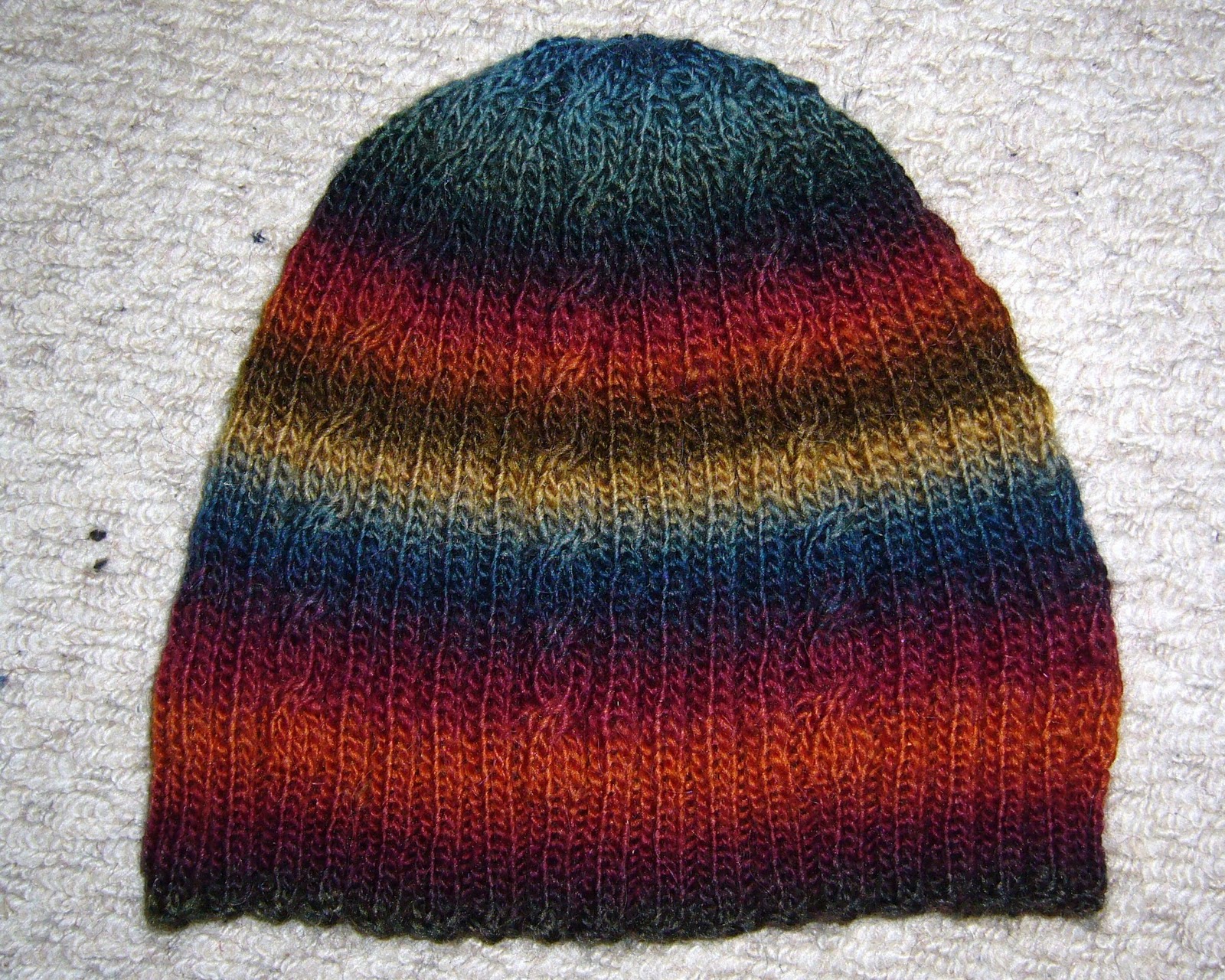
Finally, a hat which I feel comfortable with.  This is Crystal Palace Mini Mochi, in  a very lively colourway.  It looks like a thin lopi yarn without much twist and is a little splitty, but it certainly feels luxurious.  The key to fitting my over-sized head seems to lie in the ribbing, which has plenty of give.  I started on 3.25 needles and increased to 4.mm, also increasing for the cables.  Perhaps I have come to the end of a run of hats, just as the weather becomes spring-like and the first sharp greens appear on the trees.


More images of Maryport, this time of Fleming Square.   Maryport was not developed until the end of the eighteenth century, when it became a major port for the export of coal and then iron ore.  Fleming Square is a lovely open space surrounded by impressive Georgian houses.
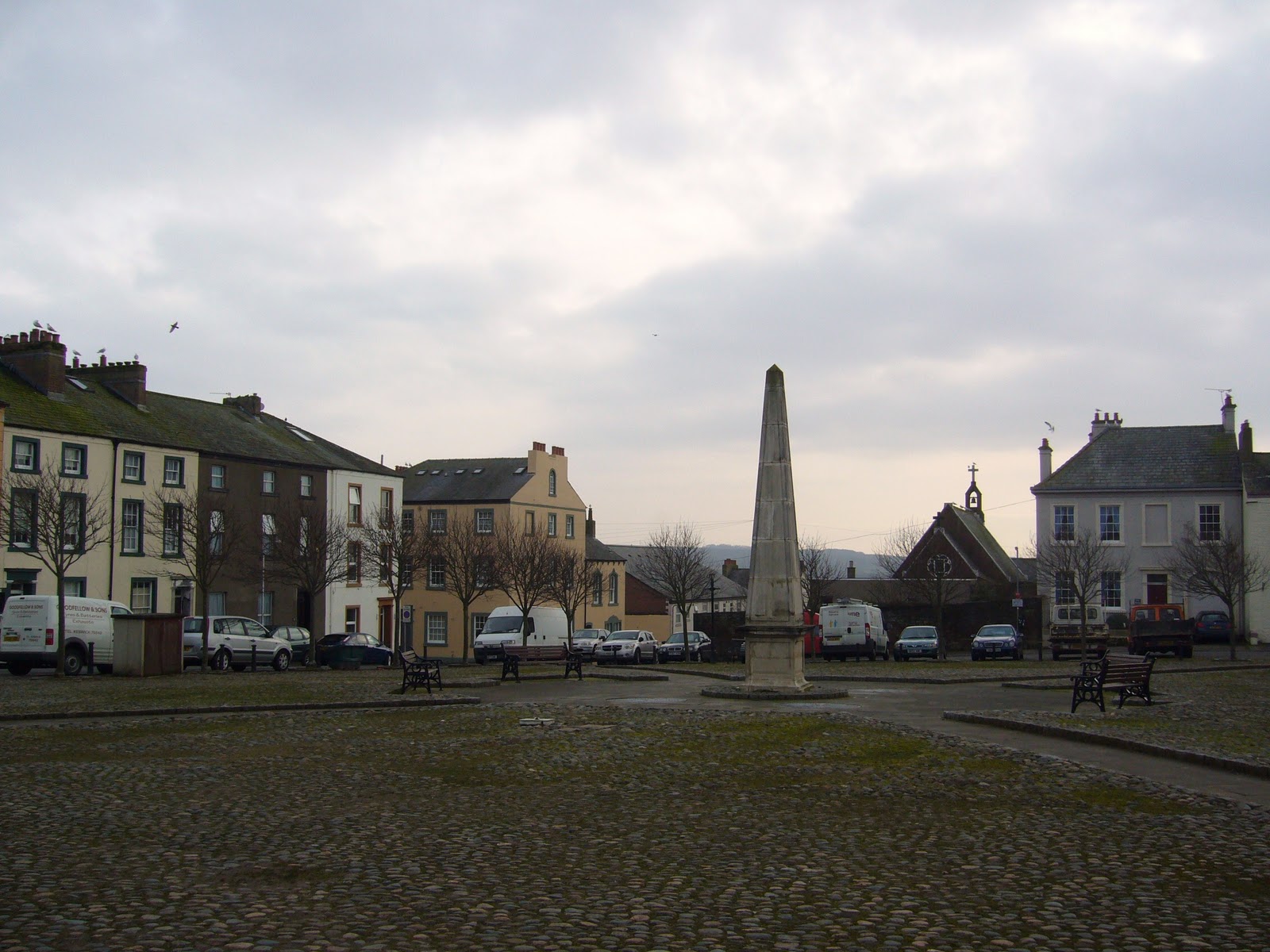


Here the cobbles of the square and  the central obelisk can be seen.  Just yards from here are unparalleled views over the Solway to the Scotch hills, and a Roman Museum full of world-class Roman artefacts from the mile fort at the top of the hill.


A curious little group of statues down by the harbour, and, just visible, a new venue called the Wave centre, hosting concerts and community events.  These things are clear evidence of regeneration, whether they are quite to one's taste or not.  Like much of West Cumbria, Maryport has gone though a long decline with prominent high street properties standing empty.  Once it was possible to walk clear across the harbour on the decks of the herring boats, an old lady in the nursing-home told me.   Those days are long past.


More Cumbrian dialect: many words seem onomatopoeic: "scrow", for example.  The high incidence of words with that initial sound is apparently due to Norse influences.  Thus "scop" - throw and "scree" - loose stones on a steep slope.  And "scratting" and "scraffling", both of which I recall used in the context of struggling to make a living.  Interesting how they evoke a whole way of life.


Tuesday, February 22, 2011

A taste of Cumbria


To West Cumbria, to visit family.  First, to Carlisle, and more wonderful Georgian houses.  Here a whole street with perfectly preserved fan-lights and door pilasters.  I particularly love the chequered brickwork - and the way the car matches the door!  However, though this looks smart as paint, the street adjoins one of those seriously run-down areas that blight northern towns.


Visiting Linton Tweeds, I find myself drawn to this graphic black and white weave - suggestive of high-rise blocks.  I am also drawn to the two for one offer on skirt lengths.  That is two different metres of tweed for fifteen pounds.  Linton have an interesting  client base, having supplied Chanel herself.  Check them out at Linton on-line

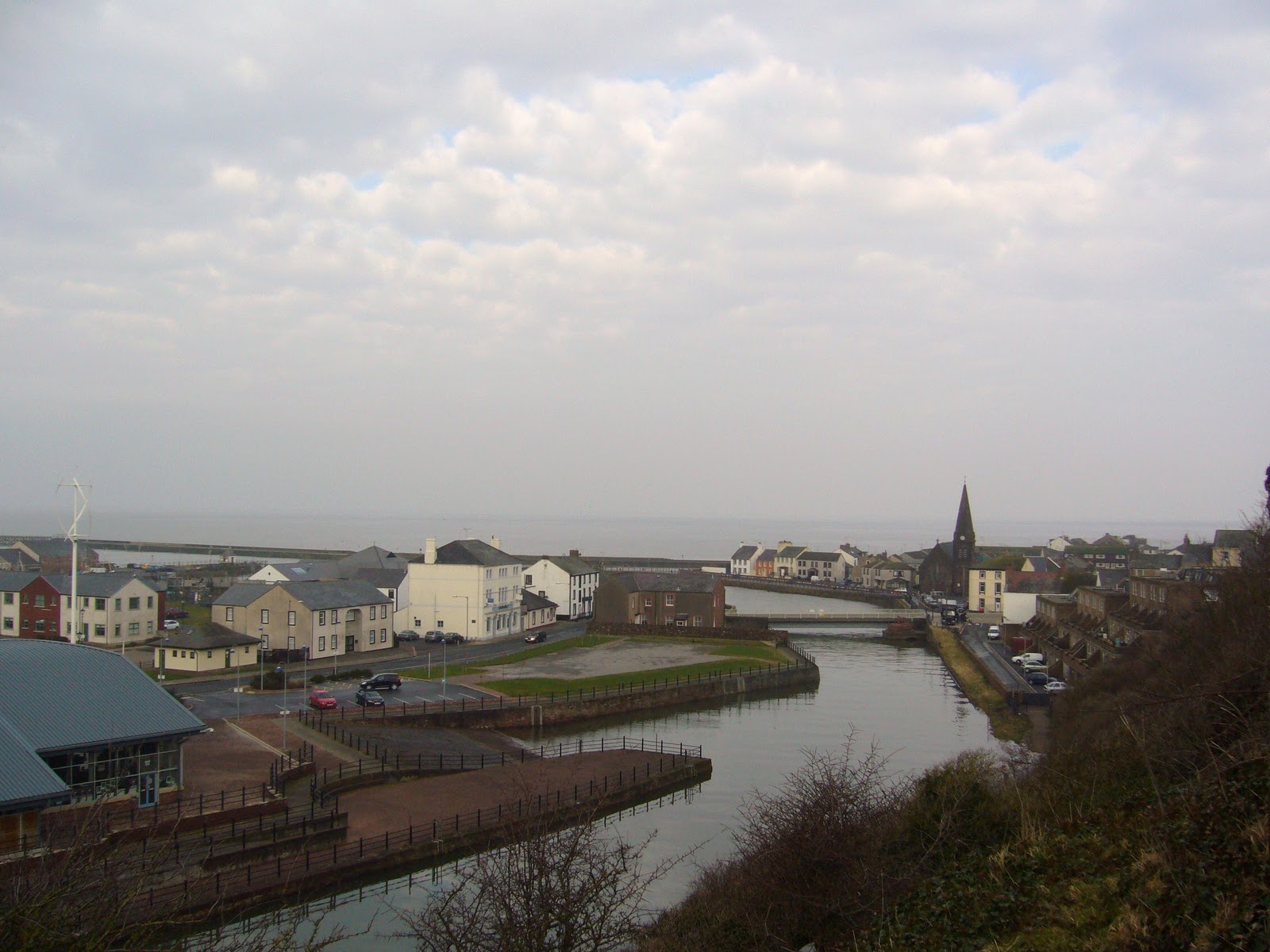
Then to Maryport, where my mother has lived for many years in a nursing-home.  A view first of Mote Hill with the flood plain awash and then of the harbour from Mote Hill.  Ancient peoples used the hill as a strategic lookout over the River Ellen, long before the arrival of the Romans. 


These views show the tide in and high water.  It is quite a different scene at low water, with acres of mud.

Some ten miles north of Maryport is Beckfoot, where I took my shore walk.  Looking north, an uninterrupted view of the Solway, with not another person in sight.


Amazingly, Enid from Wigan left a comment to say that she knew my mother's expression - "like a padding-can,"  for an untidy room.  I am fascinated by the incidence of very broad Cumbrian - for example, a checkout girl using "Yan" for "one" to another worker.  I do feel the curators of the British Library exhibition might easily have located some more vivid samples by not interviewing the people, but by eavesdropping on conversations between native speakers.   Another common Cumbrian expression: "clarty" -  sticky.

Some knitting:  a little hat in J&S jumper-weight, owing something to Kate Davies' most recent design, largely because I was in Cumbria and my reference book in Essex.  It fits me, but again suggests a swimming hat more than anything.


Finally, this week's culinary offering.  I like nothing better than to go into my kitchen and  put together something tasty from almost nothing.  This is what comes of combining two stale hot cross buns, buttered and lightly spread with orange marmalade, with two eggs beaten with a little milk and sugar.  Baked for about 35 minutes, it rises to a light, orange flavoured pudding, which is lovely with a blob of vanilla ice-cream.


Friday, February 11, 2011

A Bit of Culture

This week to the British Library, to meet my sister for lunch and to visit the exhibition on the English Language.  I would like to say that this was fascinating, and they had certainly tried hard, with original early books and artefacts, alongside recordings of various types of speech.  However, nothing quite matched that shock of the raw one sometimes happens upon in hearing English actually spoken in its regional variations within England.  One time in a Lake District pub, overhearing three hound-trailing supporters discussing the relative merits of various dogs - there's a little world with its own language.  Another time, going just that bit further up the A1 and finding ourselves unexpectedly at sea in a service station,  asking the girl on the till to repeat things because we had no idea what she had said.

At the end of the exhibition there was the chance to contribute a sample of one's own English, choosing a word we used.  My sister chose "Slarky", which means "Smeared, as in a window, or windscreen."  I chose my mother's expression "like a padding-can."  This meant an untidy room or a scrow.  I have never heard anyone else say this, so I am not sure if it is Cumbrian dialect.

After lunch, I took the opportunity of popping in to the British Museum, with a view to seeing some of the 100 Objects, and indeed I did see a couple of them: the stone belt weighing five stones which was part of a ritualised ball game, and a carved stone pipe in the shape of an otter.


What caught my eye, however, was a golden funerary wreath from the Hellenistic art section, its delicate oak leaves and acorns as abundant and shiny as when it was made.

And this carved panel:


 from Hadrian's villa at Tivoli.


Finally, an Anglo-Saxon cross in red sandstone, from Lowther in Cumbria.


This week's knitting: another version of Knotty but Nice from Knitty Winter 2009.  I knitted this flat in DK, adding one extra pattern and fudging the cable by turning one back on itself at the edge.  This fits very closely and will be ideal for cycling, although it has to be said that it looks a bit like a swimming cap in wear.  I did use a larger needle for the cable section, but it still pulls in dramatically.

This week's recipe: recently, I harvested most of our leeks.   Trim the leeks but keep whole.  Boil until tender.  Meanwhile make a cheese sauce with butter, flour, milk and grated cheese, adding a teaspoonful of English mustard to add piquancy.  Wrap each leek in a slice of cooked ham and place two of these per person in a shallow dish.  Pour over the cheese sauce.  Reheat in the oven.  This was particularly frugal since we live a few yards from the Coop supermarket who pride themselves on discarding a minimum of food as waste.  To this end, they discount items heavily as they approach their sell-by date.  Packs of perfectly good ham were 20p, having started at £3.  That's what I call discounting.


Thursday, February 03, 2011

Spring Fever

Yesterday, a thin wind, blowing right through you, but today, a blue sky, sun and the urge to inspect all the shoots of Spring in the garden.  I like the idea of getting going on the allotment, but I know that it is folly.  Potatoes planted too early have a tendency to have their tops frosted; last years earlies never recovered.


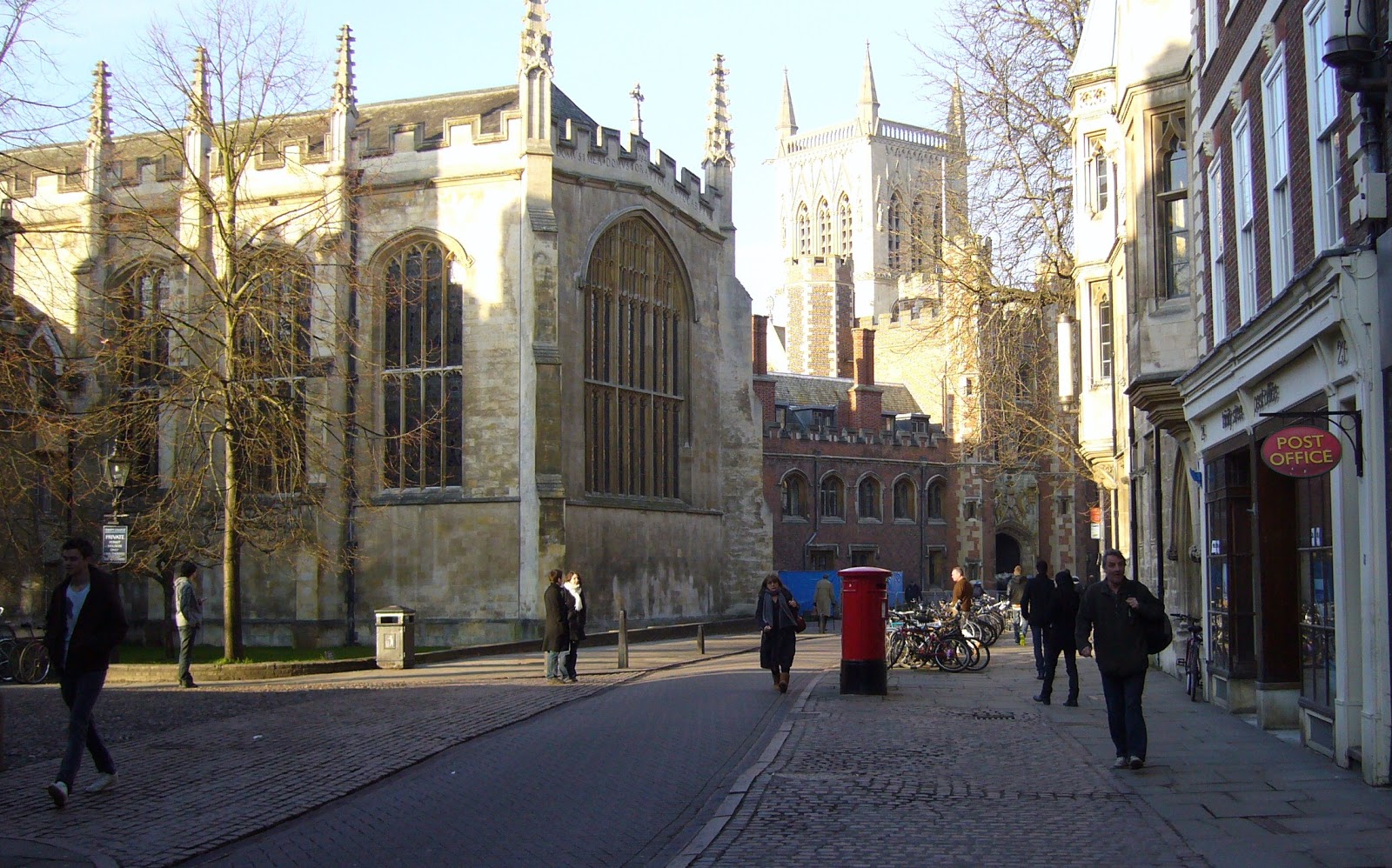
And where is this?  Occasionally, I enjoy a little light shopping and grazing in Cambridge, an easy hour's drive from here with a good Park and Ride.  In another lifetime, I was invited to  entrance interviews at Newnham.  I had left my home in Cumbria earlier in the week to go to Oxford for interview, but then had to take the coach across country to Cambridge.  I recall pottering around the open market in the middle of Cambridge with another interviewee feeling like a seasoned traveller and completely at home.


I still prefer the spaciousness of Cambridge, and the lovely little details which surprise at every turn.  Of Newnham, I remember only the very long corridors, more like a hospital than anything else.


And King' College Chapel, lovely in the sunlight.  I like to lunch at Michaeljohn, a dual use church with a great cafe at one end. 


More hat-work.  My husband was taken with my new titfer and requested a cycling hat for himself.  This cabled hat is Knotty but Nice from Knitty, Winter 2009.  He prefers plain colours and this needs to chime with a dull green scarf he has.  A number of people have commented on the swatch of J&S I posted.  It often surprises me how their colours blend together so well, even those without the same dyed fibres within the mix.  "Peerie" patterns are the small patterns lasting a few rows each.  I suppose that I was aiming at a wave effect and something fern-like for the green.  All I did was choose them from the book, though.  I suspect the swatch would make a perfectly acceptable hat, but there is not really enough "Pop" in the colours.


Food for cold weather: one of my favourite supper dishes is a casserole of pork-chops, first served to me by my elder sister.  Dice and gently fry two onions in a little oil.  Press both sides of two pork chops into some dried sage and onion stuffing mix and brown them in the frying pan.  Place them in the casserole with the onion. Add some stock and cook for about forty minutes in a moderate oven.   Braised like this, the stuffing swells and the seasoning is so nicely balanced no other ingredients are needed.  Serve with potato and greens. Very tasty.


Friday, January 28, 2011

Living off the Fat of the Land


So, if I was swatching in muted colours of J&S jumperweight, how is it possible that the finished hat looks like this?

On Saturday I went to the AGM of the Mid-Essex Spinners' and Weavers' Guild.  Someone brought in two large crates of yarn which she wanted to clear out.  I picked out a ball in this deep periwinkle blue, and another in cream, in roughly the same weight.  Another ball, this time a laceweight, in the same periwinkle - 50p, said the person on the sales table, for the three.  Working on the principle that it is better to use random harvests straight away, I made a swatch.  It was odd yarn, varying in thickness, but looking mostly like a 4 ply.  The cream was a little heavier, but that just seemed to add texture to the motifs.


Making up the pattern as I went along, I found it helpful to pull all the stitches off the needles a couple of times to try the piece around my head.  Then I thought a touch of red would lift the design, and I found instructions for the little braid.  It was new to me.  The main motifs are from Sheila Mcgregor's "Traditional Fair Isle Knitting", which I come back to every time.  I was pretty sure that it would be too tight after the main motif, but in fact it is an exact fit and the ribbing  provides a snug covering for the ears.

So what did I need a new hat for?  My husband and I are not overly keen on exercise, certainly not on sport, but we enjoy cycling and walking.  We have taken to including a cycle round some of the network of lanes which can be found in this part of Essex - traffic free, through rolling countryside, and providing that  glow of  well-being and self-righteousness which calls for a hearty lunch.


My husband, on his bike outside Great Tey church., a curious structure in which the tower dates from the12th  Century, one wing from the 13th and the other from the 14th.  On our first ride this year we were astonished to see a herd of twenty wild deer standing right in the middle of an open field very near to this church.  Essex is a very heavily populated county, its major roads often congested, yet the lanes are deeply rural still.

Arriving home from our rides, we have really enjoyed the  home-made soup we had left on the hob, ready to reheat.  I was shown how to make this by my younger sister five years ago, and since then we have eaten gallons of it.  Using one onion, two carrots, a potato, plus whatever else you have - some stalks of celery, a slice of swede - and a vegetable stock cube, it is also very thifty.  The secret is to sweat the diced vegetables in a tablespoonful of oil before adding the stock, then mash the soup with a potato masher after it has simmered for about thirty minutes.  Recently I have added a small amount of mixed lentils with the stock, which seems to add body to the mix.  It is always the same, but always different.


And this is a skein of laceweight cashmere, bought from Hip-knits on a sale day.  It was an insipid pale blue, so I have over-dyed it with a cold water dye.  Much improved, I feel.

Thursday, January 20, 2011

Swatches


So many people seem to be able to design their own patterns - not just start and see how it works out, as has usually been my way if I am not using a published pattern.   I do find it hard to visualise on graph paper, for example, but adapting a basic shape by using different combinations of colours must be within my capacity.

Above is my stock of J& S jumper weight, all of it dating from before 1990 or thereabouts.  I remember sitting on a train travelling to Cumbria and using the shade card to select a batch of colours for a new project.   I was hoping to replicate the brown Kaffe Fassett Jagged Tooth waistcoat which I had knit for my mother.


I sent off the order full of enthusiasm, but was amazed by what was sent.  One of the blue tweed yarns had solid flecks of colour rather than the blended mix I was hoping for.  Some of the muted browns were muddy, not just muted.  There was something lifeless about them which I had not noted as a feature of my previous purchases from J&S.  Of course, it was also still fantastically cheap, so I was not unduly concerned, but I did not send for any more and abandoned the project. 

In 2000 we visited Orkney and Shetland on our honeymoon.  We certainly realised why tightly knit woollies were popular - and this was August.  We had each taken a thin jumper and a thicker, walking jumper but, on the first morning, we put both on topped with anoraks before we went to explore Jarlshof.  I bought only a few ounces of laceweight from J&S.

However, now I look at this box of yarn and think that there must be the wherewithal for a hat in here.  Some of the muted browns are a blend of brown with blue or brown with green, so perhaps the lighter shade could be picked out?


So, definitely light and dark stripes, but perhaps a different peerie pattern?  or vertical stripes?  There is always the danger that the finished item will say "tea cosy", rather than "hat."  Add to that the fact that I only wear a hat for practical purposes, since I look ten years older without my hair showing.  I'm clearly not there yet on the design issue.


This is what I have actually been knitting: some more scratch mittens in subtly larger sizes.


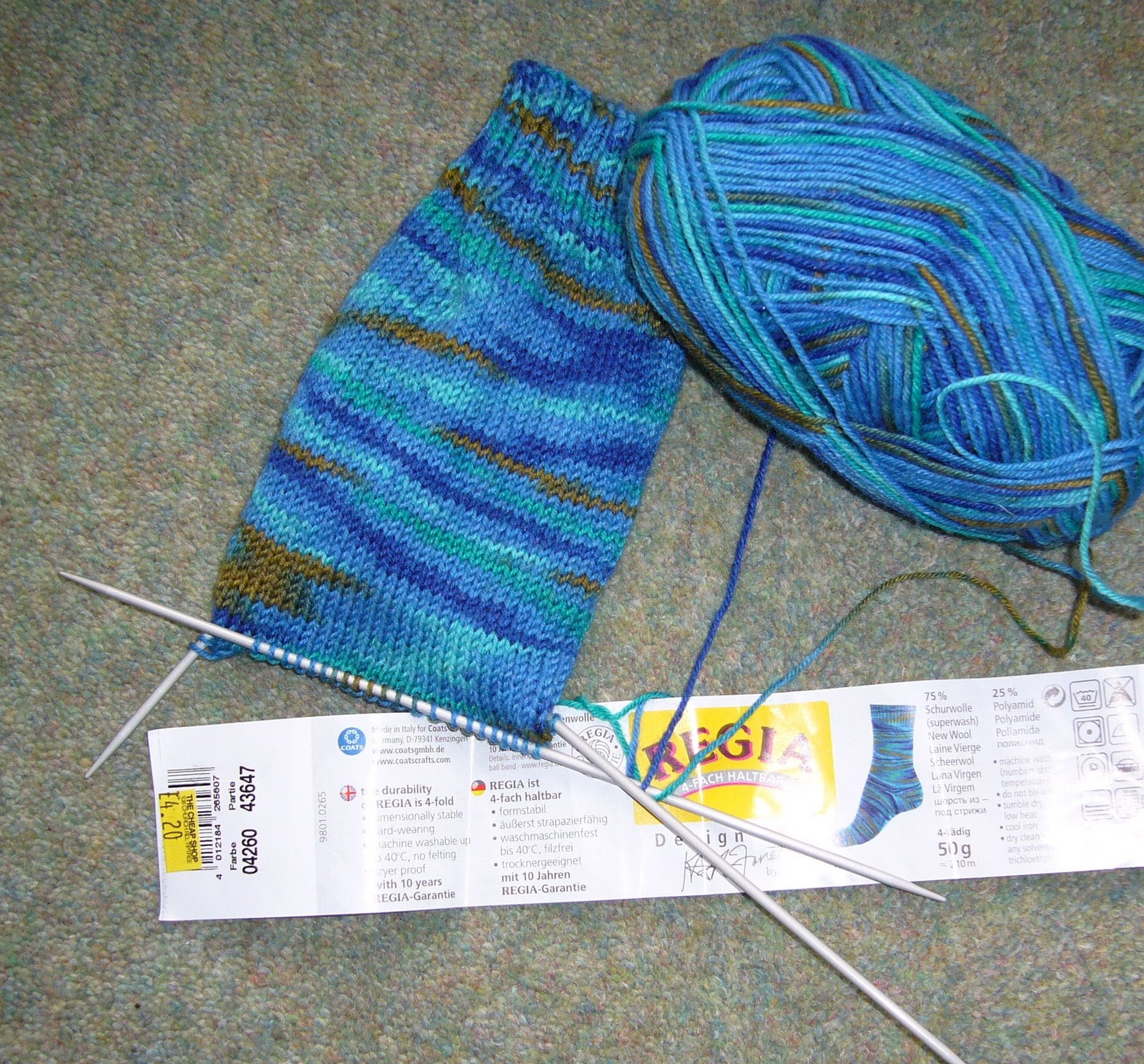
And a pair of socks in Regia by Kaffe Fassett.  Very cheering on a dark day.

Thursday, January 13, 2011

Arts and Crafts


These are miniature scratch mittens which fit the tiny hands of the latest arrival.  The 10p coin is for scale.  The pattern was on a preemie site as I had no concept how small to aim for, although the baby is not unusually small, just new-born.

This is not all the knitting I have done since finishing my shawl, but it feels like it.  I am itching to start a big project, or possibly more than one, so that I have something challenging  and something soothing. 


Here is another Eleanor Cowl pre-blocking.  It certainly became quicker to knit on the second and third times, when the logic of the pattern became more evident.  I cast off before the last half-pattern on this one.


This is my husband's most ambitious project to date.  We use it as a sideboard, hence the drinks.  It was designed to echo the other significant piece of furniture in our dining-room, an Arts and Crafts sideboard.


We bought this some years ago as a dresser - the glazed top acts as a china cabinet in another room.  We understood it to have been in a conventWhich was closing down in a neighbouring village.  the convent building was in the Arts and Crafts style so the dresser may well have been in there since it opened.  It has no maker's mark, but shows the distinctive features one would expect of the period.


Below, the dresser , and above, my husband's work, with that distinctive curve.  The shape of the panels, the profile of the beading and the routing on the edge pieces all echo the original.


Below, the original metalwork handles, and, above, the handles I sourced in Homebase - a remarkable find.


The inside of the cabinet, showing its real purpose.  It is lined with green baize and contains some of my husband's collection of 78rpm records, alongside some more later LPs.

Saturday, January 08, 2011

A Thing of Beauty


These are my two finished Eleanor cowls from Knitty 2010 - to save you searching if you have come across from Jean's blog.  The top one is in Yarnsmith's Pure Alchemy, a hand-dyed yarn produced by Becky who belongs to the Mid-Essex Spinners and Weavers.  That sharp, acid green goes very well over navy or black, as I used it before for a Swallowtail Shawl. 

The pink one is in Jaeger merino 4ply and I increased the stitch count to allow one more pattern repeat.  I don't think that the fit of a cowl is crucial but it should not be too snug or it would be impossible to get on.

This is my new shawl blocking.


And here it is being worn.  Unfortunately, no willowy young person was available for the photoshoot.


This is the Aeolian Shawl from Knitty 2009, designed by Elisabeth Freeman and made in laceweight silk in a colourway called Riverrun.  I am very pleased with how this has turned out.

Thursday, January 06, 2011

Cabin fever


This is my husband's largest piece of woodwork, and also one of the earliest examples we have.  He made it while still a bachelor, constructing one single bed, but buying the wood for the other half, so that it would make a very large double.  He was clearly someone who thought long-term. 

Now he is considering removing the foot-boards, which serve no structural purpose, but make changing the sheets an athletic enterprise. 

Behind the bed can be seen some more of our beams, including the broader one which excited the historic buildings people.  This beam is "jowled", which means that it shows evidence of having had a cross-piece jointed into it at one time. 


At last I have finished the Aeolian Shawl, seen here in its pre-blocked state.  I certainly take my hat off to the designer, Elisabeth Freeman, but also to those who have knitted it more than once and incorporated the beads, which I omitted.  The early parts went well, but the very deep edging was taking at least half an hour per row, and there were about fifty rows.  Simply casting off took several hours.  That said, it did take the edge off some long car journeys.  Listening on my new MP3 player to "The History of the World in 100 Objects," while knitting this, brought on a trance-like state.


Here it is being blocked.  The silk has less give in it than wool, but the transformation is still astonishing.  Below is the skein of yarn, purchased at the i-knit Weekender in September.


In the interests of full disclosure, these were the scarves I knitted for various unsuspecting family and friends this year.  This is Starlight Revue by Austermann, bought in  a fit of enthusiasm at Ally Pally this year.  It's a ladder yarn with a metallic thread, and in the right light it glistens in a jewel-like manner.  It does look festive on a plain black top, or I hope that is what the giftees felt. As a knitting experience it is not pleasant - big needles, scratchy, unrelenting yarn, no skill involved.


Finally, what looks like a sign of Spring.  Odd to think that this succulent decided to flower as temperatures dropped to their lowest levels.