Saturday, June 20, 2015

Day Trip

A day trip to catch up with an old friend - and to visit the Kaffe Fassett Exhibition at the Quilt Museum, in York.

Juxtapositions at King's Cross

After a hassle free trip, we walked across York, dodging very busy traffic.  The best-known streets were crowded with gawping tourists.


The concept of the exhibition was that Kaffe had selected twelve of the heritage quilts in the museum's collections, using these as inspiration for twelve interpretations of his own.  The palette was bright, although some had that bright pastel look of the 30's.  Some were cheaters, in the sense that striped fabric had replaced log-cabin piecework.  And, in the end, it was underwhelming, unlike quilt shows where the level of industry and creative imagination always amazes me.


On the way back my friend, who knows York well - sings in the Minster choir - took me along little streets packed with the sort of architectural interest which I love.


We took in the mason's yard with fine examples of newly carved stonework on display.


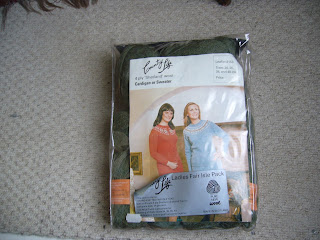
Just by chance we passed an Oxfam, and there, right by the door, was this pack, obviously with my name on it.  It's a ready knitted yoke, and enough sage green yarn for a jumper.  The pattern originated in Galashiels; I would date this to the early 70s.  I'm thinking that I will be able to improve on the rather predictable yoke design, especially with Kate Davies "Yokes" as inspiration.

All in all, a grand day out.


Saturday, June 13, 2015

Beeleigh Abbey


Tis the season for garden visiting. We found ourselves planning a visit to Beeleigh Abbey, which is just outside Maldon.  Amazing that we have not visited before. 


This is the sort of garden where everything is at its peak: roses in full bloom, luxurious lawns, borders in which everything is graded in height...unlike our own plot, where everything grows through everything else.


And, of course, the building is the perfect backdrop.


Just to finish, we dropped down to the Bog garden, and there is a bend of the river complete with reed-beds.  This is the feature we most envied.


First in a series of children's mittens  - not for now, obviously, but for the winter months.   February in New York can be bitter, or so I am told.


Sunday, June 07, 2015

Lank Rigg

First, some knitting, or rather, all the knitting done during my two weeks away.  I knitted during  the
long car journeys and while chatting to our friends in the evenings.


A pair of fingerless gloves made using Norfolk Horn 4ply.  I made these up as I went along, and am really pleased with the result.  I'm planning to wear these on colder days when on duty in the front, North-facing hall at the NT property where I volunteer.  It can be chilly in there.


Two versions of the Gidday Baby cardigan, the darker one knitted from the bottom up, simple reversing all the increases and decreases.  The border patterns are from "Charted Celtic Designs", by Co Spinhoven.


And two identical renditions of the Baby Sophisticate pattern.  Very quick to knit in Aran yarn.

So, we moved on to our own cottage on the Solway - and continued our walks.  We started with Great Cockup.  Yes, I know.  This meant climbing first over Little Cockup and eventually coming back by Trusmadoor.  Almost certainly these rounded hills looked like haycocks, to those familiar with haycocks.

Another day started damp, but cleared.  We set off at teatime to climb Lank Rigg.  Now, when I was a child, we lived on a farm just under Cold Fell, from which Lank Rigg must have been visible. But it would never have crossed my mind to climb it.  For one thing, the valley of the River Calder lay between it and us - and for another, we had our own fell if we wanted to climb anywhere.

 However, we drove to the Kinniside Stone Circle where we parked and walked in, fording the Calder and Worm Gill, then crossing the side of Whoap on a very narrow track.  Eventually, we climbed to the summit of Lank Rigg itself, where there is an ancient tumulus - and an absolutely stupendous view of the whole West Cumbrian coastal area, laid out like a map.  All those pit villages: Rowrah, Frizington, Cleator Moor.  On the way back, we got wet feet for the first time on this trip as Lank Rigg Moss lived up to its name.


So we had a rest day, visiting the osprey viewpoint on Dodd and then driving up Latrigg to the car-park near the top.  For those planning trips this summer, this is a wonderful opportunity.  For very little effort the top of Latrigg can be reached by a well-made path and the views over Keswick and the Newlands valley speak for themselves.


Finally, we returned to Ennerdale, the bit thoroughly between our teeth, and climbed Grike and Crag Fell.


Saturday, May 30, 2015

Sightseeing

Of course, it was not all walking the high fells on our recent break. We also visited some three very interesting gardens, each of them unique in its way.


First, we went to Dalemain.  The house here was developed from a very early pele tower, through an Elizabethan manor house to a Georgian pile, each distinct phase of the building clearly visible today.  Thus, you enter a hallway with high ceilings and elegant proportions, and move back through plasterwork ceilings to very thick walls and uneven floors.  How odd to have all these periods still represented, in a house still used by the original family.


Dalemain's more recent claim to fame is as the setting for an international marmalade competition, and jars of marmalade from across the world are on display. Many varieties are on sale in their shop.


Later in the week we went to Lowther Castle, recently the venue of the Antiques Roadshow.  It was emphasised very clearly to us that the house is a ruin and the vast gardens are only just being brought back to life.  Presumably people have asked for their money back before now.


The story here is fascinating:  the castle was built in the early nineteenth century by the Lowther family who owned huge areas of land and  coalmines in Cumberland.  Anyone with socialist hackles will feel them rise when looking at the crazy extravagance on display here.  One of the Lowthers visited Versailles and on his return laid out three grand avenues in the garden.


However, all is now ruined as the fifth earl squandered the fortune; the roof of the castle was removed after the war, apparently to avoid death duties.  Until recently, huge sheds for rearing chickens stood on the lawns behind the house.  Now, they have been restored. 


Everywhere there is evidence of very elaborate garden layouts still completely overgrown; the effect is actually rather charming.


We took our tea at Askham Hall, another seat of the Lowthers, about five minutes away. 


This is on a totally different scale; the gardens here are impeccable, as it is a wedding venue and country house hotel. 
 
Tea was served in a converted cow-byre, its wooden stalls and ironmongery still in position.  Very good it was too.


Friday, May 29, 2015

Ullswater


So, to Ullswater, for a week with friends in a cottage near Pooley Bridge.  Our friends had one objective: climbing the last of their 214 Wainwright tops.  This enterprise has taken many years; children aged five or six have done them all, and the challenge now has shifted to doing them all in as short a time as possible.  But for ordinary mortals, who live hundreds of miles from Cumbria, and one of whom is now seventy-five, completing this challenge is a serious achievement.


From this perspective, Pooley Bridge looks like the classic Lakeland village, and it does have some very good tea-shops - but also some quite tacky souvenir shops.

The weather in prospect for the week suggested dark clouds every day, with rain, hail, lightning and sunny intervals all possible.  In fact, it was both very windy and very cold, and we certainly endured pelting hailstones out on the hill, but were spared that sort of persistent drenching rain which makes walking very unpleasant.


After we had walked ourselves in on Heughscar Hill, we went up onto Gowbarrow Fell, passing Aira Force waterfall on the way there and back.  This is a stupendous series of falls all down a steep ravine, and with an excellent National Trust tearoom at its foot.


Next, we tackled Sheffield Pike and Glenridding Dodd.  We passed the little hamlet of Seldom Seen, probably more frequently seen nowadays as a good path goes right past it.


Going up was stiffish, but nothing to coming down, which was the sort of steep which is called scrambling.


On the Thursday, we joined our friends on their triumphal ascent of their final two tops, beginning with a boat trip from Pooley Bridge to Howtown, and a very stiff ascent on to the ridge leading to Bonscale Pike, and then on to Arthur's Pike - their last of all.


Wednesday, May 13, 2015

Far From the Madding Crowd

This week, to the new release at my local Cineworld.  How could anything equal that 70s version with Julie Christie dressed in Laura Ashley, Terence Stamp and his blue eyes, Peter Finch looking suitably deranged as Boldwood, and Alan Bates as the dependable Farmer Oak?  I saw Terence Stamp recently in one of those films made for the older generation - did they have those in the 70s? - and how time has wrought its revenges.

However - this version has Carey Mulligan as Bathsheba, and she has had good reviews.  But she looks at once too young and too old for the part, in the sense that she has that sort of gamine quality which Hardy would not have regarded as beauty.  She speaks throughout in an educated modern accent without a trace of Dorset.  It is said that the film had dialect coaches but they did not seem to have influenced Bathsheba.

Michael Sheen is very good as Boldwood, although every now and then there is more than a hint of Tony Blair about him - he played Blair in "The Queen".  Tom Sturridge looks like a cad - if a black moustache and incipient stubble will do this for a man.  What he does not look like is irresistible, and the whole Fanny Robin story is underplayed, so that the tragedy of it is curiously absent.

Much more successful is Matthias Schoenaerts as Oak.  Hardy's descriptions of Farmer Oak would not make him a modern romantic lead but Schoenaerts has a huge physical presence and the ability to look good in layers of knitwear.  Irresistible. 

So to the important bit - the costumes.  It was wonderful to see Bathsheba wearing dresses with Dorset buttons, their wheel patterns clearly visible.  Would she ever have worn breeches and a leather jacket as in the opening scene?  Surely not. But the striped silk and fancy hats worn during her infatuation with Troy were very telling.

The whole thing was filmed on location in Dorset  and Somerset.  What this must have cost, goodness only knows, but there are some wonderfully lush long shots of verdant countryside.  Less convincing were the harvesting scenes.  Perhaps it is standard now to use CGI in battle scenes to fill up the background, as they seem to have done with the wheat harvest here. Obviously, many manual labourers were used where now one huge combine would do it all.  But surely not that many.  In the scene about a hundred reapers seem to be spread across the whole, extremely messy field, at the front of which Oak is manfully scything away.   I don't know exactly how it was done historically, but I'm sure that it wasn't like that.  Oak needs to turn around and organise his workforce.

So - yes, do go and see it if you get the chance. At the very least it has taken me back to reread the book.

You may be thinking that this is a case of deja vu.  In fact, this is a new little cardigan, differing from the last one in being knitted from the bottom up.  The first one, from the Baby Sophisticate pattern, uses a top-down raglan construction, which means knitting the sleeves on dpns.  Supposing one reversed it and knitted the sleeves flat before joining them in - how would this work?  Well, it turned out just fine, except that I tried making it a little bigger at the same time and it is now too big for the new-born range.  It will have to go to the other branch of the charity.  No matter.


And yet another Gidday Baby, this one using a pattern from my new purchase; "Charted Celtic Patterns" by Co Spinhoven, of which more later.


Wednesday, April 29, 2015

Baby Knits

 In a reaction to knitting from complex Fair isle charts, I decided to do some charity knitting.  I found a charity on Ravelry which knits items for the Pine Ridge Reservation in South Dakota.   Each month thirty plus infants are born there and they need warm clothing.
 

As I've said before I've done a bit of charity knitting in my time.  I once knitted a whole batch of hats for the homeless in Austin, Texas, in response to an appeal from a regular blogger.  I knitted eleven pairs of kids' mittens out of one giant ball of yarn for an appeal for Rochester, New York. 

  Somehow I don't feel drawn to knitting for the homeless closer to home, since the last thing some of these unfortunate people need is to be wearing a rather odd, hand-knitted hat.  Thinsulate would be better for their self-respect, and warmth.


However, knitting for the infants of Pine Ridge is just the ticket.  Each of these little garments only takes a few days, and it is possible to use up odd balls of acrylic.  Knitting with very bright colours can be cheering on dull days, I find - try bright yellow.  The patterns are available for free on Ravelry, and can be customised in different ways.  Small spells of time, such as train journeys, can be used on these simple projects.


I've recently had a letter back from the coordinator in South Dakota, so I know that my items have arrived and are already in use.  An ideal project. 

Tuesday, April 21, 2015

Skye Cardigan

At last, a finished object - and not another baby cardigan.  After I finished the Pierowall Pullover at New Year, I found myself missing the challenge of following complex charts.  An Advanced search of Ravelry projects threw up a pair of socks - Skye socks by Mary Scott Hough - using a complex chart featuring Celtic spirals.  In the original, very strongly contrasting colours had been used: bright yellow and bright blue. 


For this cardigan I used a cone of Shetland style yarn which had originated in Selkirk - suitably authentic.  I matched that with a sock yarn by Katia, the pink colourway of the one I used on the Pierowall.  The marbling and speckle on the pale base makes the yarn sit well in the tweedy Shetland.


I knew that to attempt armhole or front edge decreases across a complex chart is very challenging, so it was fortunate that the chart for this one fitted almost exactly to the shoulder width, and therefore could be used intact.  I just needed to calculate how many stitches to allow for the front slope and how many for the armhole and cast these on around the panel.

I started with a twisted rib, as this looks neater.  The back is plain, and I did not introduce any waist shaping.  The older one gets, the less one has a waist to worry about.


I puzzled for some time as to how I might mirror-image the chart for the second side, but then it came to me: the answer is right there in the words.  I stood in front of the mirror holding the chart in one hand and the camera in the other and took a photo of the mirror image.  I know there is an app for that, but this was sufficiently high-tech for me - and it worked.  A little cropping of the image, and Bob's your uncle.

Shoulder seams were joined with a three needle bind-off and the sleeves picked up and knit from the top down using short rows.  I did sew the side and sleeve seams, but these seams are always less problematic anyway. 


So, all that remained was the front edge.  I needed something which would not distract from the patterned panels and thought to start by knitting a facing to the topslope and the back neck.  As I cast this off it curled up by itself, exposing the purl side of the facing. Why fight it? I thought, especially as it looked like a special little braided edge.  I picked up the front edges in the same way.  As of now it has no buttons, and perhaps needs none.  It may have some form of closure - perhaps I-cord ties?  I'll see how it wears.

On its first outing it was light, but warm.  It has a certain 40s vibe about it and may yet have shoulder pads fitted.  A success, I think.