Monday, March 17, 2014

Bas relief

 
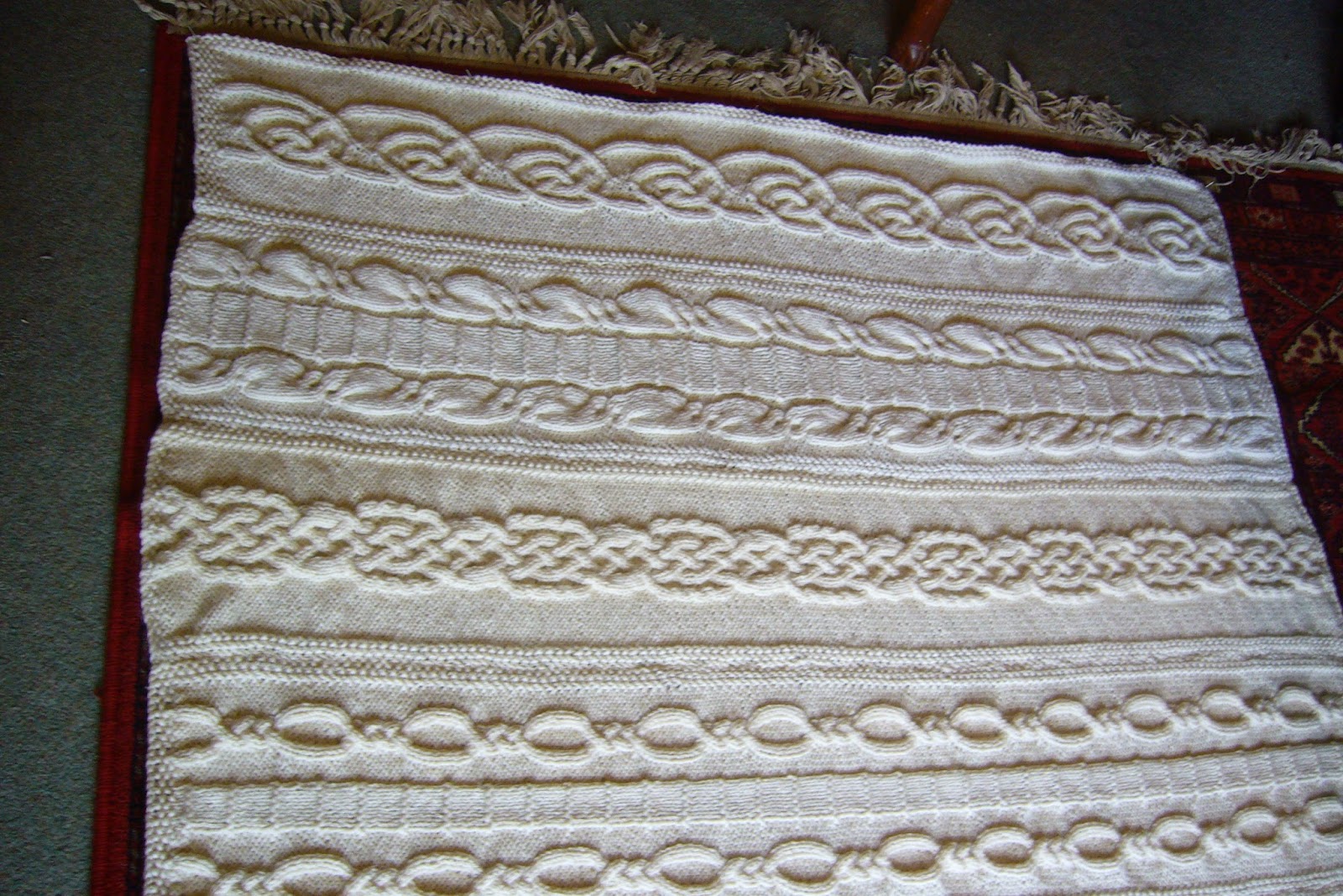
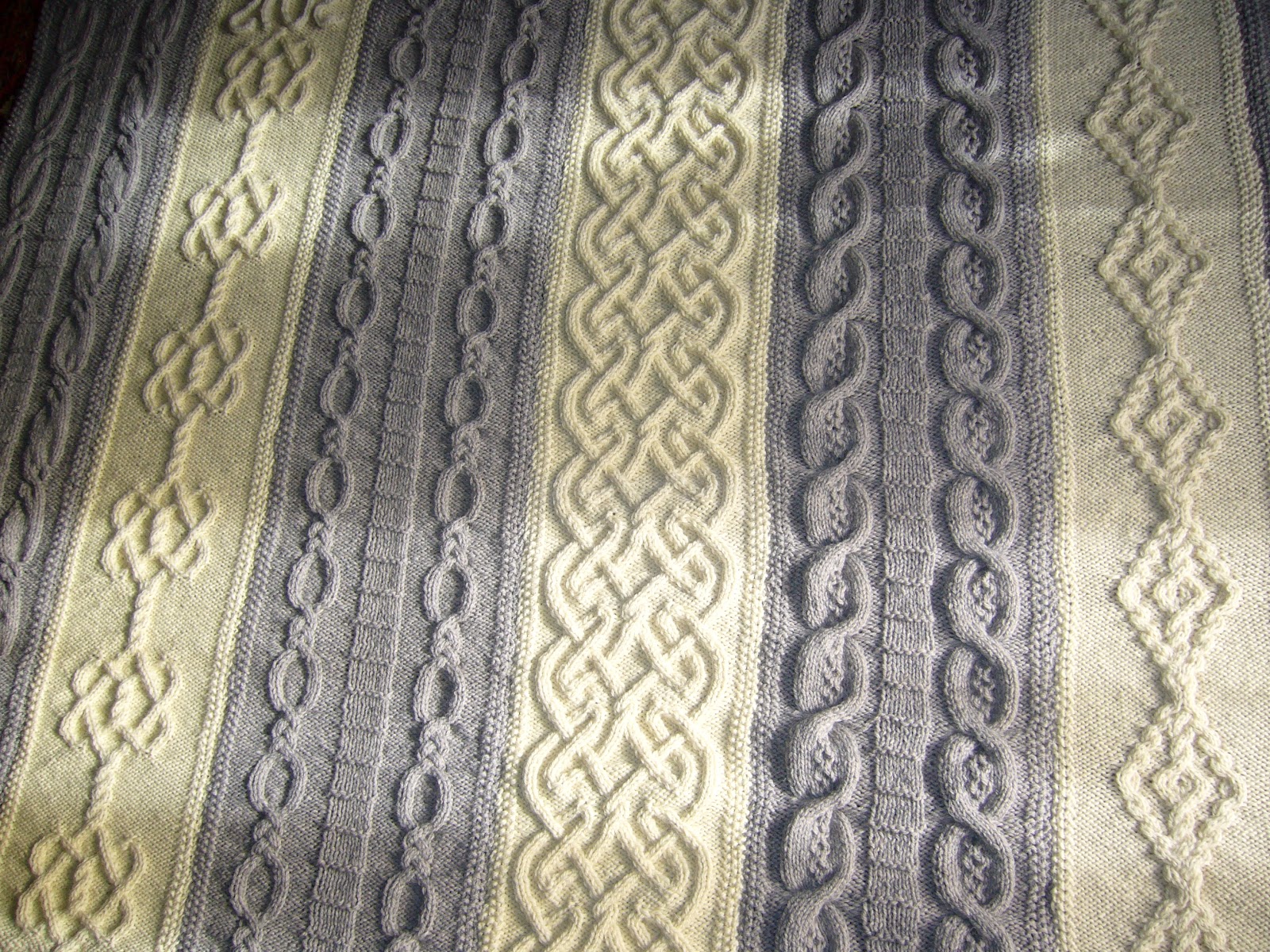
So, what can this be?  A giant's Aran sweater? Or this?
 
 
Interesting how even cream looks different in different light.


 Here is the central panel of my latest throw.  It's a cable panel called Nennir, designed by Lucy Hague and available to print off for free from Knitty.  It's flanked by two cable panels, one from Barbara Walker and one from another stitch directory.


It's hard to take a picture of the whole thing: here is one end.  I decided to use two mirror image Celtic cables for the end panels.  These are spirals based on imagery from the "Book of Durrow", no less, and charted some time ago by Monsterknitter.


This is the other end of the throw.  The last strip to be worked was this simple zig-zag, and, if you look carefully, you can see the ha'porth of tar, not that I think it really spoils the ship.  I bought a number of different lots of the main yarn, Hayfield 100% wool Aran, and they did vary quite a lot, not only in colour but also in texture.  I thought this was unlikely to matter if each complete section used the same dyelot.  On this final strip I ran out of yarn about four inches from the end and used two different oddments to finish it off. I don't think you would notice it on this view, for instance.
 

Or this.


 I am very pleased with how it turned out.  This will be the fifth throw I have made, and perhaps my last for now.  Although, I do wonder how one made from wool from different rare breeds would turn out...


Friday, March 14, 2014

Expedition

One of my closest friends is out in South Africa at the moment, taking in the Victoria Falls, Cape Town, a big game safari...

Meanwhile, my husband and I planned an expedition to Sudbury, a small market town some fifteen miles north of here.  The plan was to take the train there  - and cycle back.  Trains go off on a little branch line which must have once been the norm over most of Britain.  How this one survived is a mystery.


The day dawned to thick fog, but this was promised to burn off by late morning so we set out to cycle to our local station.  Our faces stung with cold as we reached the platform.  Then we saw that the train we had planned to take had been cancelled.  What to do?  In the end we just whiled away the hour until the next train, probably allowing the fog to burn away.

 
Once at Sudbury, we made our way to the Henny road, down the valley of the Stour.  This concrete structure is a pill-box, one of many put there to protect against threat of invasion.


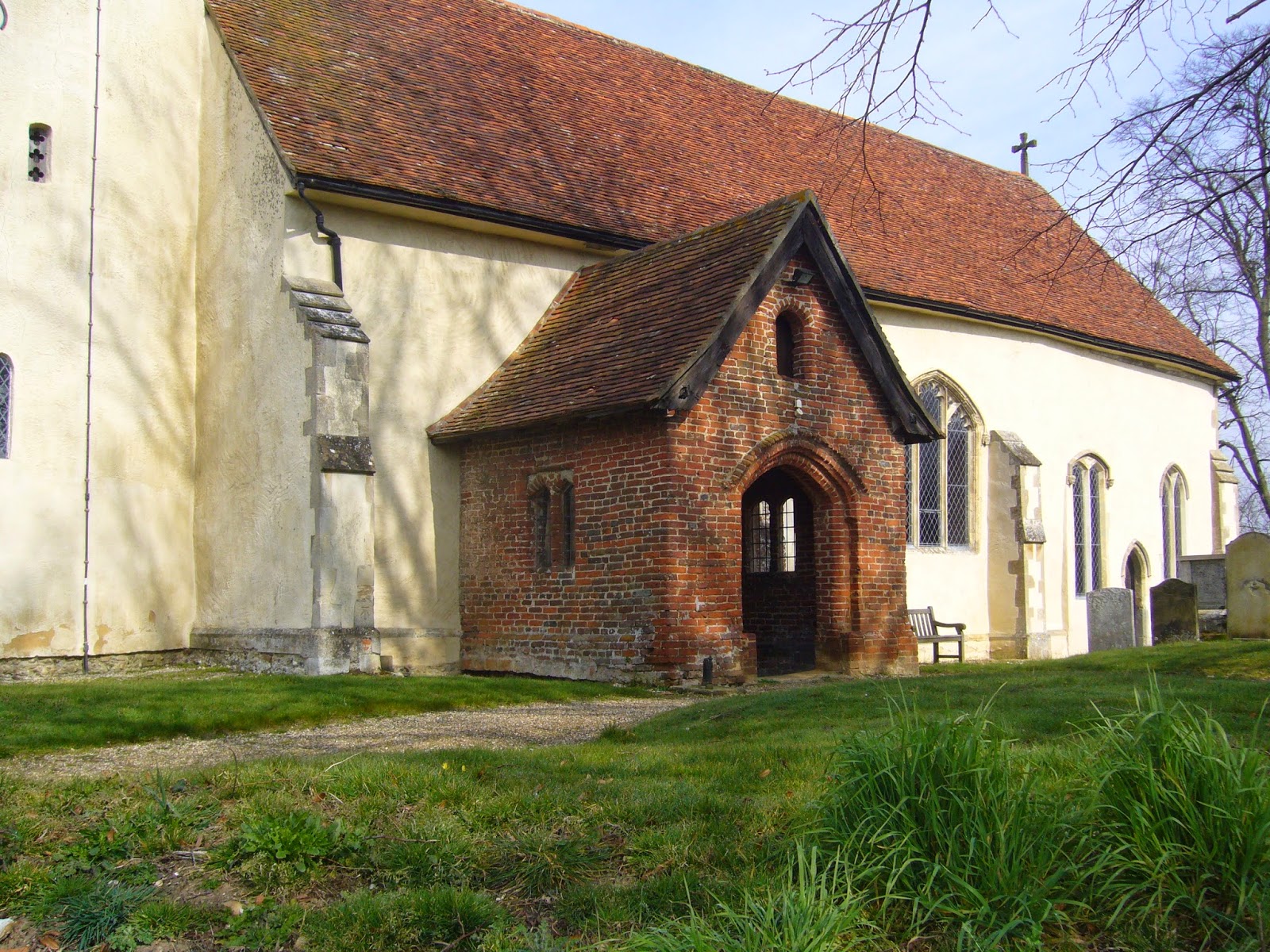
We enjoyed the many ancient farms, cottages and churches on the route, but were most pleased to see two hares running across a field, something we have never seen before.  March hares, perhaps?


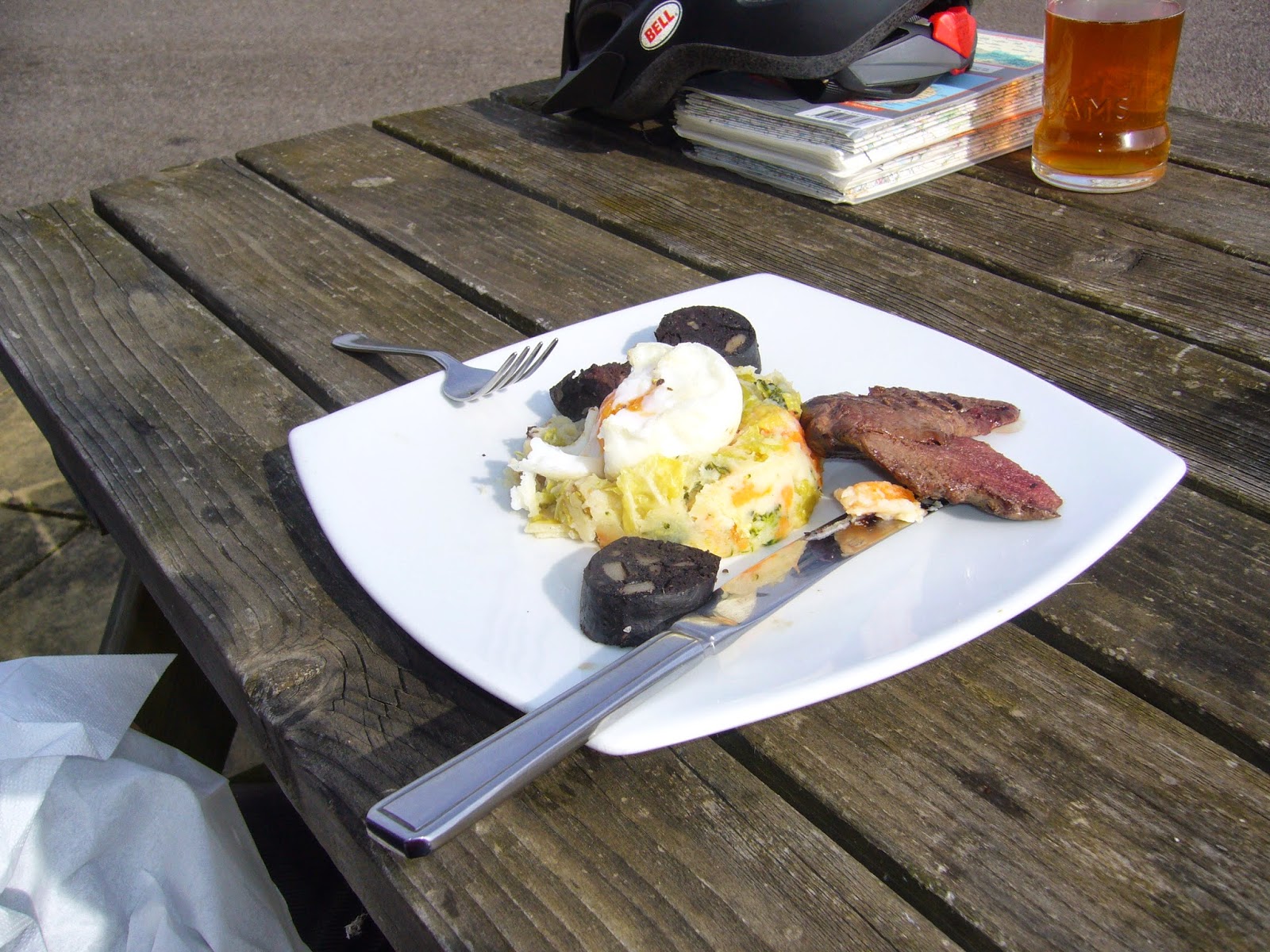
Half-way home is the Thatchers' Arms, and very welcome it was too.   We had bubble and squeak with a fried pigeon breast, black pudding and a poached egg - the kind of food one could imagine local cottagers eating for supper on good days. It certainly hit the spot as expedition fare.

 
After another hour's cycling, down into the Colne valley and then up and over into the valley of the Blackwater; we were on the home stretch.  It gave us ideas for further trips - once the saddle soreness wears off.

Knitting

This is half of my latest throw, now nearing completion.  The length of the most complex panel - Nennir by Lucy Hague -  had to dictate the length of all the strips, so extra repeats have had to be added to some.

A thought did occur to me about the significance of the Celtic knotwork, with its illusion of infinity.  Some religious buildings include a maze, to aid meditation.  What if these designs were to be used like mazes, only without the need to walk the lines?
 

Friday, February 21, 2014

Outings

It being half-term, we had planned a little trip to our cottage in Cumbria, but it was not to be.  We watched as the news featured overturned high-sided vehicles being towed off  the stretch of road we would have to use.  We regrouped, deciding instead to have an extra day in Stratford, then return home. As luck would have it, the weather then took a turn for the better, at least where we were.

We had a wonderful day at Compton Verney, newly reopened after the winter closure.  All across the  lawns, sculpture by Henry Moore and Rodin was on display.  We were told that a falling tree branch had narrowly missed a "Seated Figure", which had had to be moved.

This gallery makes you think.  All those years my mother filled in her football pools, and posted them off, presumably with a postal order.  She showed no interest in other forms of gambling, not even the Grand National, but the pools were a weekly ritual.  What would she have made of Compton Verney, founded by one of the Moores family, presumably with money from those postal orders?  Would she have thought it money well spent?  It's certainly a very civilised place to have lunch.

We usually stay in a very homely Bed and Breakfast, but we thought we would have supper in the very nice Alveston Manor Hotel, at the end of the same road.  I found myself rendered speechless, or as my husband said, sounding like Alan Bennett's mother, by the menu item: Pot of tea for two people: £8.00.  Surely that's not just me?


I plod on with my Celtic throw.  These are strips six and seven, out of nine to do.  How did I reverse the spiral?  Well, it is a charted design, printed on white paper.  If you hold it up to the light, the pattern for the reverse spiral is revealed.  These two will not be side by side in the finished item, so the different dye lot will not matter.


On Tuesday, we were off again, this time to Norwich, to the Sainsbury Centre.  We remembered visiting the gallery many years ago when my husband was doing some teaching at UEA.  This time we caught the end of an exhibition of Masterpieces of East Anglian art.  My goodness, what a broad range of items had been recruited under this heading: a Roman head of Claudius, photographs of Norfolk fishermen, objects by Faberge, the designs for UEA itself....  hmmm. 


But Norwich itself never fails - so many interesting doorways... and tea in the Cathedral Refectory: Pot of tea for two: £1.75.


Saturday, February 08, 2014

The River Wild...

Here in Essex the terrain is fairly flat, but we are also some distance from an actual coast.  Water meadows, however, are a landscape feature here; our village has a willow plantation along the banks of the river.  Famous name cricket bats were made, probably still are, from that willow.


So we should not have been surprised to see the river burst its banks this morning.  We've seen it much higher than this.  One half-term I parked my car in its usual place down the road, just opposite a sign for Lakes Meadow, before going north to visit my mother.  My husband, in our house some few hundred yards away, and several feet higher, saw my car on the local news bulletin.  The flood water had risen and filled the footwells on the car.  Strangely, it started first time and dried out eventually, although there was an awfully swampy smell in there for some time.

 
 In the middle distance, swans taking a break on the river-bank.


This strange little item is made of a linen yarn bought from the Sudbury silk mill on a cone, so probably a weaving yarn.  Even used double it is very light and has no give.  I'm using it to make a pouch for my MP3 player, which I use to create my own little zone at the gym.  Those who know me in person would be surprised how well I have taken to regular gym visits this year.


 On my first visit I was astonished to see a former colleague on her way out, and even more  to see her name on the chart for the top performers of the previous month in our age-group.  Nothing like a bit of competition to spur one on.  Last month, there I was, in the top five.  But I do find it awfully beneficial, not only in keeping my joints going, but also in inducing a state of calm, so that the rest of the day can be enjoyed.


 Finally, the latest strip for my  cream Celtic Throw.  This attempts to emulate the spirals which appear in Celtic cross carvings.  It's not my invention; I simply looked up Celtic Cable on Ravelry. 

Alongside is the dear little pincushion and pins given to me by one of my great-nieces, who has begun to fall under the spell of the haberdashery store.  In my attic, I have the hand sewing machine used by my own grandmother to earn her living as a travelling dressmaker.  She would strap the machine in its case on the carrier on the back of her bicycle, and off she would go.  This would have been before the First World War.  She was beyond sewing when I knew her, but after she died, my father bought this machine for me from the auction of her effects.
 
Now, should I give this machine to my great niece, that would be her great-great grandmother's sewing-machine.  Strange to think of it like this.

Sunday, January 26, 2014

Finished objects


Two very different projects reached completion this week, and they could hardly be more different.  This very jolly pair of socks - First Footing by Kate Davies - has been on the go since before Christmas when the pattern was published.  I bought it through Ravelry, downloaded it and started work using some oddments of yarn I had to hand.

 After discussing  the pattern in detail with other intrepid souls on Ravelry, I kept going through the heel turn and beyond.  It's the first time that I have knitted a sock in stranded work, and they would not bear inspection by the sock police.  Decreasing while keeping the colour changes going was beyond me.  However, it is very cheering to knit with such bright colours in mid-winter. 

These socks are clearly in a tradition, and that tradition is probably Turkish.  As I knit them, I thought what nice mittens the pattern would make.  After all, what kind of outfit is it that allows for socks like these to be seen and appreciated?  Clogs?  Sandals?  Canadian manners where you take off your boots at the door when visiting? 

Secondly, a pair of mittens and a camera pouch.


I bought the yarn for these from another member of the Weavers, Spinners and Dyers Guild to which I belong.   She has a website: Natural Yarn. This is Norfolk Horn yarn from sheep reared on the Wimpole Hall Estate, a National Trust property.  This is beautiful yarn, actually a cream with darker fibres through it so it looks beige in the picture.  It has lots of bounce and feels warm to the touch.  A group did some research into what breed of sheep would have provided the white wool used by the Cistercian monks at the abbey in our village for their characteristic white habits.  They decided that the Norfolk Horn was the nearest they could get, as it would read as white when set against a much darker fleece such as a Hebridean.  So this yarn has very deep local roots.

I had 100gms of yarn, and I wanted to see what one could knit with that.  I used the cable pattern called Stag's Horn in Barbara Walker's First Treasury, published in the 50's.  I made up the mitten pattern - I've knitted a few pairs of mitts in my time.  Then I thought to use the same cable on the pouch.  There was enough yarn for two of these, and they have a much nicer handle in actuality than the picture suggests.  In cold weather, these mittens would be a real comfort.

Edited to add: We had Canadian visitors mid-summer who expected to remove shoes on entry.  This would be unusual for anything other than walking boots or wellies in England.

The Norfolk Horn yarn is sorted and washed locally, then sent off to a mill in Cornwall - Natural Fibres, I think, - for spinning.  It is wonderful springy yarn.


Sunday, January 19, 2014

Knitting on the hoof

I find long car journeys very trying, but since we travel regularly to Cumbria, and my step-mother-in -law lives over three hours away, I am often looking for anything to take the edge off. 

Recently I've shared some of my knitting with groups and have commented on how knitting fits this bill for me almost every time - unexpected traffic jam, slow moving because of congestion... of course while the light lasts and I am the passenger.


This, for example, would be ideal.  I began this in a meeting which had its longueurs.  The pattern is from the Barbara Walker Treasury, but is so straightforward that one would not need a copy to hand.  I inserted the Jacob's Ladder in the centre and reversed the cable for symmetry.  All I have to do now is knit for forty three inches - ideal car knitting.  The cable moves four stitches, so a cable needle is more or less essential here - over two or three I just drop off the stitches and pinch them in my left hand.  However, I've discovered that the wooden pin from my shawl pin makes a good substitute cable needle, so that need not be a problem.


Here, now, is something I probably wouldn't knit on the hoof - or at least, that small part which is done in intarsia.  Multiple small bobbins of wool - or, if you are like me, an unholy tangle - and a picture to follow reasonably accurately - no.   But the back, the sleeves, the rib, the rest of the front are all plain sailing and so ideal for car knitting.

So what about lace knitting?  Obviously when setting up the pattern it might be a problem, or if the yarn was very light or fragile.  However, most lace patterns - like this one - have plain purl alternate rows, and these are ideal.  Those long chevron rows are really very mechanical once established, and do take about half an hour per row.  This, the Aeolian shawl by Elizabeth Freeman, does have nupps  - small bobbles made by a two row manoeuvre - and I would find those a bit challenging on the move, but that's about all.  Most knitting is a short sequence of stitches repeated many times.

Friday, January 10, 2014

Knitting as sculpture

In one of the Wallender books he describes how his father paints the same scene -  a lake with some ducks rising from it - over and over again. So I find myself locked in to a series of cabled throws.


  As I finished the muted tones throw, I already had a spare strip in cream Aran on hand.  Then it struck me how interesting it would be to use only cream, allowing the textures to be the only feature.  So now I am four strips in to an Aran throw, without actually having a destination in mind for the finished item.  It would "Show the muck" dreadfully, so would need only light use.


These are again cables drawn from Barbara Walker's Third Treasury of knitting patterns.

 
A different kind of cable, accompanied by vines. With the sunlight shining across it, the central cables seem deeply incised, almost sculptural.

And, for the central panel, this work of genius: Nennir by Lucy Hague.  This was published in "Knitty" as a cowl, knitted in sock yarn.  However, in Aran yarn the constant crossing of the cables creates a very firm handle.  The link with Celtic crosses is more obvious here.

 
I took this to a knitting group recently, to gasps of amazement, but the chart makes all clear, once the rhythm is established.  You will, of course have noticed the mistake I made in the knitting?
 
Edited to add: Just in case you too are wondering about the advantages of strip construction over knitting the whole thing at once: I am only ever working on about forty stitches and one cable pattern.  This makes for a portable project, possible to memorise after a few iterations.  I can decide on the hoof which panels to include - denser to balance another strip, or very complex or simpler.  I can knit strips of different colours, but only ever one ball at a time.  The trickiest bit - making strips all the same length while stopping the cable at a neat point sometimes involves a little fudging - adding some more rows to the moss stitch borders, for example, but this can be done at the assembly stage.  The finished throw still has all the Wow factor of setting complex patterns alongside each other.
 
Now, imagine the alternative. You would have to make all your design choices before starting. because once started you would be committed.   Nine times forty is three hundred and sixty stitches in one go - and that's Aran weight yarn, not lace-weight.  Then, and more crucially, that's nine different cable patterns to keep track of, each with different repeats.  I certainly don't think that you could pop the project in your bag and use it to while away a long car trip, as I have been able to do with these.  But, no doubt it could be done.


Monday, December 23, 2013

Stormy Weather


A brief visit to Cumbria this last week.  We made the most of our first day, the only really good walkable day, by walking along the woodlands on Loweswater shore and having lunch at the Kirkstile Inn, always a treat.


Keswick Oxfam  yielded up this haul: two 100gm balls of Soay yarn from a farm in Wales.  This has a lovely natural chocolate colour. 


And then, crewel wool by Renaissance Yarns.  Twenty-five metre skeins of lambswool dyed using natural dyes.  I just had to have them.


As the week went on, so the weather worsened. Roofs were being blown off and roads blocked.  We drove up the coast to enjoy the spectacle of the white horses in the Solway.


Another day we treated ourselves to lunch at the Pheasant Inn, Bassenthwaite.  We have often parked here on our way to the Sale Fell walk, but never had a meal.  This is their pheasant pie, and very tasty it was too, although I've never had beans served like chips in a little cup.

 
A merry Christmas to one and all.


Friday, December 13, 2013

Seasonal Knitting

Having recently finished a large project in muted shades of taupe and grey, I find myself strangely enlivened by this item.  It is a sock designed by Kate Davies called "First Footing".  Through the wonders of the internet, I was able to download this pattern as soon as it went to Ravelry. 


I'm using some odds and ends of 4ply yarns, as no-one has yet invented a means of downloading Shetland yarns.  Though, with the advent of 3D printers, that day cannot be far off.


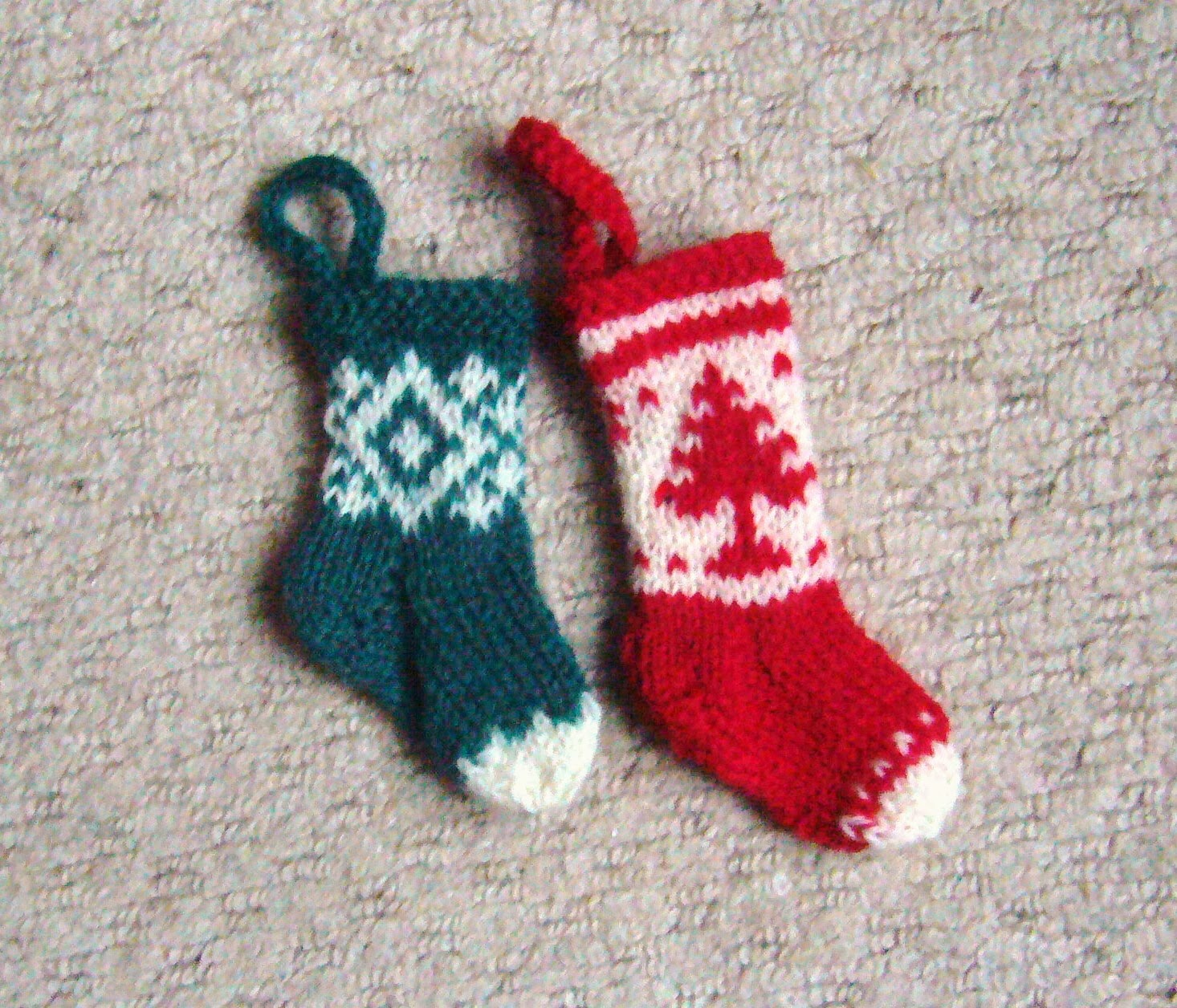
I am convinced that knitting in bright colours has a cheering effect on the brain in these darkest days of the year.  Someone at the knitting group pointed me towards the mini Christmas stockings offered as a free pattern by Julie at Little Cotton Rabbits. 

That will be just the thing for the holiday - fiddly, colourful and producing a quick result.  I'm thinking, a little garland of these, perhaps in graded sizes using different weights of yarn....


Last Sunday, my husband set off with a packed lunch to do a day's hedge-planting at the local Nature Reserve, which has just been redeveloped. A little community involvement. While he was out, I went up to our allotment and was pleased to harvest parsnips and leeks, which have done well this year.  I made a large pan of vegetable soup, and a fruit cake.  All the while I was pondering the making of an angel costume, for a colleague's little girl.  I had the basic measurements and an idea of concept - Biblical not Christmas tree - but I still needed to concoct the pattern.  How deep are the armholes for a small girl?  How big would the neck opening need to be to go over her head?


In the end I measured out an outline on a piece of newspaper and then just went for it.

My husband returned, having planted a section of hedge and nursing a bad back.  He had been surprised to find that his fellow "Volunteers" included not only a party from the Sixth Form College racking up community service points, but also a group for whom "Community Service" meant paying their debt to society!


Friday, December 06, 2013

Farm Child


Some thirty-five years ago, I first knitted this jumper.  Intarsia was all the rage at the time, and this pattern from "Farmers' Weekly" was not at all unusual.  I made it in dark green with a red tractor for my nephew, who was under ten at the time.  Then, since it was October half-term and I had some time on my hands, I also knitted a bigger, matching jumper for his father, my brother-in-law.  I customised them by adding their names to their jumpers - each name was three letters long, so this was no big deal.

At the recent family gathering it emerged that the bigger of the two sweaters is still extant - after all this time!  Sadly, I have no picture of it.  However, "Farmers' Weekly have made the pattern available again.  My sister asked me to knit it for a small boy she knows.  My great-niece was able to tell me that their tractor would be a New Holland in this striking blue livery.

I'm quite pleased with how this has turned out, although I had forgotten what a pain intarsia actually is to do.  I don't remember this being a problem on the first round.  I have not included the name as I'm not sure that a child in 2013 would feel comfortable with that.

Thursday, December 05, 2013

Crafted - technical

Although this is primarily a knitting blog, I rarely feel moved to get down to the technical aspects of the craft.  This time, though, I shared a photo of the throw on the Cables group on Ravelry, and there may be some interest in how it is done.


The beauty of this kind of project is that it is very forgiving: it does not have to fit anyone or be of a set size.  However, my throws go on the back of a sofa, for occasional use as  blankets, so they do need to be big enough to serve that purpose.  This comes down to nine strips, each about forty stitches wide and roughly forty-three inches long.

I used Aran yarn for these, but that covers a whole range of types of yarn in actual fact.  On my Cromarty throw, the cream stripes were knitted from a cone of Aran yarn.  I used this doubled to match the weight of the branded duck-egg blue yarn.  My preference is always to use up what I have to hand.  Because the throw will not be worn next to the skin, a budget Aran yarn in a 400 gm ball would be fine, but it should have at least some wool in it to give it warmth.  Each strip took about 100 gms of yarn, so you would need about two large balls.

 
So then, the pattern sources.  I'm a big fan of Alice Starmore and own several of her books: "Celtic Knitting", "Fishermen's Sweaters", "Sweaters for Men" and, more recently, "Aran Knitting".  Charts of the separate cables are found in all of these and can be simply repurposed.  This most recent throw uses only patterns from Barbara Walker's "Third Treasury of Knitting Patterns".   Sometimes I photocopied the chart so that I could carry the project along.

Choosing the patterns is the easy bit - at least to start with.  The chart will say how many stitches the pattern takes eg twenty-four.  The strip has three border stitches at each side, and I made my strips roughly forty stitches wide = So that's three border stitches, five reverse stocking stitch (purl), cable panel, five reverse stocking stitch and three border stitches again. 

Start by knitting three rows of moss stitch.  Because cable patterns pull in, cast on fewer stitches eg 36 and increase in the middle of the row to allow the cable more room.  When you have about 42 inches complete the strip with three rows of moss stitch.  Start these three rows by decreasing in the middle of the row to take out the extra which the cable needed.


As you choose the patterns for your nine strips you might want to look for designs which complement each other, or look broadly similar to give symmetry to your throw.  On my Cromarty throw I used the same pattern on all the cream strips.  On the Taupe throw I used different kinds of cables.  I can't tell you how to make an even number of repeats in the strip, because that was just luck,or fudging after the event, and in some cases I added extra edge stitches to add length.

 
Assembling the throw is just a matter of stitching the strips together.  I pressed some of them lightly, but that can flatten the cables.  Then I pinned the adjacent strips right sides together, starting by finding the centre of each one and pinning that together.  You can ease in a little length difference, but not too much.  I just used one of the yarns to sew it up and basically just overcast the two seams together.  This made a flat seam which is virtually invisible in the moss stitch border.