Tuesday, November 13, 2018

Geiger 7 - Finished Object.

Earlier than expected, we have a finished object.


Once I had decided on the steps to be taken, it was relatively quick to adjust the shoulders by bunching up the cables, unravelling the sleeve heads to remove two and a half inches and re-knitting them.  Greenmountaingirl - you might not need to do all these alterations if you are large.  I am five foot nothing and have begun to realise that tops often look too long on me.  That is really all I altered here:  started the armholes ten rows early on the back and fronts.  Then the four inches taken off the sleeves.


I used the I-cord edging which I have used before and it honestly looks as if that was what the designer intended.  I sifted through my button tin and found these navy and gold buttons.

I'm really pleased with it.  The elaborate cable on the sleeve makes it look vaguely like some kind of fantasy uniform jacket.  However, it is just full of clever little designerly details, such as the ribbed cable cast-on and the seams.  I'll know they are there even if no one else does.


Sunday, November 11, 2018

Geiger 6

Not another post on Geiger? Any non-knitters will be thinking, why not just buy a ready-made cardigan?  Or, possibly, why not just wear one of the many cardigans you already own?  Well, this is one for the process knitter ie the person who enjoys the business of making rather than just being interested in the product.  Remember that the pattern itself runs to thirty pages.

So I've seamed the body, and because each piece has a 4-stitch textured edge, with any increase or decreases done inside the edge strip, the seaming looks particularly neat.  You are directed to seam with wrong sides together and the mattress stitch seam disappears into the edge strip.

I've tried it on.  I did shorten the body sections by about ten rows because I am short myself and I did not want to be swamped by it.  It is about the right length now, although the blocking has caused it to relax a little.  I think that is what happened.  Katia Merino 100% is made up of a number of 2ply strands coiled together, but still really quite separate.  The wet-blocking seems to have caused the yarn to lose some of its spring, so the fabric feels quite stretchy now.  With hindsight I might have been better using a 4mm needle instead of the 4.5 mm I used to get gauge.

I have not yet blocked the sleeves, but I did seam one and tacked it into the armhole.  Hmmm...  this could be better - a lot better.  Although I was forewarned by others' comments about the floppy ends to the sleeves - an intentional device, I'm sure - so that I had already shortened the opening rib section by about 2 inches, the sleeve was still far too long.  I can't just take off some more of the rib at the bottom as some have done at this point, so I have chosen to unravel the sleeve head and begin the sleeve decreases about two inches earlier.  This is no big deal as the sleeve head is relatively simple to knit.

But then, there is also a problem at the shoulder.   Seaming from the right side meant that I was virtually grafting the back and the front together at the shoulder.  On the cabled section this has the effect of spreading the stitches and therefore pushing the shoulder out further than is ideal for a set-in sleeve.  The solution may well be to make the cable stitches overlap more, so taking out some width from the shoulder.  Of course that may result in an ugly bump - we'll see.

I'm also thinking that I will use an I-cord edging instead of the ribbed bands in the pattern.  There is already a garter strip at the front edges and I-cord allows for  very simple buttonholes.  I'm not too impressed with the effect of the front neck extensions seamed to the back neck and I-cord may give that a bit more structure.

I'm maybe a week from finishing this.


Friday, November 09, 2018

Fall

To Sudbury, for a tour focussed on silk production - the town still has four working silk mills.

This is the main church at the top of the central marketplace, swathed in a swag of netting covered in poppies to commemorate the ending of World War One.  Apparently they asked for 5000 and received 23,000, all hand-knitted or crocheted.  It made an impressive and moving spectacle in the November sunshine.

This is a wool merchant's house in the town, now used as a restaurant.  Note the extensions to the windows upstairs, possibly to allow in more light for weaving.

And these are silk weaver's cottages.  The middle floor would have housed the looms, and you can still see on some of them how the windows have been reduced in size.

In the garden of Thomas Gainsborough's house, both a large mulberry tree and this lovely quince, laden with golden fruit.  We are enjoying one stewed with apple for dessert.
And a sample wall-hanging in the Assembly Rooms, built 1828, presumably as a ball-room, but now the Registry Office.  This is silk woven by Stephen Walters, one of the four companies still operating.


Autumn is blazing away all around us, but not for long, as the weather turns windy.  I spent yesterday afternoon raking up leaves in Paycocke's garden.  There are many more to fall.


Wednesday, November 07, 2018

Geiger 5

When I bought the yarn for Geiger I knew what I was looking for: 100% wool, a good vibrant colour and preferably not breaking the bank.  The Geiger in the pattern picture is in dark navy, and I can see how this might work as it is quite a show-off sort of design, so it does not really need a bright colour. But I was hoping for some colour stimulation in the knitting and a pop of colour for winter wearing.

Once in Franklins, the local wool-shop, of course your choice is determined by what is there.  I have used Katia sock yarn before and found it worked.  Here was Katia 100% Merino DK in a lively green shade.  And it was Superwash - easycare, it said.  Should that have told me anything?

I did knit a couple of swatches, not something I always do as I tend to knit to a moderate gauge, not loose or tight. But I did not wash the swatches. I chose 4.5 mm needles because this gave me the right stitch-count, and the ball-band stated that this was a possible needle size for this yarn.  I would usually knit DK on 4mm needles.

While I was knitting this a friend asked if it was a cotton yarn and I could see what she meant: very crisp stitch definition because of the smooth, rounded yarn.

So, I have the back and both fronts knitted finally -  just the sleeve-heads still finish, then the button-bands.  I decide to block the finished pieces in the time-honoured way: a short soak in luke-warm water, a rinse, rolling in a towel to remove excess water and pinning out to dry to size and shape  on the dining-room floor.

But what was this?  The firm, crisp handle of the knitted pieces was gone, and replaced by drape.  It looked at first as though the pieces were much larger, certainly much floppier.  There was a certain amount of bloom - woolliness which had not been there before.  I patted the pieces into shape thinking of all the hours I had spent on the knitting only for this to happen.

Once dry, I tacked the pieces together to see if anything could be done.  Curiously, it does fit, although the handle is still drapy and the stocking stitch sections seem a little limp.

I am finishing the sleeveheads, so that the cardigan will at least be complete, even if it is not quite what I was expecting.

Sunday, November 04, 2018

Geiger 4

So there I was, knitting up the left front of Geiger.  Apart from underestimating the importance of counting and counting again, which meant unravelling a two inch section right at the start, the chart was very straightforward, and familiar by now.

What's so challenging about this pattern? I asked myself.

Then I arrived at the start of the armhole decreases and I realised.  The chart has numbered rows, but some whole sections have to be repeated two or even three times.  This means that numbers cannot be used to identify what happens in each row.  So the written instructions do not identify the rows by number, but just by a sequence which you have to follow.

All the decreases are done away from the edges, so that those for the front slope are in the same place as those for the pattern shifting.

There is a single sentence paragraph which contains different sorts of brackets and asterisks for which only the word "Advanced" will do.  That's advanced pattern reading; the actual knitting remains quite straightforward once you have understood what has to be done and how often.

I would bet that quite a few Geigers will remain as wips as knitters remain mind-boggled by the directions.

Tuesday, October 23, 2018

Autumn break


To Cumbria, for a little pre-winter break, hoping for some leaf-peeping and fell walking.  We took the train, challenging ourselves to pack all we needed for the week into carry-on suitcases so that we could cope with the underground.

Rule one of any trip: always expect the unexpected.  My husband had booked the hire car from the branch of the firm nearest to the road south we needed to take.  Arriving at Carlisle, we climbed into a taxi.  The driver shook his head: that branch looked as though it had closed down.  We went to check and his information was correct.  I'm still astounded that a national car hire firm would take a booking for that location but not bother to inform the hirer that their business had transferred to the other side of town.

And there was more.  One of our pleasures while in Maryport is to go for a drive up the coast, something we cannot do so easily in Essex.  So we were  dismayed to find that the road up to Allonby was closed for repairs, necessitating longish detours by the inland villages to reach the coastline.


But, these problems notwithstanding, we had a relaxing week with weather good enough to enjoy our regular walks in rotation.
 

On the best day it was along the shore of Loweswater, up through the mixed woodland and out on to the high path above, all the while enjoying the autumnal sunshine.


The lake was about as calm as we have ever seen it.


Another day we drove to Keswick to buy some wet weather gear, then down past Thirlmere  to Grasmere.  Sarah Nelson's gingerbread shop was doing roaring trade.

We were there to see the exhibition "This Girl Did" at the Wordsworth museum.  Given that Dorothy Wordsworth was 46 at the time that she ascended Scafell, the term "Girl" is pushing it a bit, but of course her long-distance walking had been habitual.


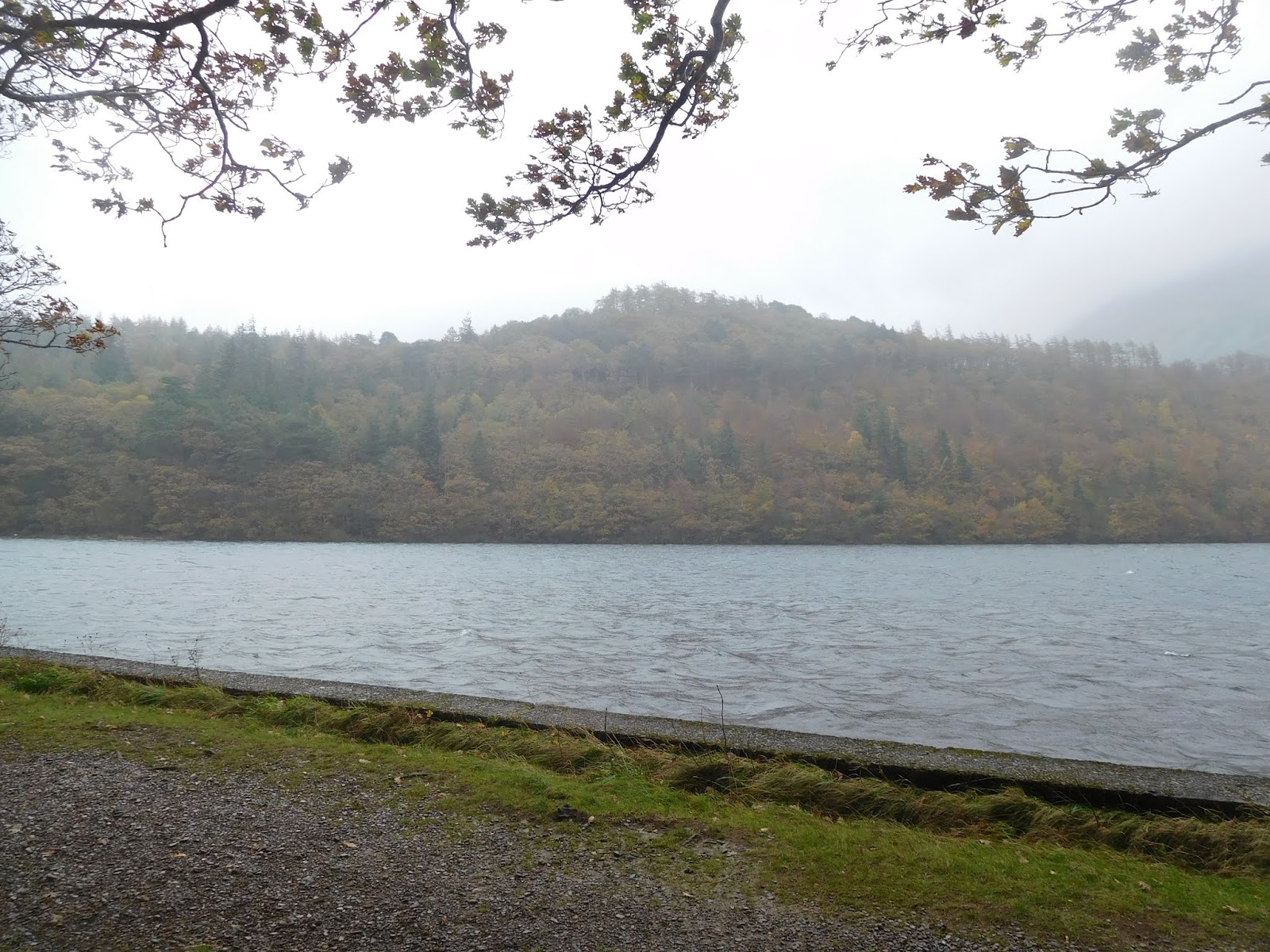
Saturday was both windy and rainy but we had determined to make the most of our time, so off we went: through Lanthwaite woods to Crummock.  The views from Crummock shore were obscured but we enjoyed the walk nonetheless.


Monday, October 08, 2018

Geiger 3

Progress report on Geiger:  I've finished the back and begun work on one of the fronts.  This is taking a while, largely because if you blink while knitting a section you find yourself having to rip back before you can start again.  Sometimes you don't grasp how a technique works until you have got to the end of the process and then the rows at the start of the process look off.  This is not a forgiving pattern.


You can see certain elements of the pattern quite clearly here.  Notice how the pattern shifts by inserting extra stitches in the centre and decreasing them at the side.  This apparently creates a tailored look to the back.  

I was rather surprised that the back ended in a straight cast-off without any shoulder or neck shaping.  We'll have to see how this works out.  I'm probably more than half way through now, although the front band involves a good deal of finicky work.

When I say that I've had to rip back some sections, this is as nothing to the usual form in my knitting group.  A keen knitter arrived last week with a whole top and most of the front of another and spent the session unravelling both.  She did not like the colour of one and had realised that she would run out of wool on the other.  It would be true to say of some of these knitters that they always have some knitting on the needles but never finish anything.  Some of them knit the same yarn several times which at least saves money, I suppose.  Each to their own.

Friday, October 05, 2018

Who knew?

We were staying at East Runton, a mile from Cromer, where there are huge caravan sites.  On an early walk we noticed where a landslip had toppled some caravan bases down the cliffs.  We were glad that we were in a cottage, because those vans at the top can't be too secure.


All the time that we were out and about on the beaches of North Norfolk I was scanning for amber.  I'd heard it said that you can just pick up pieces of Baltic amber from the beach.  Now, the frustrating thing was that many of the pebbles were in fact quartz, but stained a kind of rusty orange, a bit like an amber colour.  So I was constantly picking bits up and then dropping them again.


On our last day, we were just poddling along the beach at East Runton.  Here the beach had patches of flint, some of it knobbly and misshapen.

I spotted a short pinkish object, like a piece of sea-glass - about an inch long.  Then another similar, but with a hole through it.


Soon I had a number of pieces, one with a pointed end.

And then a longer piece, like a finger, but hollow.


I showed them to my husband, thinking that they were some sort of glass, abraded to opacity by the sea.  Some sort of electrical fitment perhaps?

"I think it might be a fossil," my husband said.  I was sceptical.  However, it turns out that he was right.

It was a belemnite - the calcified skeleton of a prehistoric squid-like creature.  And when I say prehistoric we are talking six hundred million years ago.


East Runton is apparently one of the best beaches for fossil-hunting because it has high chalk cliffs which are eroding on to the beach.  Now we had noticed the layers of flints in the face of the cliffs, but we had not thought of them as fossils.  That belemnite must have been buried in the chalk all those years.


Wednesday, October 03, 2018

Sheringham Park and Blakeney Point.

The weather continuing fine we were able to enjoy a range of outdoor activities.  Near the seaside town of Sheringham lies the National Trust property, Sheringham Park.  However, here the house is tenanted and not open to the public.  Instead it is the wooded parkland laid out by Humphrey Repton, on of the great landscape designers, that is the draw.


We walked out across the park and climbed up to a wooded rise topped by a Gazebo.  We had no idea what to expect, but it certainly was not what we found.  The trees at the top of the rise are mature oak trees.  The gazebo is a structure of oak and metal, with flights of stairs up to a viewing platform above the tree canopy, a most peculiar experience.


We were just surveying the view when we heard the unmistakable hooting of the steam train.  A moment later and it hove into view, crossing the landscape in front of us.  We could not have timed it better if we had planned it. 


The following day we set out in some trepidation for Blakeney Point.  This is a nature reserve at the end of a long - very long - shingle spit.  With the tide in we would have to walk on the shingle bank,
every footstep taking double the effort.


As luck would have it, the tide was out, exposing the firm sand of the beach, a quite different proposition.  

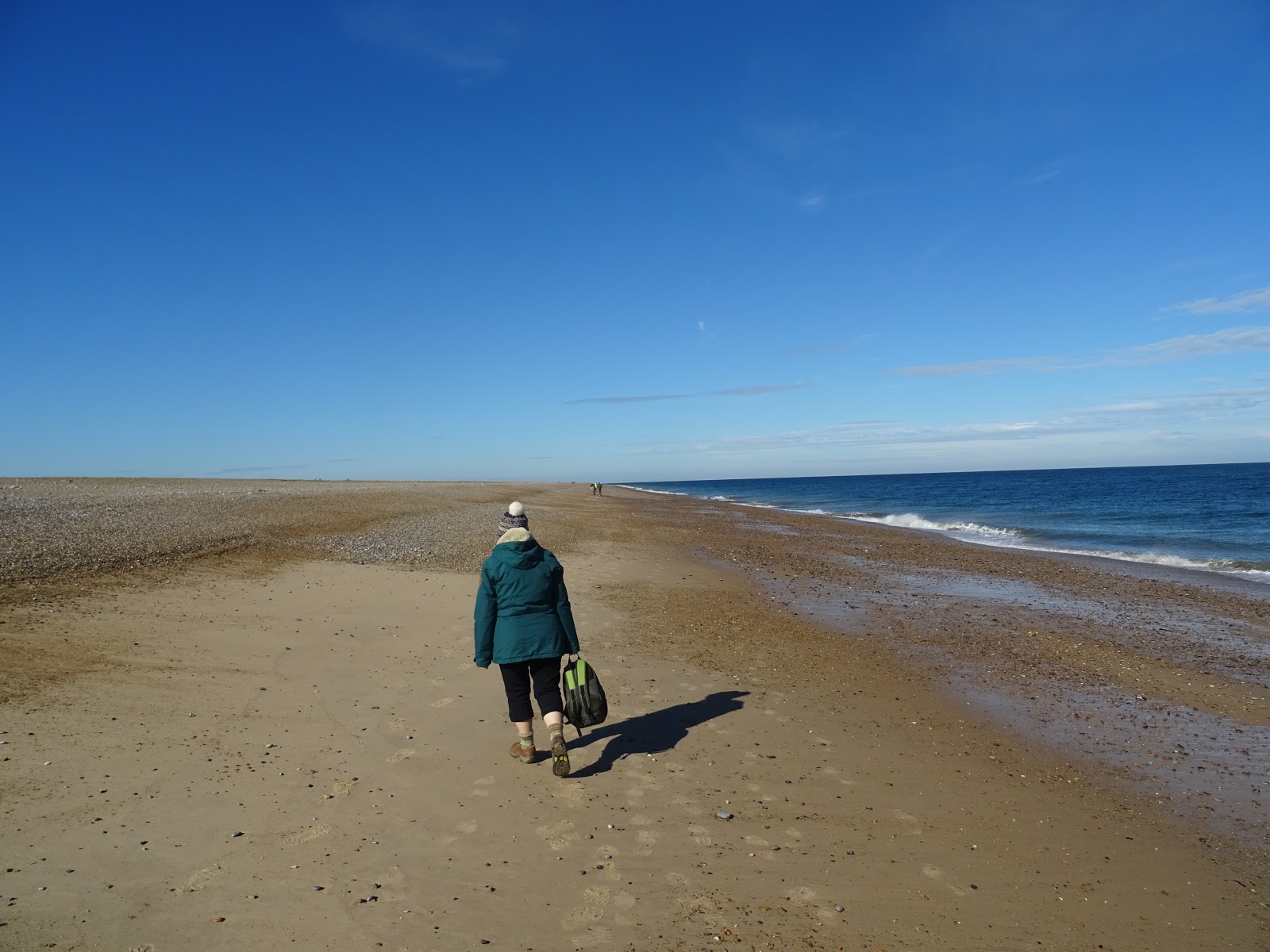
It was still a lengthy and unvarying trek, but the sun was out and the wind was in our favour for the return journey. In the dunes at the far end is a disused lifeboat station, now a visitor centre and field studies base.


At some distance, basking seals


So then we walked the four miles back along the beach for tea in Blakeney itself.


Tuesday, October 02, 2018

Fellbrigg


Not ten miles from Blickling is Fellbrigg, now also owned by the National Trust, and of a similar date.  This is the one for those who love stories of  eccentric ancestors.


One of the Wymondhams went on the Grand Tour around Europe for four years and returned with so many works of art that he needed to add a wing to the house to fit them all in.

Another returned engaged to an older lady in Switzerland, a long engagement followed by an expensive settlement for breach of promise when he found love with someone more locally.

The art installation here explores the idea of a cabinet of curiosities.  The curator of the piece was allowed access to items store in the attics which were then assembled in various ways.  This was certainly an improvement on the torrents of books, as far as we were concerned.  But, in fact, you did not need to hunt through the attics to find oddities.


My husband assured me that this is not what it seems!  Apparently oil from sperm whales was used to make candles.

And what about this?


Imagine trying to lift this when full of boiling water.  The whole kitchen was a delight for the eye.


In contrast, the dining room looks quite cold.


We took a stroll around the parkland: mature trees, a lake and its own church.


This is another church with fine ancient memorial brasses in the floor, covered with drugget and carpet pieces to protect them.


Perhaps the most eccentric of the Wymondhams had developed the habit while at Eton of dressing up as a train guard and going down to the station to join in the running of the railway, causing havoc.  He would have been happy at the Sheringham to Holt Steam railway. Later, he was caught by a lady of dubious virtue who robbed him blind, causing the house to be sold.

Fellbrigg is certainly worth a visit, if you are in the area.


Monday, October 01, 2018

Sheringham to Holt

So, to Holt on the North Norfolk heritage railway, pulled by steam engine.  Nostalgia is a huge selling point here.

They have regular events where people turn up dressed for the 1940s and take the trip in vintage carriages.


 The railway has a collection of rolling stock, not all of it for passengers.  Most of the staff are retired folks who have dreamed of wearing the cap and waving the red flag since childhood.


It has to be said that once you are in the train it does not feel all that much different to a regular train, but the engines certainly look impressive.

Holt itself is a lovely little town crammed with independent shops, antique shops and eateries.  Disposable income floats like a haze in the atmosphere here, as we found in Cirencester last year.


All across the town are outposts of the famous Greshams public school, which probably adds to the sense of tradition and exclusiveness.


We had a very relaxed day out.