Monday, June 10, 2013

Bibelots


This week I learnt a new skill: weaving on a wire warp.  Melinda Berkowitz was running a workshop as part of the textile festival at the Warner Textile Archive.  First we hammered in tacks to make a simple loom.  Then we wound the warp around the tacks.  After that it was child's play to weave yarn of different textures, using a tapestry needle.

 Here, I'm aiming at a beach landscape, and have incorporated a piece of beach glass to add authenticity.  It's not finished yet of course, but I am quite pleased with it.  I say "Quite pleased" because I am struck by my lack of visual memory when I start something like this.  Does the sand get darker or lighter to give an illusion of distance?  I should have used a photograph as a guide.


Saturday to Cambridge, which is an hour's drive away.  When I was eighteen I had an interview for admission to Newnham.  I clearly remember wandering around the open market in the centre and seeing a stall selling sheepskins.  I remember buying a pair of blue tights, which I was very fond of.
Cambridge is still a delight for a little light browsing, as the presence of so many students  - and tourists - fosters all knds of arty shops which you don't see elsewhere.


Everywhere you look are little architectural details from older times.


And, of course, there are lots of lovely places to eat - my favourite being Michaeljohn, a converted church.  This is a theme we've been seeing a lot recently.

Monday, June 03, 2013

Norwich 2


When we visited Norwich late last year, we promised ourselves that we would repeat the trip.  This Wednesday we took the train again, starting out with a visit to Strangers' Hall.  The "strangers" in question were Flemish weavers, arriving in medieval times.  The museum now includes a veritable warren of rooms, beginning with a hall in the ancient sense of a large room open to the roof.


Through the building, rooms are furnished to match different periods of the house's occupation, from the 14th century vaulted undercroft onwards.  This fine walnut cabinet was in a room of 17th century inlaid furniture.  There was a Georgian drawing room and a Victorian nursery.  We found it fascinating.


By then it was lunch-time and we had booked at Jamie's Italian, which is in the Art Nouveau Royal Arcade.  Apart from the service, which was very slow for lunch-time, we enjoyed it very much.  Even simple bruschetta had lovely fresh ingredients and a lemony dressing.  Nor was it over-priced.


Everywhere you look in Norwich there is something interesting to see.  What about this little survivor, standing alone?


A cinema converted from some ancient buildings.


The wall of the house next to the Bridewell Museum, faced with shaped flints.


Knitting on the Star Leaves Shawl continues apace now that I am beyond the chevron of nupps.  These are clearly a key feature of Estonian lace, and lovely when they work out.  However, it is all to easy to miss a thread or two when purling them all together, and jolly difficult to put right.  My plan is to secure any messy ones at the finishing stage, which has worked for me before.


I am moving through the lace leaf section, and here the logic of lace, where the stitches sitting on the needle dictate what must be to happen in that row, makes for a very satisfying time.  I have discovered that it is possible to listen to the archive of "Desert Island Discs" on i-player - U.A.Fanthorpe - classic English songs, Vikram Seth - his own translation of an 8th century Chinese poet set to music, Alice Walker - highly emotional contemporary pieces ... absolutely fascinating.


Friday, May 24, 2013

First Fruits


This week we ate the first of the lettuces grown on from seedlings.  Odd how lettuce seems to be frost-resistant.  I had thought this might have the bitter taste red lettuces sometimes have, but in fact it was tender and sweet.

 
Yesterday I made the first batch of jam this year: rhubarb and ginger.  I remember eating this at my grandmother's house, but I have never made it before.  One kilo of rhubarb with a kilo of jam sugar and some preserved ginger.  It was very easy to make and tastes absolutely delicious.


This is the Spectra scarf by Stephen West.  I used Noro Silk Garden Lite in an odd colourway where the second skein suddenly included a bright orange - I left it out.  Now the puzzle is to work out how to wear this, as, of course, it twirls around.  Looks spectacular though, and would be an ideal way to use up two skeins  of lovely yarn bought on impulse.

 
My new project is just up and running, speaking of lovely skeins.  I bought this at The Woolclip at Caldbeck at Easter. It has a large element of silk in the mix so that the colours really glow.   Something with leaves, I thought, and downloaded the pattern for the Star Leaves shawl by Jennifer Johnson Johnen.


This is Estonian lace, and even the explanations for the abbreviations had me foxed.  But the wonders of the Internet are boundless.  On the Ravelry KAL for the shawl, some kind soul has uploaded a little video tutorial on the unfamiliar stitches - taking the picture herself by holding the camera under her chin while filming.  Truly amazing and very helpful. 

Sunday, May 19, 2013

Box of Delights


And who might this grim-looking crew be?  In fact, this is a picture taken to mark the Golden Wedding of my great-grandfather in 1926, pictured seated with his wife and surrounded by his seven children.  The mood certainly looks like a celebration, doesn't it?  The photo appeared in the local newspaper.

Family legend has it that the old man refused to change out of his clogs for the event, or the photo.  What his wife felt is not recorded, though doubtless after fifty years she was used to him. 

My great-grandfather was a farmer in Cumbria, but he was also a self-educated man, well-versed in the law.  In the attic of the farm where I was born remained part of his extensive library of second-hand books, history and non-fiction in the main, but with some collections of poetry.  I remember reading "Hiawatha" from a miniature Selected Longfellow.

 The story goes that as a youth he severed the ligaments in his ankle in an accident with a scythe.  They were on a remote farm, so his mother sewed him up with a sewing needle and in later life he walked with two sticks.    This did not stop him walking distances we would find unbelievable now, not as a sport but in order to visit the various cattle auctions.

The chap on the far right is my paternal grandfather, who was about thirty-nine at the time of the picture.  He looked very much like this when I knew him in his seventies.  On his feet he has a pair of stout boots, although he woould have worn clogs for every day, like his father.

I had never expected to see a photograph of my great-grandparents, but this one surfaced quite recently.  Perhaps someone also has an image of my maternal grandfather, a man I never met.


I thought I would share with you some images of the box I described in my last post.  This is a sycamore box, about a foot in each dimension.  Inset on each side are panels of silk, painted and embroidered, showing different natural scenes, possibly the four seasons.  This first one is definitely spring-like.


Or perhaps this increasingly green panel is Spring and the blue one Summer?


Here, the mood has changed to stormy.  The painting of the heron in flight is particularly dramatic.


And now all the colours are bleached and the bird has become a kestrel hovering.


I think these panels were embroidered by Meg Falconer, but I am not absolutely certain of that.

Inside the box are other containers, nestling one inside the other, like Russian dolls.  I won all this as a prize in 1983, and unpacking it was a revelation.


Wednesday, May 08, 2013

Double Damask


Some knitting to start with.  This is Austermann Step, in quite a lively colourway, ideal for country socks.  I bought the yarn in a little wool shop of the old school, tucked in behind the main street in Cockermouth.  As the very nice lady said, it would have been good to have a window, but she had wanted to get started again after the floods and this was better than nothing.  Sock yarn always comes in handy.

This week we have tackled the redecorating of the dining-room, another room which has been waiting for some time.  We have several massive items of furniture in there, and far too much junk, so the clearing of the decks was problematic.  In the end we tackled it in two halves, so that we could move items from one end to the other.

In our other recent projects we have chosen light refelective papers of a modern design, but here we wanted something more classic.   The papered walls have to sit against those fifteenth century beams on the fourth wall, after all.  What would the merchant have done all those centuries ago?  Perhaps some lime-wash?  Not rich enough for tapestry wall-hangings...  In the end we chose this ivory paper, in a pattern which reminds me of white linen damask tablecloths.  It certainly brightens up the room, though it is not very medieval.


A number of searches recently have picked up my images of our new wardrobe doors in Elephant's Breath and Dove Tail.  On the Farrow and Ball shade card, I would have read these as beige tones.  The tester pots gave a very purplish tinge on the old cream doors.  Now in place, one pair of doors reflects light from the window while the other is in shade. One looks like two tones of mushroomy grey, while the other has a more beigey look.  The point is, though, that the finish, using a roller to apply the top layers, is lovely and the effect subtle and understated.  My husband knocked them up out of MDF, but you would never guess.


Last Wednesday I gave a talk to the Art Group which meets regularly in my village.  I had given the same talk to my Weavers, Spinners and Dyers group last year, and this prompted a member of both groups to invite me to repeat it for them.  So what was it about?  In 1983, the Guild of Lakeland Craftsmen in Cumbria moved their annual exhibition from a venue in Windermere to a venue in Keswick.  To advertise this move they organised a competition, with the prize being created by their members.  I was lucky enough to win the prize, and I was presented with it by their President, Tobias Harrison.

 The prize is itself a kind of puzzle, as, from the outside, it looks like a wooden box with inset embroidered panels, about a foot square.  Inside is a series of nesting boxes, each made by a different member of the guild, in textiles, pottery, leather...  It is exciting to unpack for a new audience as the standard of workmanship of each item is so high.  It has given me lots of pleasure to own it over the years and it was good to show it off to an appreciative group.  Perhaps I will feature some of these pieces here in coming weeks.


Wednesday, April 24, 2013

Two Shades of Grey


First, the very discoloured cream doors of the wardrobe fitment in our bedroom.  These have been in situ since the late 80s when our predecessors installed them.  At first we toyed with the idea of a large Edwardian triple robe, and, indeed, saw several which would have worked quite well.  Inertia is a strong force for us, however, and the years passed by without us doing anything about it.

Recently, I read a comment from a lady who was downsizing, about how she had had enough of "brown furniture."  That would be "brown" as in "wood-coloured", I suppose.

Anyhoo, we thought the time had come for these doors.  My husband ordered some MDF and, much glueing, clamping and five coats of paint later, we have the "After" picture.  He ordered a narrow, lightweight mirror for the central panel.  We scanned the Farrow and Ball paintchart and chose Dove Tail and Elephant's Breath, not quite realising how these colours read differently depending on what is nearest to them.  Here, they are definitely pale grey and  even paler grey, but we are very pleased with the sleekness of the effect.  My husband did have some fun coming up with alternative names: Monkey's Elbow and Duck's Bottom, for example.


Reflected in the mirror, you can just see the beams behind our bed.

I have been enjoying the "Great British Sewing Bee", although  people sewing beautifully makes less interesting television than eccentrics sewing badly but creatively.  I was constantly struck by the effect of time limits on the tasks.  Of course, sometimes the home-sewer is up against a deadline, and this will induce stress.  I well remember my mother finishing a dress late into the night, sewing a little floral trim on to turquoise organdie.  But often home sewing projects run on for weeks, months, years...

One of the tasks was to make a man's shirt in four hours - but it was a shirt with no cuffs.  When I was at university, two of my housemates were getting married.  It was a winter wedding and the bride had chosen a burgundy fabric for the bridesmaids' dresses.  She planned to make the bridegroom's shirt from the same fabric, but time rolled on and they had booked to go to a ball on the eve of the wedding.  While they were out I took the pieces of the shirt and made it up, working late into the night.  I had no sewing machine, but the ladies' college just across the road, St Hugh's, had a sewing room, which I "borrowed".  I wonder if they still have it.  I do remember that I somehow put the buttonholes on the wrong edges of the cuffs so they fastened back to front.  He wore it to the wedding, though.


Saturday, April 13, 2013

Spring Harvests


Today, to the allotment, for the first rhubarb of the season, and some of the last leeks.  It has been so cold and wet up there in recent weeks that we are behind with our planting, but we made a start today using our trusty Mantis tiller.  We had already dug the plot through in - was it? - February, so now we are working it up for potatoes.  Onions, too, need to be going in.

We are just returned from Cumbria where we feared to find Arctic conditions followed by that sort of grey drizzle which is the default weather in the coastal towns.  However, although it was bitingly sharp at first, the sun persisted and we made the most of the weather.


My husband, dressed for the weather, wearing his new hat knit to his specifications with enough brim to roll down over his ears in the bitter wind.  This was my knitting for the journey north.

 
This is our usual Lorton walk, including a sheltered lane.  Clearly it had filled with drifts the week before, and not yet melted.  We have done this walk in all weathers, but have never seen this before.


Another day saw us walking along Loweswater to the Kirkstile Inn for lunch.  It is a favourite walk, but the return takes you down the road, which can be busy.  In the brilliant sunlight I suggested to my husband that we follow the path over Low Fell instead - yes, it would involve a climb, but we could expect views and would avoid the traffic.  Both these proved to be true.  However, this image shows not only most of Crummock - Loweswater is off to the right -  but also gives some idea  of the steepness of Low Fell - and this is where it levels off at the top.  To the right is Melbreak, which stands above where we had lunch.  In the distance, you can just see Buttermere, around Rannerdale Knotts.

 
In order to rest our bruised toes, we took an outing by train to Whitehaven.  The line runs right along the coast, between the cliffs, or the industrial wastelands, and the sea.  It is ideal for bird-watchers. 
This image shows the pretty face of Whitehaven harbour, where we actually saw a seal swimming.  Vast sums have been spent on the marina, and indeed it was full of all shapes and sizes of yacht.  This was the town where I went to school, and it was our local shopping town as I was growing up.  However, the actual shopping streets now show the kind of blight which afflicts all these coastal towns - pound shops, charity shops and tattoo parlours much in evidence.


We lunched in what remains of St Nicholas church, most of which was burned down in 1971.  Now, there is a lovely public garden, a chapel and a tea-room run by volunteers, serving food at very low prices.  We pensioners appreciate this sort of thing.

Up the hill is another spectacular church - St James's.  I do remember being crocodiled there for a carol service one December afternoon.  I did not recall the wonderful Georgian interior.

 
Making the most of the weather, we took a bus up the coast and got off at Beckfoot, in order to walk the four miles back to Allonby. This has always fired my imagination since I visited the Senhouse Roman Museum and saw funerary urns, found on the beach at Beckfoot where a Roman cemetery is gradually falling into the sea.  It gave a new impetus to beach-combing.  On this day, though, we saw only the great flocks of oyster-catchers grazing then flying up, wheeling and turning.  Ringed plovers hawked across the beach or stood still, ideally camouflaged against the pebbles.  My husband was amazed to spot a lone fulmar cruising through.  This last image gives some idea of the spectacular emptiness of the Solway coast.


Monday, March 25, 2013

Ice Age

Two treats this week.  First, we tried out the National Theatre Live scheme at our local cinema.  We drove a few miles, parked for free and  settled into our seats in good time.  Shots of the theatre audience similarly settling into their seats added realism.  Then we enjoyed every minute of the play - "People" by Alan Bennett, starring Frances de la Tour - as if we were in the front Stalls at the National.  We had imagined rather static shots, rather creaky transitions but this was not the case.

As for the play itself, it zipped along, fuelled by Bennett's sense of the absurd, and his biting satire on the heritage industry.  It did turn into a rant at times, but what a change from the average film!  And this opportunity was shared at hundreds of local cinemas up and down the country.  No need to trek into London, no problems with trains - we were home within fifteen minutes.

Next, we did go up to London to see the Ice Age Art exhibition at the British Museum.  We met my sister and her husband and treated ourselves to the Ice Age menu in the Court restaurant, a very civilised venue.  Now what did they eat in the Ice Age?  From the evidence of the exhibition, which was largely composed of bone fragments, the answer is anything that they could catch.  Probably they did eat small quanties of raw meat and share out the fish between them.  Perhaps potatoes were still somewhere in the future, likewise grain, and therefore bread.  But did they really have red peppers and courgettes with their protein?  Seems unlikely.


As for the exhibition, it lacked something.  The items on display spanned nearly twenty thousand years - a mind-boggling length of time.  Yet we had little sense of the lives of those who made these scratchings on bone - images of running horses, and of reindeer, and many tiny images of the female form.  As archaeological finds these must have been thrilling, but they are underwhelming when presented in a glass case.  More resonant were the modern minimalist stone sculptures presented alongside them.


Remember the garnet-inlaid shoulder clasp from Sutton Hoo?   Millefiori glass in blue and white and garnet inlays in a geometric pattern. This is the pattern charted: one stitch representing one square. 
Intarsia, rather than Fairisle patterning.  No gold of course. 


So now, this is the same chart but with two stitches per square.  The stepped pattern of the original becomes clearer here, but the white still shouts too much.  In the original, the gold base had been stamped in a diaper pattern which showed through the garnets as a chequer-board.  This could be achieved by patterning the red diamond in K2P2.  But still no gold.


For a while I knitted Newfoundland mittens non-stop.  Perhaps the mesh used in these could be done in a metallic yarn to contain the coloured shapes?  The white needs to be toned down to an old white, in the Farrow and Ball sense.  Would the resulting fabric work as the back of a glove, rather than mittens?  We'll see.


Wednesday, March 20, 2013

Garden visitors

The Christmas before last, I asked for a bird feeding station from Santa, who duly obliged.  We placed it centrally, for optimal viewing, and waited for visitors.  It took a while.  Was it too exposed? we wondered.  And, indeed, one day we were surprised by a swooping sparrow-hawk,  so we may have been right.

However, "If you build it, they will come," is one of my husband's favourite movie quotes.  And so it proves.  Especially if you invest heavily in sunflower hearts and niger seeds.

Long-tailed tits
 
We have regular resident birds: robin, wren, blackbird, bluetit.  Daily visitors include pigeon, collared dove, starling, magpie, chaffinch, sparrow, great tit.  And now, regularly, we have a flock of long-tailed tits, three goldfinches and a pair of siskins.  Occasionally, we see a pair of blackcaps.  None of these is particularly rare, of course, but they are a joy to watch, especially the goldfinches.  The one thing we miss is a thrush, although we used to have one feeding on the garden snails.

Goldfinch
 
Bedroom furniture - Our redecoration meant we became reacquainted with the items we take for granted in our room.  This first image shows the new mirror we have added, above the chaise longue.  I made the throw some years ago from fabric samples showing the colour range in tweedy upholstery.  I love these pale muted colours.  Also in this shot is a faux-bamboo bedroom chair hand-painted by my husband - and a row of his shoes!


Next, this is my dressing table.  It is an old treadle sewing machine table, from which the machine had already been removed. I stripped down its water damaged surface.   My husband showed me how to apply real veneer to the top - it came as iron-on strips.  Then he explained how to French Polish and left me to it.  After many coats, amazingly, it worked a treat.  However, I used regular varnish on the drawers and carcase, and I cannot see any difference.  The mirror, I have described before - made by my husdand with burr elm fronts to the drawers.


This week, to a fascinating event at Sutton Hoo.  Dr Sam Newton runs day-schools, sharing his encyclopedic knowledge of the ship burial, the stunning grave goods and the culture of the Wuffings.  My friend had booked this event and we sat enthralled as he strummed a replica lyre and chanted in Old English.  It took us both back to the first year of university, where Anglo-Saxon and the study of "Beowulf" was a compulsory course.  But the spectacular artistry of the garnet-inlaid buckles and clasps was inspiring.  Why is it that I am seeing Fairisle mittens?


Sunday, March 10, 2013

Spring?

This lively item  - I hesitate to call it a scarf - is Spectra by Stephen West.  I'm using Noro Silk Garden Lite and Sirdar Click, istead of the sock yarns called for in the pattern.  I have a feeling that this will affect the drape, but my LYS had no Noro Sock.  It is certainly an entertaining knit so far, and the many renderings of the pattern on Ravelry suggest lovely alternative colour combinations.  I saw this first on Not Just about the Knitting, so thankyou.


The Cazalet chronicle continues its serialisation on Radio 4.  What I loved most about it was Elizabeth Jane Howard's ability to empathise with such a wide range of characters.  For example, Miss Millament, the elderly governess, lost her fiance in the Boer War but still cherishes his letters.  The writer gives this ancient affair as much attention as any of the many other relationships in the novel. Guilt is also done rather well.  Food is described in unusual detail, as are clothes.  "Somewhere between Tolstoi and Maeve Binchy" - was it Martin Amis who said that of her work?

This week's task has been redecorating our bedroom.  We moved into this house in 1991 - over twenty years ago.  The people before us had spent their four years taking the front of the house back to its timbers and renovating from the ground up, so every room was freshly decorated.  The only thing we really hated was the bathroom suite - a full-on rendering of "The Country Diary of an Edwardian Lady," and a bath which somehow narrowed just at the point where I broaden.  "It will have to go," we both said, but it was eleven years before we got round to it.

So, now we have time to look around us, we notice that our room has not been redecorated in over twenty years.  One advantage of failing eyesight is that you simply don't notice the grime, but that does not mean it is not there.  We shifted a lot of dirt.


Styles in wallpaper move on with the years, too.  The one we have used here has a ruched surface, with the effect of pleated moire silk.  It's in oystery tones, so the effect is quite delicate.  I was also drawn to the Farrow and Ball shade-card - just the names and descriptions: Elephant's Breath, Mouse's Back and so on. These are likely to put in an appearance on some painted furniture, although elephants are scared of mice, so perhaps not those two together.


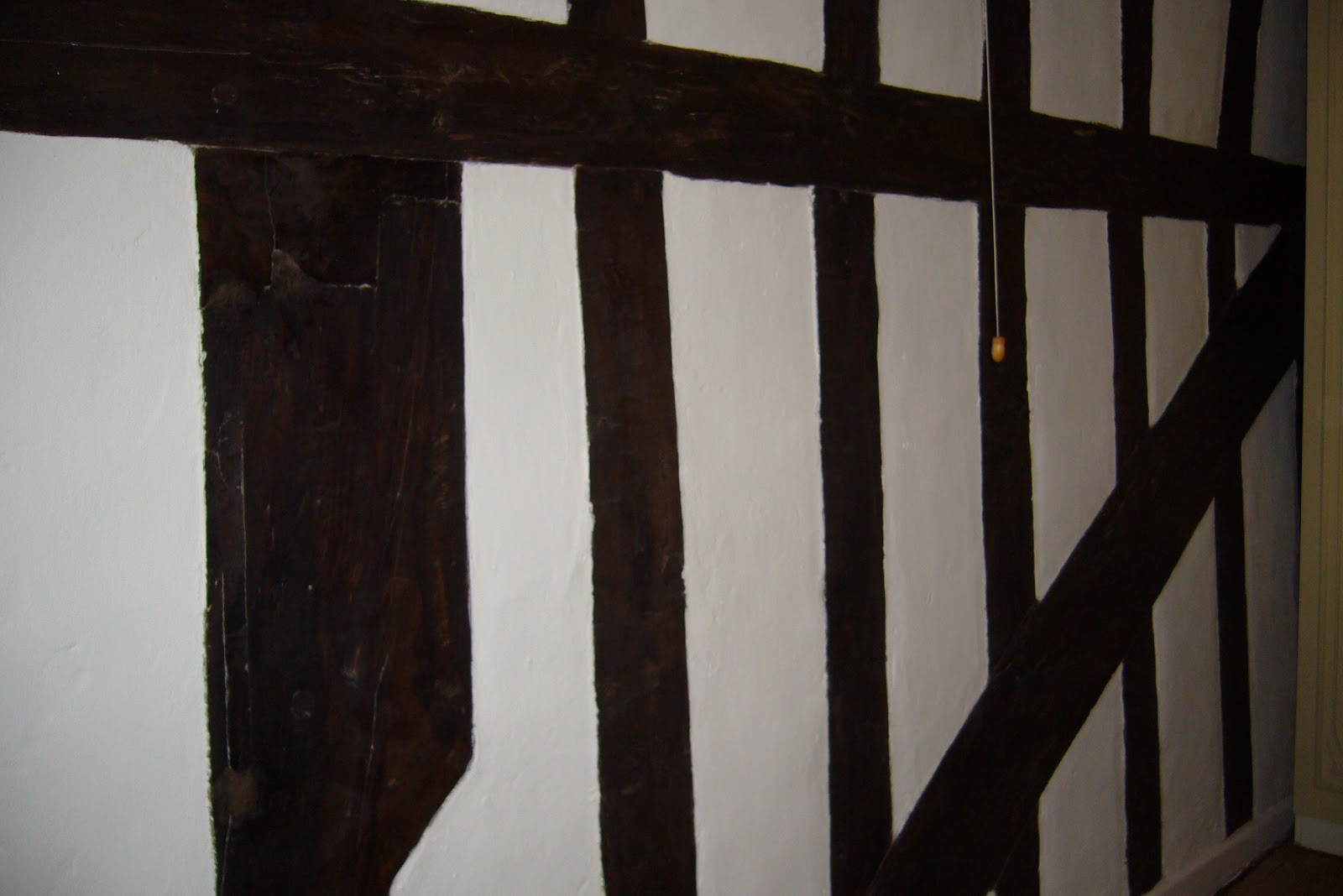
More on our beams.  These are the beams in our bedroom wall, the upper part of the end-wall of a hall dating to about 1400 - about the time of Chaucer.  A hall was a large  room open to the roof, with a central fire but no chimney.  The experts who visited explained that the upper horizontal beam would have been installed in 1636, when the roof was raised and the first and attic floors put in. 


The thicker vertical timber has filled-in slots where timbers for the front of the hall would have been, some three feet back from the current front of the house.  A detail which I had never noticed before is that these timbers in our bedroom are smooth, whereas the ones in the dining-room have been hacked all over to take a rendering of plaster.