Friday, October 29, 2010

Home Ground

Half-term and I feel as though I am "nivver off t'road", as my mother used to say.  First, we visit the in-laws in the Cotswolds on a bitterly cold weekend.  Somehow, freezing fog seems to gather over Stratford-upon-Avon.

Next, by train to this northern city, Carlisle, its streets studded with Georgian treasures like this one.

Georgian street in Carlisle.


To Wigton, birthplace of Melvyn Bragg, the very essence of a run-down and depressed small town, although this memorial looks bright enough.  Sample"crack" in the charity shop I visited:

"How come he had a 36 inch flat-screen telly when he was burgled and he's nivver had a job in his life?"

"Mebbe somebody was just pinching it back."

Highly edifying, but if one was planning a slice-of-life drama set in the north...


Wigton, Cumbria

To Caldbeck, where John Peel has his grave, and where the Wool Clip, and the cafe above it at the Priest's Mill, is a place of pilgrimage:

Caldbeck Church


Click the picture to read the date over the door on this cottage.

It was wet and windy while I was in Cumbria, but weather like that creates the most dramatic lighting effects.  Here, the play of light over the fells as seen from the A596.


Finally, knitting.  I travelled up by train and entered the usual conversation with a lady of a similar age to me, as I showed her my progress on the Aeolian shawl in the lovely Cascade silk.  Why is it that people imagine you could sell hand-knitted items at a profit, or that you would want to?

This last, a cushion made from a failed attempt at a Starmore sweater, which was impossibly bulky. The buttons are Icelandic reindeer horn, gifted to me by my sister.


Thursday, October 21, 2010

Period Details

A brilliantly sunny day last Sunday: so wonderful I cannot bear to be indoors.  We took down our bean row and began the last of the heavy digging on the allotment.  Courgettes, beans, leeks, swede and the two butternut sqashes -all gathered in.


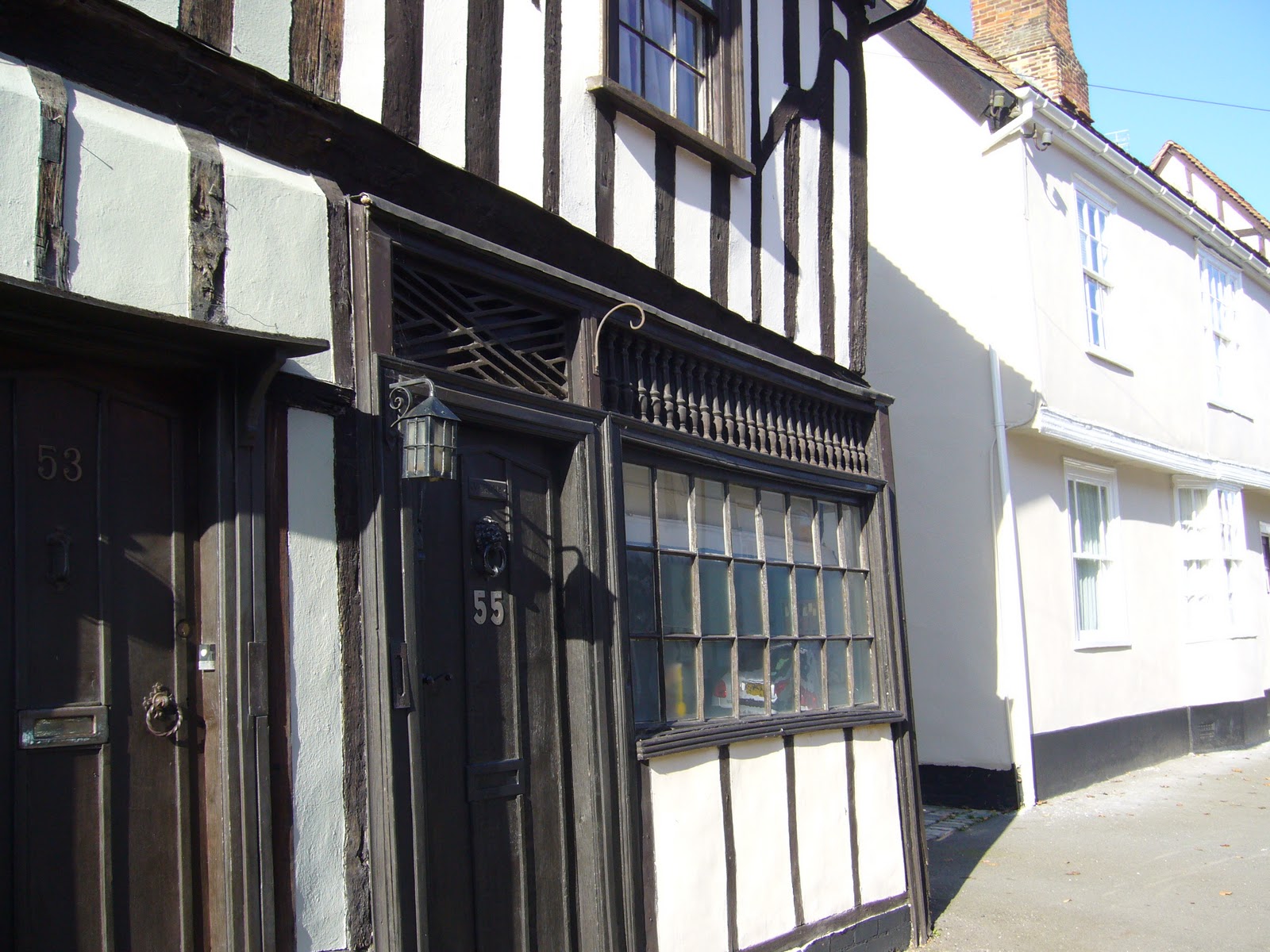
 A walk up Church Street takes you past some fascinating period details.  Bow-windows with bulls-eye glass:


Full timbered houses, some of which have been shops at one time:


Carved bressumers:


And woodwork revealing previous use as a butcher's shop;


A quaint, country inn:


And a clothing warehouse, last remnant of the trade that built the wealth of the area over the centuries:


At last to the church, St Peter ad Vincula, with its "flinty, fifteenth-century tower", as Betjeman has it, although, in this case, war damage necessitated a rebuild at that end.


I don't think that this is the brass of Thos. Paycocke and his wife, but it is of the right period.

Finally, this week's tweed.  I can't tell you how happy this fabric makes me.  It's a jersey base, with the other threads felted on to the surface.  At Ally Pally, I saw a commercial stall selling a coat with panels of this fabric.  I plan to make the usual basic  skirt, the only dilemma being whether to feature the plain edges as the hem.


Friday, October 15, 2010

Old Beams


I'm currently embarked upon an Aeolian shawl, using this glorious laceweight silk, bought at the i-knit Weekender.    What really strikes me about this, apart from the lovely colour mix, is the label.  This must be an American import but the silk is said to be from Switzerland.  So this yarn has crossed the Atlantic twice, at the very least.  Henry's Attic and Cherry Tree Hill both appear on the label, leaving me not much wiser.  Since I try not to buy air-freighted veg, it does seem that we might need to invent the concept of yarn-miles.


Last week the Clock Tower and now the National Trust property in the village: Paycockes' house.  This is a wonderful mediaeval merchant's house, the exterior covered in very intricately carved beams.  It is an astonishing survival, since less than twenty years ago, the main A120 thundered past it, bringing huge lorries through from Harwich.  Houses lining the route were blackened with road dirt, and it was not unusual for buildings to be nudged when two juggernauts met.

The lovely linen-fold panelling on the doors guarded by these mysterious figures.


Every small section bears its elaborate decoration; it's a treasure-trove of detailed imagery, and a constant delight, as every time you look, there's something more to see.


And what might these be?  They are Pocket Book Slippers - see Ravelry .  You insert your foot into one side and the ribbing stretches to become a Mary Jane type slipper. Not a very substantial slipper granted, but one for indoors on a cold night, or for hotel rooms. 

These were knit from two skeins of Art Yarns sent to me as a reward for knitting little hats for the Innocent Smoothies campaign, by someone called Amelia.  It is lovely smooth hand-painted yarn, but each skein is unique, as can actually be seen here, in the more yellowed and muted colours of the left hand slipper.

Friday, October 08, 2010

Markets


We are blessed to be living in a village with a long history - the clock tower dating from Victoria's Jubilee - and yet which still has an excellent butcher, a Spar and a Co-op which are open until late, and at least five functioning hostelries within walking distance.
But it's only now, when one of my free days coincides with market day, that we can really take advantage of the goodies on offer.  A well-stocked fruit and veg stall....


a huge array of artisan loaves and cakes...


and, best of all, fresh fish and a cheese stall offering about fifty different cheeses.  One could spend a fortune, and some do.


This week's tweed, now a skirt.  Some many years ago, my mother's eldest sister died and, in the clearing of her house, a box of textile items was set aside for me.  Last week, rummaging through our loft for a quite different piece of fabric, I lit upon this.  A quick soak in Wool Wash and an hour or two on the line and there was a yard of tweed in colours which were doubtless biding their time for this season.  The zip, lining and petersham together came to about four pounds, so I am well-pleased with this.


Today, to Ally Pally, to a market of a quite different nature.  The heat, the crowds, the over-whelming range of choices on offer - each year I vow "Never again" and each year I forget the discomfort enough to venture forth again.

Thursday, September 30, 2010

After Apple-picking


Two apples from our cordoned Bramley.  These two were from one spur: one pound two ounces and thirteen ounces.


Some time ago, I tried to install a site-meter, and was dismayed to find that it e-mailed each week to inform me that no one had visited - again..  How could this be, when I have two sisters and at least one colleague known to follow my blog? 

Last week, I discovered the Stats section of Blogger for the first time and was astonished to find that someone in Turkey has visited many times, along with visitors from India, Greece, Switzerland, Thailand....  I hope that they were not disappointed. 

Now, I have four followers, which I find very flattering, as I only follow two blogs and have a number of others on my Favourites list.

Recent posts have touched on the Celtic knotwork of the early 90s in knitting.  This quilt which is on the bed in our spare room, has a long history.  Some twenty-three years ago we had a snow-day - a rarity for us.  I intended to make it memorable and spent it cutting out the pieces for this Dresden plate patchwork, not thinking of it as a quilt.


 Once the blocks were completed and assembled, I thought to add wadding and backing.  Then I tried some simple outline quilting and discovered the template for the cabled sashing.


The navy valances needed some support from quilting.  Never one to be underambitious, I tried the feathered  ring, without grasping how to place the template accurately.


At that time, I realised two things: the wadding I had chosen was much too thick for hand-quilting and I didn't like getting my fingers needled so often.


I bought some Celtic quilting patterns from Ally Pally and I improvised some others by photocopying and enlarging, in one case a ceramic keyfob.  Celtic knotwork was in vogue at the time, on brooches and scarves.   I repeated patterns up each side.


Eventually, I had completed all but one roundel.  At this point Christmas visitors were expected, so I finished the edges without doing the final block.  That's how it remains, because that is the most complex block.

Friday, September 24, 2010

Random Harvests

Opal Socks


A pair of socks knitted in an Opal yarn I had not seen before.  Curiously, each colourway has the name of a Prince or Princess.  They are lovely colour combinations, richer in the yarn than in the photo.  In Selestat, in Alsace, I saw some yarn which produced a chequer board pattern.  These don't do that but they are more subtle than some self-patterning yarns.


The blue version has very small pink sections.  I chose to make the heel speckled, by selecting some from further though the ball.  The yarn has very clear colour repeats.


This week's dress-making features a lovely piece of tweed with a mid-brown base and pale blue and purple checks.  I bought this skirt-length in a sale in  Stratford some years ago: two lengths for £10.  This skirt has a pleat in the back to allow a bit more leg room - essential for getting into the car.  I am really enjoying getting back into sewing but it will take a while to build up my repertoire again. 

As a teenager, I made all my clothes using the hand sewing machine belonging to my mother.  She had bought it second-hand for thirty shillings - that is £1.50.  On it she made all our childhood dresses.  I recently came across the notebook in which my friend and I kept a record of what we made and where the fabric came from.  In the 60s it was still possible to buy fabric and all the notions more cheaply than you could buy ready-made clothes.  This would be a challenge today.  Fortunately, I have a stock of lovely fabric to work through.

Today was our shared day off, so my husband and I went up to our allotment.  Harvesting carrots, swede, leeks and using our own potatoes and onions I made soup for lunch.  Simple pleasures.

Friday, September 17, 2010

Handwoven


My knitted sample from Alice Starmore's class.  I had taken a spare ball from my throw and knitted a few rows before the class in anticipation.  Alice kept repeating "Read your knitting," as a kind of mantra, and of course it makes sense.  I always need a clear picture of the end product in sight, so that the chart comes alive, and not all patterns provide clear images.


Some more views of my throw.  I designed it for a specific location, where I already have a blue and white strippy Aran sampler throw. 


 My original intention was to adapt knotwork patterns from the Viking crosses found in West Cumbria, specifically the one at Gosforth.  There is a modern replica of this at Aspatria, where the knotwork is much crisper.


However,  I had reckoned without my inexperience in writing stitch patterns, so instead I used the knotwork patterns from Starmore's Cromarty sweater as the blue stripes.  Then I put together two Aran elements from Barbara Walker's "Treasury" for the cream stripes, which I felt needed vertical continuity.


The only element where I actually managed to do it myself is in the central panel.  Viking knotwork panels often turn out to be serpents or dragons with heads and tails.  I havered over the heads for some time, but, while on a long car journey, it came to me just to fudge it:  I opened up the cable I was knitting and made the outline of the head.  I then enhanced the mouth and added the ear and eye in embroidery.  I am more pleased with the device of having the heads face each other.  This would have been beyond me, so instead I knitted two strips and grafted them together - this is evident at the edge where I have not mastered grafting in moss stitch.


I am very pleased with it - so pleased that it is now in daily use in our living room, where it does not go with anything else colour-wise.

On a different note, I spent yesterday reliving my teenage years, knocking up a new item of clothing from a bargain length of fabric.  Some weeks ago, I bought two tweed skirt lengths from e-bay, for less than ten pounds the pair.  I would love to know what was going through the mind of the original owner who appears to have sent away for about five pieces of tweed from Strone House, Argyllshire, each autumn, but then never used any of them.  All these years later, I paid very little more than she did, perhaps because the seller suggested they might be slightly musty.  I know from musty, as the Americans have it, and these were completely free of must.

The hem is often the giveaway on homemade items, so I made use of the selvedges which provided a little fringe.  Keeping the orientation of the tweed  while doing this procedure cost me some thought but I managed it.

 Handwoven tweed, in lovely colours, and the knee-length skirt once more a wearable item in fashion terms.- - what more can one desire?


Saturday, September 11, 2010

Starstruck


Friday, and a day off, so I make my way to the i-knit London Weekender, getting off at St James's Park and walking over a few streets.
I'd booked the class on Celtic Knotwork by Alice Starmore, whose work I have admired since I first saw "The Celtic Collection"


I don't know what I had imagined - she has a ferocious reputation - but she was charming, friendly and helpful, patient with those having troubles.   Her accent has that Gaelic lilt, quite different from Scots but with the odd trans-Atlantic nuance.  In the picture you can see the wonderful purple cardigan she was wearing, the shaping achieved alongside the Celtic braids and cables.  It is a lightweight Aran and certainly looked quite different from the boxy affairs in Celtic Knitting", especially on her svelte figure.  She was wearing Westwood - either that or her tartan skirt had got caught up in her underwear, but no - it was Westwood.

This was my first ever knitting class, so what did I learn?  To be fair, other people all around me were having lightbulb moments, as they realised how those closed motifs are started and ended.  And I did grasp for the first time what was meant to happen at a crucial point in the manoeuvre.  But I had basically got my head round the method when I started my throw, or at least by the time I had finished it some eighteen months later.

No, what I learned was how to make use of an OHT without someone using the dreaded word "PowerPoint."  I learned something about how she began to design knots and a little about their life on a croft.  I also learned that she will be seen using natural dyes on an episode of "Coast" some time in the future, using a cauldron they unearthed in the garden of their croft, which sounds remarkably like the one I have standing in the centre of my garden which came from my parents' Cumbrian farm. 

Sadly, I didn't learn how to translate source material from Viking crosses into knitting patterns.  But it was worth every penny to have Alice Starmore declare my knitting sample excellent.


Saturday, September 04, 2010

What we did on our Holidays Part Two...


Strasbourg Cathedral
From Colmar, we moved on to Strasbourg - that's about fifty miles, but we were intent on making stress-free journeys this time.  Strasbourg cathedral has to be one of the Seven Wonders of the World.  We admired it in the sunlight...


And at night, at a wonderful son et lumiere presentation orchestrating dramatic lighting effects to Russian music.  Just a tiny part of me thought this was a terribly populist way to treat such an impressive and important building.

We climbed the tower - all 338 steps of it - and looked out across the ancient town....


and we spent ages looking at all the intricate detailing, from gothic statuary -


to ancient and extremely fine graffiti...


We did our best to sample the local cuisine, although choucroute and three types of sausage did not suit us.  The local tourte flambee - a very thin type of pizza - was more to our taste, and when we saw a version with apple slices bathed in blue flames from the Calvados poured over it, we knew we had to try it.