Sunday, May 26, 2019

Hawkshead, again.


A week in the old farmhouse just outside Hawkshead, with our friends.  We were blessed with the most beautiful weather, unlike March when we never saw the sun.  The property is set in extensive gardens running up against woodland, so we were surrounded by birdsong.  Each evening we were able to sit out on the terrace overlooking the valley and eat our evening meal.  We enjoyed it all the more for its rarity.

Bluebells were out in force in the woodlands and we did many low level walks to tarns and beside lakes.

On the Monday we drove through Sawrey to the ferry across Windermere, and on, via a garage where our car needed some attention, to Blackwell, the Arts and Crafts house.


 We had seen that the current exhibition is of furniture made by The Rusland Movement.  My husband has made a bit of furniture himself, so we were interested to be able to hear their designer explaining some of the processes involved.  


Some of their pieces are just the sort of thing one could find room for.


Their clients commission pieces to fit specific spaces.  I don't seem to have a picture of the cocktail cabinet, with slate shelves and quilted lime-green leather interior but if you had a spare eighteen thousand you could order one.


This settle was made specifically for the exhibition, for the white drawing room. The back is not one piece of wood, but twenty layers of sycamore veneer glued together and bent in a jig to form that lovely curve.  Such ingenuity.  

Friday, May 03, 2019

Red Letter Day

This is Red Letter Day by Fiona Ellis.  Curiously, there are only three projects up on Ravelry for this design, although it is relatively straightforward for quite a spectacular effect.

It begins like Geiger with some ribbing.  I shortened this by six inches because I am short and it would have been coat length.  There is only one chart for the cables and it is repeated up the back to a certain point and then only the simpler element used above the armholes.

Exactly the same cable is split across the fronts, adding to the impression of military style braiding.

I went for bronze buttons with a crest because brassy ones distracted from the cables themselves. The only technique I added was to use a two stitch I-cord bind-off on the front edges, which worked really well.  

This is a budget yarn, designed I think for toddlers, but I was drawn to the strong colour.  I'm now imagining it done in a pure wool, perhaps in a deep green, and worn with a tartan skirt with a suggestion of kilt about it.  If one went to events where that sort of thing could be worn, that is.


Wednesday, May 01, 2019

Tulip Time


Ready for a visit to Paycocke's House?  You enter by the cartway at the side.


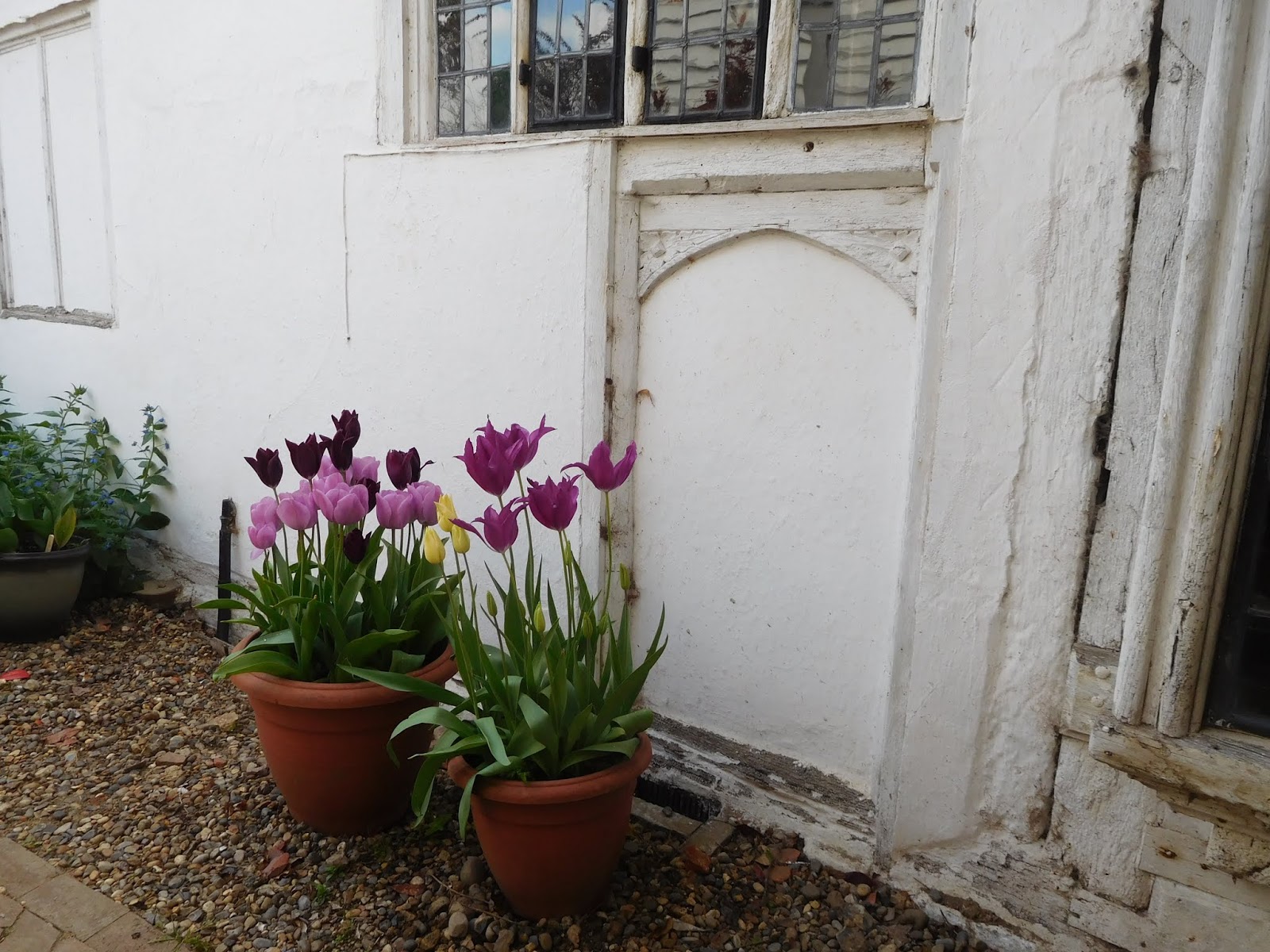
Multicoloured tulips set alongside old entranceways.


The wisteria in full swing above the door to Reception.


Tubs of tulips against the backdrop of the garden.


And my most recent finished item.


This is a pattern called Red Letter Day, and I could see this being worn for a special event.  Complex closed loop cables run down the sleeves and the back, so that the whole effect has the air of a dress uniform ornamented with braids.  It was curiously straightforward to knit, and is a great fit.


Monday, April 01, 2019

Memorial


To Cumbria for the memorial service for my aunt, the last of her generation.  When someone dies at ninety-five, full of years, there is a sense of completeness.


This is St Mungo's church, Bromfield.  There has been a church here since Norman times and possibly earlier.  My mother's family went to primary school at Bromfield, walking the couple of miles from their farm.  Whether they actually attended this church is less certain, as in those days you were "church or chapel" and I think that they were "chapel".


My cousins had prepared a summary of the key events of my aunt's early life: losing her mother at eleven and having to leave the grammar school at fourteen since the family moved to a more remote farm.


At nineteen she joined the ATS.  World War Two was in progress but she was a cook in barracks at Edinburgh, so it was a positive change for her. After the war ended she continued to work as a cook, moving from job to job as the fancy took her.


In this same churchyard is buried my cousin Betty, whose death from polio at the age of eighteen plunged her family into tragedy.  My aunt returned home to care for her elder sister. It was a devastating loss.


The churchyard is full of early nineteenth century tombstones, moved over and ranked in rows.  They tell of families in which every child died in infancy, or of sisters dying in their twenties, perhaps of TB.  

The wind sweeps through this churchyard, across open farmland from the Solway Firth, but these memorials are remarkably well-preserved, dignified as standing stones.


Tuesday, March 26, 2019

Spring flowers...


Apologies to those of you still waiting for the thaw.  After that false Spring at the end of February we have had high winds and rain, hail and sleet.  But here we are at the end of March and everything is getting back on track.


Snowflowers still going strong alongside self-seeded primroses.

 Grape hyacinths - that lovely strong blue.


And daffodils under the window of Paycocke's House in the early evening sunlight, the incised carving showing to perfection.


Thursday, March 14, 2019

Cables


Remember this?  This is a sample panel knitted from a mystery chart posted on a Facebook group I belong to.  The sweater it relates to uses two of these panels side by side up the front to create a very modern take on the cabled sweater - asymmetric and unusual.

I prefer a balanced, symmetrical approach, but I also like a challenge.  Someone at the Spinners and Weavers group asked me if I chose my knitting patterns solely on the basis of the level of difficulty.  Perhaps I do, but this would not qualify - it's a very straightforward chart with only one cable crossing at a time.

So then - how to make it into a jumper since there was no pattern as such?  I had decided on a DK weight yarn and went out to buy a denimy blue.  I bought 700 gms of an unusual colour somewhere between a mustard and an acid green.  It actually took about 425 gms, but better safe than sorry.

I knitted a little swatch - cast on thirty stitches and knitted about ten rows.  Then I checked how many stitches per inch I was getting.  Answer 7.  So I just multiplied half my hip measurement by 7 and that gave a notion of how many to cast on.  I used a twisted rib.  The panel was 41 stitches wide so two plus a one stitch divider gives 83.

We scanned in the original chart and found a way to flip it so that the cables could be mirrored rather than placed side by side.  This was a good decision, since it added the symmetry I was looking for.

The armhole decreases followed a standard shape for a set-in sleeve and then I had to decide where to scoop the neckline.  This took two tries since at first it was too high when I offered it up. Alongside the front I began the plain back in reverse stocking stitch and finished that at roughly the same time so I could tack the pieces together to test the fit.

So then the sleeves.  Measuring my biceps gave me the target width for the top of the sleeve, multiplied by 7 which was the stitches per inch.  Measuring my wrist gave the starting point for the cast on.  It happened that the row gauge was also 7 so I knew if the sleeve seam had to measure 17 inches how many rows I had in which to increase from the cast-on stitches to the top of the sleeve measurement, so that gave the rate of increase.

I did try picking up the sleeves and knitting top-down but the pick up looked ugly in the reverse stocking stitch  so I went with separate sleeves.  I knit them both at the same time flat on straight needles.  I used the instructions for the sleeve-head of Geiger as it is a complex shape, but once I had sewed them in place it was clear that they were too deep so I took them back and shortened the sleeve-head by doing the same number of decreases but in fewer rows.  They fit much better now and should settle in wear.

I decided to use an applied I-cord to finish the neckline - simple and quick.

All this is why knitting is not what you might call a mindless activity.


Sunday, March 10, 2019

Malmesbury


To Malmesbury, an ancient town along the M4, once  the site of an abbey.  The town stands on a hill between two rivers so it was an obvious choice as a settlement.


This is what remains of the abbey church.  In about 1500 the spire, taller than Winchester's, collapsed.  Then the dissolution of the monasteries saw the abbey buildings sold off and bought by one William Stumpe, an immensely rich clothier.  He gave the nave of the church to the parish as a parish church, meanwhile building himself a rather nice mansion using the abbot's house as its base and robbing out stone from the church itself and causing the tower to collapse.

It's still an astonishing building.


The porch, with its romanesque arches, is particularly fine.


Once there would have been a procession of pilgrims coming to pray.  This strange little cabin was apparently an early surveillance system manned by the monks.


So this is what we had come to see: a memorial plaque to the lady we have been researching this winter.  She died in 1631 and one of her daughters put up this plaque to her memory.  She was a grand daughter of Thomas Paycocke, the clothier responsible for the building of Paycocke's House where we volunteer.  The man she married - or one of them - was the second son of William Stumpe, and they lived in the Abbey House.


Malmesbury was a centre of conflict during the Civil War, but the ancient town walls are still clearly evident.

It is a really interesting place to look round and well worth a detour.


Friday, March 01, 2019

February


February, and one of the warmest on record.  We continued work on our allotment, planting up the whole onion bed.  Usually, February brings the rain and in Essex that means that all the field paths are turned into quagmires.  But not this year. No good will come of it, as someone said.

We enjoy walking along a secluded ancient lane - Pantlings Lane - several miles from our village.  Oddly the village church is clearly visible in the distance, even though it is at the other side of the village.  There is a small rise leading up through the churchyard but it certainly does not stand on an obvious hill.


So far, so bucolic -   but look the other way, over the hedge and there is this enormous gravel workings excavating the gravels laid down by the River Blackwater.

After all that charity knitting, something new.  Someone posted a link to a site in Russian which included the chart for an unusual cable design.  Now, I'm not really a fan of asymmetry, but this one has some appealing features.  On the original, the cable panel was repeated twice across the width just placing the panels side by side.  I decided to mirror-image the panels which introduces some symmetry.  As people used to say: you won't see yourself coming and going in this.

Thursday, February 07, 2019

January

 January - and it started out so mild that we were able to make headway on the allotment for the first time in years - the soil was light and friable - good digging weather.  Thursdays were housekeeping days at Paycocke's so lots of polish was rubbed into floors, ready to act as a sacrificial layer.

A day in London, meeting family for lunch just opposite HMS Belfast.


 A pair of fingerless mitts, making use of, but never quite using up some of the pile of scrap yarn in the house.

Making progress on our research task for the winter, a trip to Lavenham seemed like a good idea - this is the Guildhall.  The weather here was bitter, while the rest of the country was under six inches of snow.


And more fingerless mitts.


Our regular winter walk at Marks Hall arboretum  So cold that the lakes had frozen over.


A Fair Isle hat, surprisingly successful and using up almost all the dark green yarn bought all those years ago at Coldharbour Mill.


Is it possible to knit too much?  My finger joints seem to be saying yes, so I am trying not to knit during the day.  This is what I sent off to Knit For Peace at the end of January.