Wednesday, October 03, 2018

Sheringham Park and Blakeney Point.

The weather continuing fine we were able to enjoy a range of outdoor activities.  Near the seaside town of Sheringham lies the National Trust property, Sheringham Park.  However, here the house is tenanted and not open to the public.  Instead it is the wooded parkland laid out by Humphrey Repton, on of the great landscape designers, that is the draw.


We walked out across the park and climbed up to a wooded rise topped by a Gazebo.  We had no idea what to expect, but it certainly was not what we found.  The trees at the top of the rise are mature oak trees.  The gazebo is a structure of oak and metal, with flights of stairs up to a viewing platform above the tree canopy, a most peculiar experience.


We were just surveying the view when we heard the unmistakable hooting of the steam train.  A moment later and it hove into view, crossing the landscape in front of us.  We could not have timed it better if we had planned it. 


The following day we set out in some trepidation for Blakeney Point.  This is a nature reserve at the end of a long - very long - shingle spit.  With the tide in we would have to walk on the shingle bank,
every footstep taking double the effort.


As luck would have it, the tide was out, exposing the firm sand of the beach, a quite different proposition.  
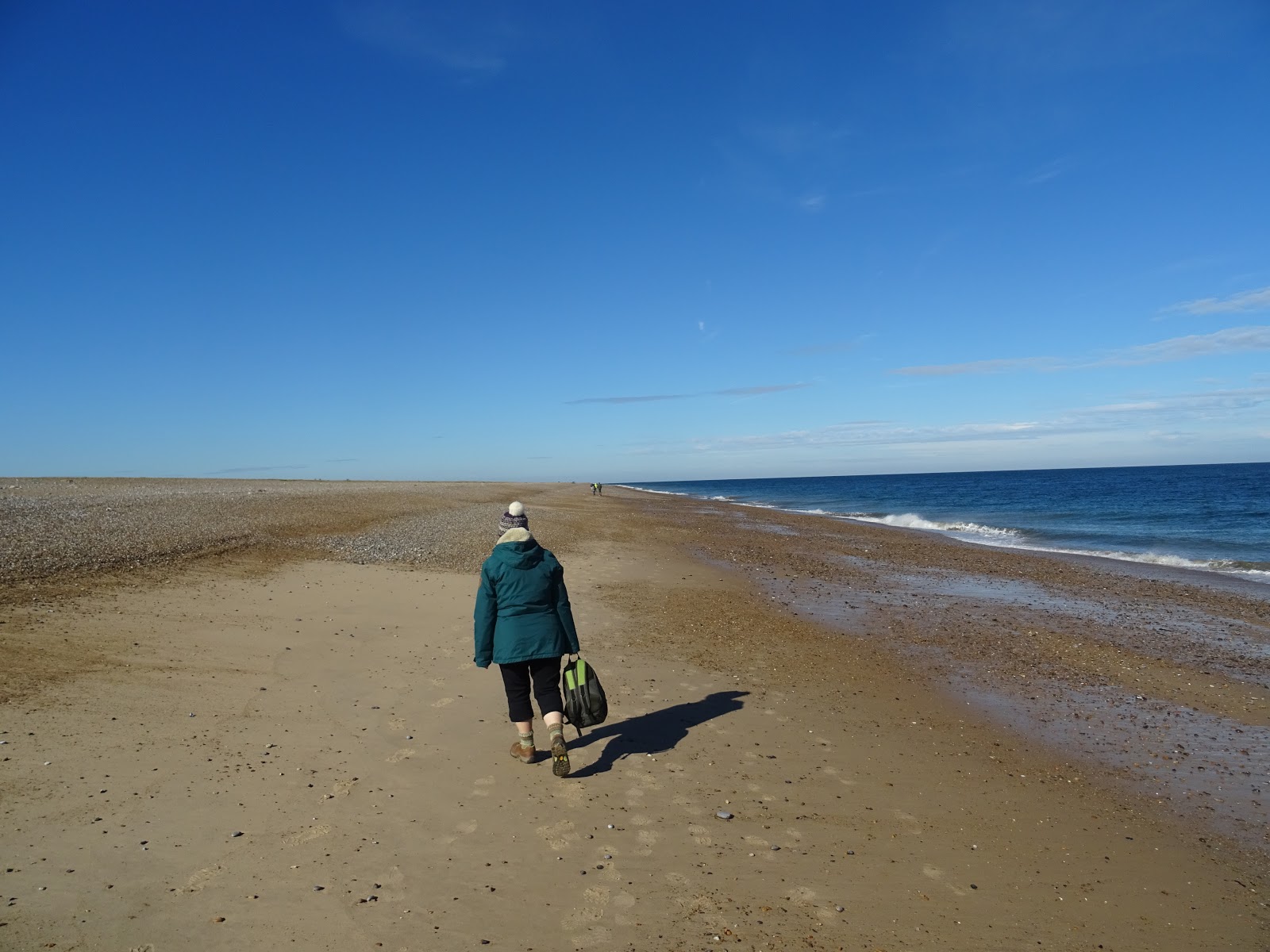
It was still a lengthy and unvarying trek, but the sun was out and the wind was in our favour for the return journey. In the dunes at the far end is a disused lifeboat station, now a visitor centre and field studies base.


At some distance, basking seals


So then we walked the four miles back along the beach for tea in Blakeney itself.


Tuesday, October 02, 2018

Fellbrigg


Not ten miles from Blickling is Fellbrigg, now also owned by the National Trust, and of a similar date.  This is the one for those who love stories of  eccentric ancestors.


One of the Wymondhams went on the Grand Tour around Europe for four years and returned with so many works of art that he needed to add a wing to the house to fit them all in.

Another returned engaged to an older lady in Switzerland, a long engagement followed by an expensive settlement for breach of promise when he found love with someone more locally.

The art installation here explores the idea of a cabinet of curiosities.  The curator of the piece was allowed access to items store in the attics which were then assembled in various ways.  This was certainly an improvement on the torrents of books, as far as we were concerned.  But, in fact, you did not need to hunt through the attics to find oddities.


My husband assured me that this is not what it seems!  Apparently oil from sperm whales was used to make candles.

And what about this?


Imagine trying to lift this when full of boiling water.  The whole kitchen was a delight for the eye.


In contrast, the dining room looks quite cold.


We took a stroll around the parkland: mature trees, a lake and its own church.


This is another church with fine ancient memorial brasses in the floor, covered with drugget and carpet pieces to protect them.


Perhaps the most eccentric of the Wymondhams had developed the habit while at Eton of dressing up as a train guard and going down to the station to join in the running of the railway, causing havoc.  He would have been happy at the Sheringham to Holt Steam railway. Later, he was caught by a lady of dubious virtue who robbed him blind, causing the house to be sold.

Fellbrigg is certainly worth a visit, if you are in the area.


Monday, October 01, 2018

Sheringham to Holt

So, to Holt on the North Norfolk heritage railway, pulled by steam engine.  Nostalgia is a huge selling point here.

They have regular events where people turn up dressed for the 1940s and take the trip in vintage carriages.


 The railway has a collection of rolling stock, not all of it for passengers.  Most of the staff are retired folks who have dreamed of wearing the cap and waving the red flag since childhood.


It has to be said that once you are in the train it does not feel all that much different to a regular train, but the engines certainly look impressive.

Holt itself is a lovely little town crammed with independent shops, antique shops and eateries.  Disposable income floats like a haze in the atmosphere here, as we found in Cirencester last year.


All across the town are outposts of the famous Greshams public school, which probably adds to the sense of tradition and exclusiveness.


We had a very relaxed day out.


Sunday, September 30, 2018

Cromer


We explored Cromer, once the fashionable capital of Poppyland .  It's a place of faded grandeur.


...but also doing rather well for itself now, perhaps because it is easier to reach from London than many other seaside places.


The church is unmissable, its tower prominent from afar.


Its a wonderful light, airy building.  Of course, we had to go up the tower.  Half-way up is a sign saying "Only 88 steps to go".
  

Extensive views in all directions.


We paid for the climb the next day, though.

Then it was on to the Lifeboat Museum commemorating Henry Blogg who rescued literally hundreds of people as Coxswain of the Cromer boat up to and including World War Two, by which time he was in his seventies..


One of our favourite programmes just now is "Saving Lives at Sea", perhaps because it is the perfect antidote if you believe the world is going to hell in a handbasket.  The daily selflessness and heroism of those lifeboat crews all around the country restores your faith in humanity.


Saturday, September 29, 2018

Blickling


North Norfolk abounds in large estates surrounding historic houses: Blickling is a particularly fine example.  So fine, we went there twice.

  On our first visit we looked round the house and saw their current exhibition: The Word Defiant. This is an installation mounted by a theatre company looking at books from a number of angles.  Thus a copy of "Winnie the Pooh" shelved between other books, making the point that it remains a banned book in China. 

In an upstairs bathroom a bath and hand-basin were filled to overflowing with books.  In a cellar, books embedded in black ash to represent libraries burnt in conflicts.  

Most controversially, in the historic library a torrent of books flowing down from the shelves and pooled on the floor.  

This was certainly an exhibition which divided opinion.  Some found it thought-provoking, but for many it seemed that the sight of so many books thrown about and mauled was distressing, even books destined for pulping.


On our second visit we hired bicycles from the store and cycled round the estate through woodland and across parkland.


Then we looked into the church.  This is a house once occupied by the Boleyn family, although I don't think that Anne Boleyn was born here.  The church has a fine collection of brasses

.


How about this couple with their numerous brood? That's eleven sons and five daughters.


And, of course, we finished with yet another National Trust tea.


Friday, September 28, 2018

Flinty


 What country, friends, is this?


 Rolling surf, usually attended by intrepid surfers, even at eight in the morning?


Historic piers, offering surprising end of pier entertainments?


And, everywhere, locally caught sea-food, crabs a speciality.

This is the North Norfolk coast where we chose to holiday this year.  Last year, Vienna; this year, Cromer.


Very distinctive is the local building material: flint, here deployed in orderly rows.


And here, tightly packed together.


Sometimes, very small beach pebble was used instead.


Or, flakes of flint were tightly packed into the surface, as here: Flint House.


Imagine the labour involved in this technique, which we have only ever seen used to protect the mortar between larger building stone.

We had lovely, late summer weather all week which enabled us to see and do lots of things.  More later.


Thursday, September 20, 2018

Geiger 2

Pressing on with the knitting of this cabled design by Norah Gaughan.

So, now I have knitted both sleeves to about the sleeve head shapings.  I'm pausing them here so that I can check for length.


I've knitted the back up to the end of the first chart.  I've done the first set of waist decreases alongside the chart pattern.

This has not been a difficult knit so far, although the chart is so straightforward that it is easy to lose your place in it.  It's the sort of knitting that you can easily do while watching television.

It took me two tries to master the short row section, partly because I had not read the explanation of why they were needed on the back of the cardigan - it's apparently to compensate for the distortion caused by pattern-shifting.  So, the wonders of YouTube helped me to locate a very clear tutorial on how German short rows actually work.  They seem invisible on the right side of stocking stitch and less so on the reverse, which is what we have here, but it's OK.

I'm expecting to have to concentrate a little to get my head around pattern shifting, but it seems simple enough.  The sad thing will be if the whole thing does not fit well at the end after all this tailoring.