Tuesday, March 06, 2018

When icicles hang by the wall....


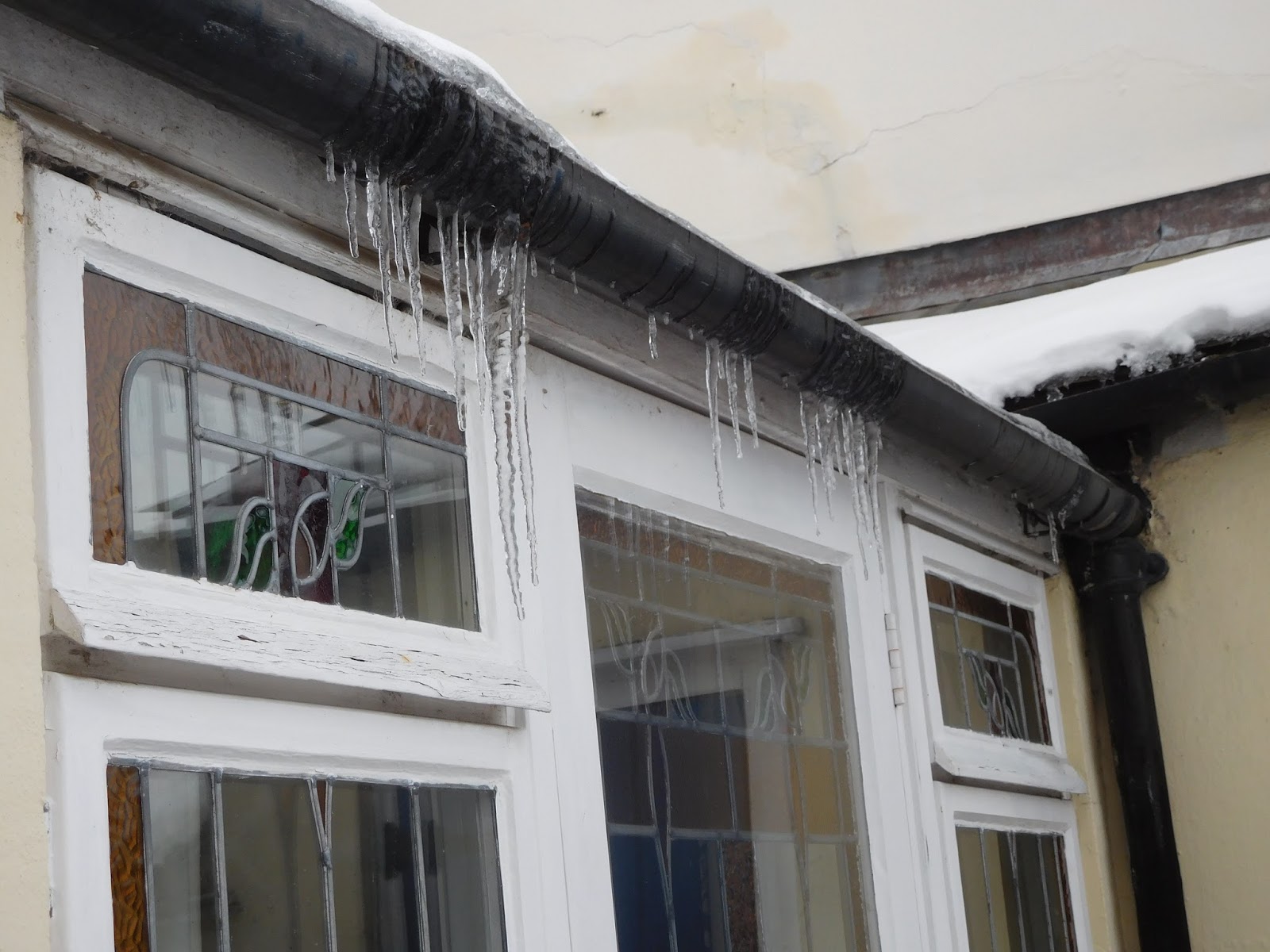
As the thaw started so we saw some spectacular icicles on our kitchen roof.  It's all gone now of course, but on exposed country lanes the snow is still banked up at the edges where it had formed drifts.  Surprising how quickly the whole country can be shut down like this.


While the snow coverage was at its height we actually had a pair of fieldfares in the garden.  These are ground feeders and they floundered about in the snow.  This is a song thrush: a pair of these appeared for the first time in years.  We saw evidence that they had winkled out some snails.  Here, he - or she - is just sampling some of my home-baked bread.


This is the Odds and Ends hat, this week's effort, with bought faux fur pom-pom.  

And, finally, the collection of hats made from Milarrochy Tweed.


Thursday, March 01, 2018

Tweedy


This week's hat: Tweedy.  The yarn is called Milarrochy Tweed and this has a tweedy look to it.  I have alternated panels of broken rib with panels of dogtooth check.  Then the crown is just little squares and rapid decreases.  This one fits better than the other two and is very cosy as the ribbing makes for a thicker fabric.

In my many years as an English teacher I must have read the play "The Thwarting of Baron Bolligrew" many times.  In it a diverse group of characters set out to paint a basket of eggs for the market to a time deadline.  The actual egg-painter produces his usual quota of professional eggs, the quixotic Mike Magpie produces a few works of great imagination and the hero, Sir Oblong Fitz Oblong, knocks out a large quantity of rather ordinary eggs.  

Looking at the entries for the hat competition one can see all these qualities on display.  There are certainly some very polished efforts and one or two quirky works of genius.  Mine are at the Oblong end of the spectrum. I realise that, although I don't often knit to a pattern these days, what I habitually do is bodge together bits from a range of sources.  This is fine when it's an item for one's own use but can hardly be done for a competition.

And yet...  I do wonder what kind of copyright applies to collections of patterns such as Barbara Walker's first book.  Or what about Co Spinhoven's charts for Celtic patterns?  If you corner the market in charting out these designs, can no one else use them in a design?

While thinking up ideas for these hats, I wondered about knitting in some text and came up with some catchphrases - "Walkies" was a case in point.  Looking on Ravelry, I find that someone has already designed items under that name.  Do they then have copyright on it?

It has to be said that there are thousands of hat patterns out there and the chances of being totally original without being plain outlandish seem pretty remote.

Wednesday, February 28, 2018

Snowfall


The view from our window, first thing this morning.


Overnight, a good six inches of snow piled on every surface, even the caps of the bird feeder. 


This afternoon, the park under snow.


And the river, not frozen over.


The church and, opposite, The Woolpack Inn. 


Friday, February 23, 2018

Greywacke

In 2014 we went on a trip into Galloway which is just around the corner, as it were, into southern Scotland.  You drive north east to Carlisle, on to Gretna Green and you are across the border.  Whereas on our side of the Solway Firth  red sandstone forms the characteristic building material - indeed our own terraced cottage is built of it - it is a different matter on the Scottish side.

                                         We drove down to Kirkcudbright and on from there to Whithorn, a very early Christian settlement.  At Whithorn there is a ruined abbey with a museum.  In the museum is a truly breath-taking collection of early carved crosses.  These have round heads with incised circles and the shafts are decorated with interlaced Celtic knotwork.

This is all the more remarkable because the nature of the local stone is very resistant to carving of any sort.  The name of that local stone: Greywacke - great name for a rock, no?  Essentially it is a type of grey sandstone, a sedimentary rock of the Lower Paleozoic, but it has embedded in it all kinds of fragments, of subtly different colours.

One of the colours in Kate Davies' new line of yarn, Birkin, put me in mind of the stone colours in Greywacke, especially when it has a little acid yellow lichen in its weathering.

This is the thinking behind my second hat design.  I also wanted to see how well the tweedy yarn behaved when cabled - would it have enough definition?


I began by making some simple cable crossings on my sample piece.  But I wanted to echo the incised circles of the Whithorn crosses without going into full-on Celtic knotwork.  So I brought the two cables together, in the simplest way possible. I pondered on adding bobbles to the centres and decided against.

Obviously the definition of the patterning is not as crisp as it would be in a smoother yarn, but I am still pleased with the result.  Soaking the cabled strip before blocking made the mohair content bloom, which again adds a kind of misty softness.


I had thought to go for a tweedy texture for the crown of the hat and tried reverse stocking stitch at first, but I prefer the contrast of the smooth surface with the patterning of the cabled strip.


This is a light hat but I could see it becoming a favourite.  It's less of a statement hat than a Fair Isle can be, but it is making a statement nevertheless.


Monday, February 19, 2018

Designing hats


Some of you may have come on over here from Ravelry.  This is my first entry for the hat design competition to promote Kate Davies' yarn Milarrochy Tweed.  I was really pleased with how this turned out, not least because this is only the second time I have charted and knitted a crown design like this.


Now, you might recognise the pattern on the main part of the hat if you have seen my brown Museum waistcoat from last year.  The point of the design is to use the classic OXO configuration but to use five different lozenge patterns.  This increases the interest, for the knitter as well as the wearer, but it does require a bit more concentration since there are five separate patterns to keep track of in each row.  Having it all charted out makes this possible, so I drew it all out on knitters' graph paper.


So now, this raises interesting questions.  If this is a design competition what sources would be valid to use without breaching copyright? If you collect traditional patterns together and chart them out, does that give you the copyright on those patterns, or only on the charts?  This is particularly relevant with stitch directories where surely the compiler cannot claim ownership of those combinations of knit and purl.


Once I had finished knitting, I gave it a bath and then chose a saucepan with the same large circumference as my own head to block it on.  This stretched out the crown very nicely, but it did look very odd while it was drying.

Julie (See Comments), you will be relieved to know that after a quick wash and brush up we were able to go out for a late but civilised lunch last Friday.  My husband commented on how the whole adventure made the contrast even more enjoyable.


Sunday, February 18, 2018

Allotment tales

A brilliantly sunny day, and we are due to go out for lunch.  One of the pleasures of life, for my husband, is to get smartened up and to enjoy eating in style.  I'm happy to share in this, although if it is sunny I prefer to be outdoors.

So it came about that we nipped up to the allotment to continue some of the repairs to winter storm damage and generally poddle about in the sunshine before setting off for our meal out.  We finished in good time, loaded the car and headed for the exit.  Then it all went pear-shaped.

It has been quite a wet time here recently and the ground at the allotments is not well-drained.  This includes the little roadway, no more than a few yards, leading from the parking place to the gate.  Somehow I misjudged the speed or the line or something.  The car slid, the wheels spun: I could make no progress.  My husband tried.  We shifted a few feet.  We enlisted the help of another allotment holder.  We pushed: nothing.  After about half an hour of this, covered in pocks of mud thrown up by the spinning wheels, we called it a day and walked back to the village centre.

My husband went straight to the council office to take advice.  Yes, they did know of someone with a tractor.  Yes, he would ring us back.  So we found ourselves back at the plot in our other car.  Through the gate came an elderly gentleman on an absolutely pristine grey Ferguson tractor, clearly his pride and joy.  He backed into position, produced a brand-new orange tow-rope and hooked it to the back of our stricken vehicle.  Within seconds he had towed us clear of the morass - and all without a speck of mud hitting his vehicle or his rope.  I expect he went home and hosed down the tyres.  We were very grateful to him.

In about 1950 my father started farming on his own account, taking over a hill-farm "Lock, stock and barrel" from his uncle.  This included a working horse, but soon this was replaced by a small grey Fergie tractor, the double of the one that came to our rescue.  This must have revolutionised his working life as the Ferguson featured a hydraulic lifting system for attaching implements, such as ploughs, harrows and haymaking tools.  It was a wonderful machine - and still is.

Thursday, February 15, 2018

Evergreen details

Thank you for your comments.  The waistcoat came out better than expected and I seem to have mastered how to shape the front edge so that I don't have to adjust it when picking up the front bands.

You ask about I-cord buttonholes.  Warning:  If you are a visual learner You-Tube is your friend.  Like many things, it is easy to do but quite complex to explain clearly.

  On the armholes I simply applied the I-cord to the edge, by casting on three stitches and knitting them.  I lifted one edge stitch on to  the left-hand needle and transferred the three stitches back on to it.  I then knit two and knit two together through the back loop, thus attaching the I-cord to the edge.  And so on, until I had gone right round the armhole, just changing colour for the front.  The effect of this is that it looks as if the cord encloses the edge completely.

For the buttonhole band, I began by picking up stitches right along the front edge, this time pulling the working yarn though each stitch.  Then I purled back along the row.  Now I was ready to do the I-cord.  So I cast on three using the backward loop method and transferred them to the left hand needle where the picked up stitches already were.  I knitted two and knitted two
together through the back loop, so using up one stitch of the picked up stitches and effectively casting off in I-cord.

I had already worked out that if the buttonholes were two stitches wide, I needed to work 13 stitches between them to ensure even spacing.  At the start of the I-cord, I worked two stitches, then the first buttonhole.  I just lifted the next stitch over its neighbour and repeated this to cast off two on the picked up stitches.  Then I worked two rounds of I-cord without attaching it before starting to attach it again.  This leaves a gap between the I-cord and the cast off stitches which makes a very neat buttonhole.

I assure you that it is really easy and actually much quicker than knitting buttonhole bands in rib.

I was very pleased to be able to use up a few of the antique buttons I bought from a boot fair some years ago.  These are dark mother of pearl with a stem glued to the back.  They seem to complement the design without distracting from it.

Today is the fifteenth of February.  I ate my lunch on the bench on our patio, in brilliant sunshine.  Yesterday a gale was blowing and it was what we Cumbrians call "pickling" or "starvation".  But today was a different season altogether.

Sunday, February 11, 2018

Two finished objects

Like most knitters, I have a few unfinished objects lurking in cupboards.  There's that oatmeal cardigan from last year, still half done.  It would have been just the ticket in the raw cold weather we are experiencing at the moment.  But it stalled when I realised that the two lots of yarn I had to have in the charity shop may have been the same colour but were different in other ways.  Not sure it is worth resurrecting.


Here we have a shawl/ scarf which I have knitted before, but in a lime green.  This is Afetos, knitted in Jaeger Alpaca.  It is a lovely blue-grey but the project stalled somewhere in the last big band of garter stitch.  It's finished now, though, and on the lookout for a good home.

And here is the Evergreen waistcoat.  This has been on the needles a while but not because it was resting.


Remember charity shop jumper - £8.99 -  from which I sourced most of the yarn.  The dark green stripe, in bright sunlight, has that wonderful tweedy richness.  Now it is the back of the waistcoat, dull in lamplight and lovely in the sun.


The fronts went through some transitions before arriving at this finished state.  I find it easier to visualise things when I see them in place, so if they look wrong I have to rip back and reknit.


On previous waistcoats I have felt that ribbed armhole edgings added unhelpful width on the shoulders.  This time I finished the armholes with an I-cord edging, just to neaten them.  So then, on the fronts, I wanted to use I-cord buttonholes, so I picked up and knit the stitches and then cast off with I-cord including the buttonholes in the cast-off.

I'm very pleased with how this has turned out.


Wednesday, January 31, 2018

Chancery Lane


To London, to have lunch with my younger sister at Brasserie Blanc, in Chancery Lane. Or, in my husband's case, memory lane, as this was the area where he spent a year reading for the Bar, more years ago than he cares to recall.


We filled in some time by going off Fleet Street to visit the Temple Church, first established in the twelfth century.  This is an area of London in which time appears to have stood still - ancient quadrangles and courts, free of traffic.  Of course, this is an illusion as there was bomb damage during World War 2, but the buildings were restored.


This is the monument to William Marshall, Earl of Pembroke.  We came across him not only in Pembroke Castle where you might expect, but also in Cartmel Priory in south Cumbria, at the other end of the country.


A current exhibition focuses on the stories of the very many members of the Inner Temple and the Middle Temple who were killed in the First World War.  It's very moving.


After a delicious lunch, we strolled back up Chancery Lane to Lincoln's Inn Fields where we visited the Sir John Soane Museum.  This was given to the nation in 1824 and is a group of three houses adapted to accommodate the collections of Sir John Soane who was the leading architect of his day.  It is certainly unique.  His Picture Room contains works by Hogarth and Turner with paintings hung on a system allowing them to be shown in rotation.  It is a collection which inspires amazement, more than anything else.

And this is a Little Owl, basking in the sunshine.   We have seen him there many times, but this is the first time he has been caught on camera.

Tuesday, January 23, 2018

Evergreen


Not hard to see where the name of my new waistcoat comes from.  you will notice a difference from the early sample below.  Off-setting the little trees but keeping the rows distinct led to a rather bitty design which was not doing it for me.  Curiously, tessellating the pattern gives it the movement it lacked and makes an all-over fabric, instead of rows.  I like this much better.


Now, I am not happy with the first pattern section above the rib.  this is the rib colour used as pattern on the main background colour and the level of contrast is not sharp enough.  I will cut one strand at the top of the section and unpick it before reknitting the rib.

At my knitting group a lady arrived with a large carrier bag containing the pieces of a heavy knitted cardigan which she had set aside in despair some five years before.  When she was trying to sew it up she realised that one front had one repeat too many before the armhole shaping, so was two inches longer than the other one.  Personally, I would have just pulled it back and reknit it, but someone suggested that it could be cut and grafted.  I was the one nearest, so I showed her what to do.  The following week I showed her how to graft the two sets of live stitches together, a sequence which does require some concentration if you have never done it before.  In the general conversation of the group it was quite difficult.  But she did manage to complete the garment, so I suppose it was a success.

At my new job at the local nature reserve we serve a mix of older couples out for lunch, carers with their charges and dedicated birdwatchers.  These are easy to spot because they always carry lots of kit: tripods, cameras, binoculars, telescopes.  And they dress differently.  But also, they are exclusively male, sometimes single and often in little groups of two or three.  They are not fussy eaters: bacon rolls, baked potatoes and cups of tea are all they need.

However, there is another type of customer altogether.  These are female and have selective dietary requirements.  We had already established that one was "Non-dairy".  She and her friend approached the counter again, eyeing up the cakes.  

"Is that one really sweet?" said the friend, pointing to  flapjack with caramel icing and covered in nuts and seeds.  The fact that it was actually labelled "Caramel Heaven" was apparently not a big enough clue.  She chose a large slice of Victoria sponge instead.

So, to meet the needs of these two, food need to be non-dairy, non-gluten, low calorie and look like a slice of Victoria sponge with buttercream through the middle.  Not a big ask then.


Sunday, January 14, 2018

Midwinter spring?

Almost a month without posting - what have I been doing?  Not huge amounts of knitting, that's for sure.

I have been doing a good deal of head-scratching related to the green waistcoat.  The trouble is that I am likely to be influenced by the last thing that has caught my eye.  In this case, there's a dose of Marie Wallin in the mix, specifically using a combination of multi-coloured peerie stripes and a block of a monochrome pattern.  Not that I have any of her designs, of course, but just the concept.


I felt that the swatch, rendered as a full garment would look a bit stripy from across a room, as the colours are so different.  I also think this version will look like conifer woodlands in their serried ranks.  There's a touch of Alice Starmore's Oregon here, although that is multi-coloured.


So - a walk in our local arboretum, and we find catkins fully out and waving in the January sun. A bit premature, I feel.


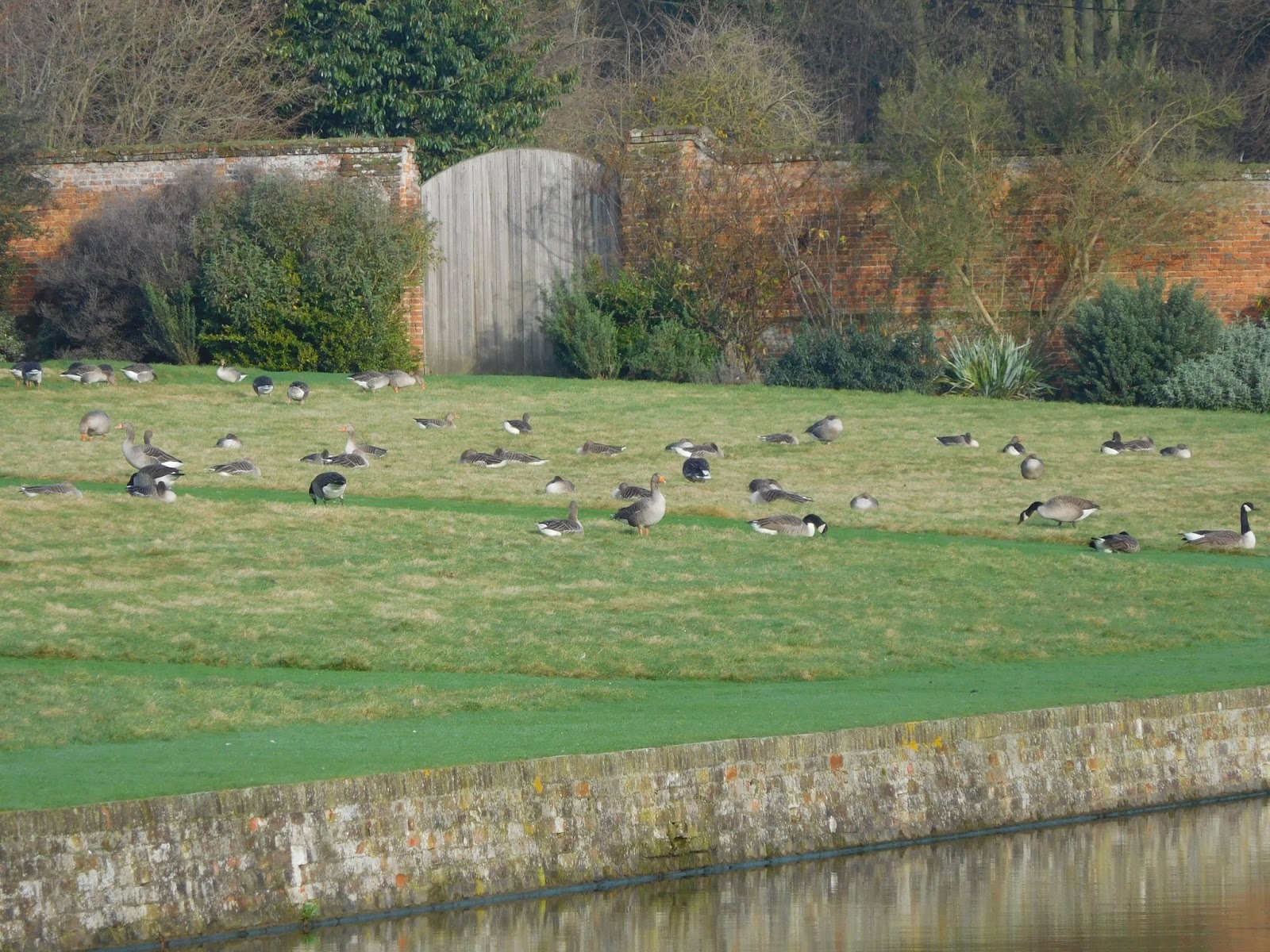
Geese grazing near the walled garden.


And Hamamelis , but curiously, no scent.


Monday, December 18, 2017

Work in Progress


Oddly, given my title, this is a finished object, not a work in progress.  It is a little table, made by my husband to serve as a little tea-table in our cottage.  I can imagine it in use: we will have come home from a strenuous walk, and be enjoying the afternoon sunshine in our front room, mugs of tea to hand.

This little table and its drawer were made from recycled oak.  Many years ago, my husband made the bed we use now with both head and footboards.  More recently, he decided to update it and removed the footboards.  The wood was in good condition, and here it is, put to good use..


This is where I have got to with my swatch for the new Fair Isle waistcoat.  One of the issues in making up a colour scheme from an actual scene - woodlands in autumn - is that it becomes rather literally pictorial.  Yet these skeletal trees are there in Sheila McGregor's "Traditional Fair Isle Knitting,"  pictured there as the first motif on a scarf in yellow and scarlet.

I am trying to use up some of my Shetland Jumper-weight, rather than ordering more.  I happen to have some of this purple to hand, alongside a pile of green oddments.

I will lose the brown band altogether, but am liking the effect of the purples, which suggest shadowy twilight in deep woodland.  I'm thinking perhaps I will try a more decorative band instead of peerie patterns between the two conifer stripes.  It will probably look completely different in its next version.

Thursday, December 07, 2017

Recycling

I'm taking my time planning my next Fair Isle waistcoat.  In Cumbria recently, for the literary festival, we noticed how the mixed woodland along the shore of Loweswater  featured a very pale lemon against a dull purple, a lovely combination.  But would it work as part of a colour scheme?

Against the rich dark green of the back, I can see a mixture of rusts and mustards.  But would it take the very bright yellow which I have actually got in stock?


As I said in an earlier post, my eye was caught by this jumper in a charity shop.  It might even have been wearable, except for those sleeves.  First, I ravelled it out, winding it on to the niddy-noddy which my husband produced some years ago, to skein it.  A soak and then a gentle spin - to try to relax some of the crimp.


Before washing...

And after...

By now, I am almost to the armholes on the back, but no further forward on the colours to be used for the fronts.  At some point, I would like to make use of a batch of mixed green oddments bought from a factory on Shetland in 2000.  Perhaps their moment has arrived?

Monday, December 04, 2017

Work

Today I started a new job.  While I was working full-time I used to  dream about what retirement would be like. Whole empty days to devote to hobby projects - time to tackle long-distance footpaths, learn a language, cook more adventurous food... Sundays without the drudgery of sets of exercise books to mark, a chore which nothing made bearable.  Mondays without the inevitable battle through rush-hour traffic...

And, to some extent, this turns out to be true.  I certainly don't envy those women just slightly younger than me who are still waiting to qualify for their state pension in order to be able to retire at all.  Most of all, I enjoy being able to be outdoors when the weather is fine, making the most of the daylight in these short December days.

And yet, I find myself drawn to volunteering opportunities for what can only be called work.

The other day I was at the National Trust property in my village for a winter cleaning day, along with a small team of others.  My colleague, a retired banker, was hoovering the floor of the Great Hall so that I could apply polish to it in the old-fashioned way, on my hands and knees.

"I don't do this at home," he said, wonderingly.  "I pay a cleaner who comes in to do it for me."

"Yes," I replied, "that's because that is housework, whereas this is a leisure activity."  Now this is true, but it is also still hoovering.

A week ago we were at the local nature reserve having a cup of tea in the visitor centre.  Through the open door of the kitchen I could see a volunteer loading a  dish washer.  "I could do that, " I thought.

So today, I drove across country in blazing sunshine to spend the day clearing tables and loading the dishwasher at that same centre.  From the kitchen, as from the café, a panoramic view of the reservoir teeming with birdlife:  lapwings, cormorants, Brent geese... As a view from a workplace it can have few equals.

I drove home through the dusk, feeling tired but pleased to have been of some use.  Not such an easy feeling to come by in retirement.


Friday, November 03, 2017

Constable Country

Recently we had some visitors in our National Trust property who had been to Flatford Mill and had found it to be "Like Oxford Street."


On my birthday, I chose for us to go and have lunch in Dedham, which is about twenty miles north of here.  We pottered around a few shops, then drove on to Flatford Mill in the sunshine.


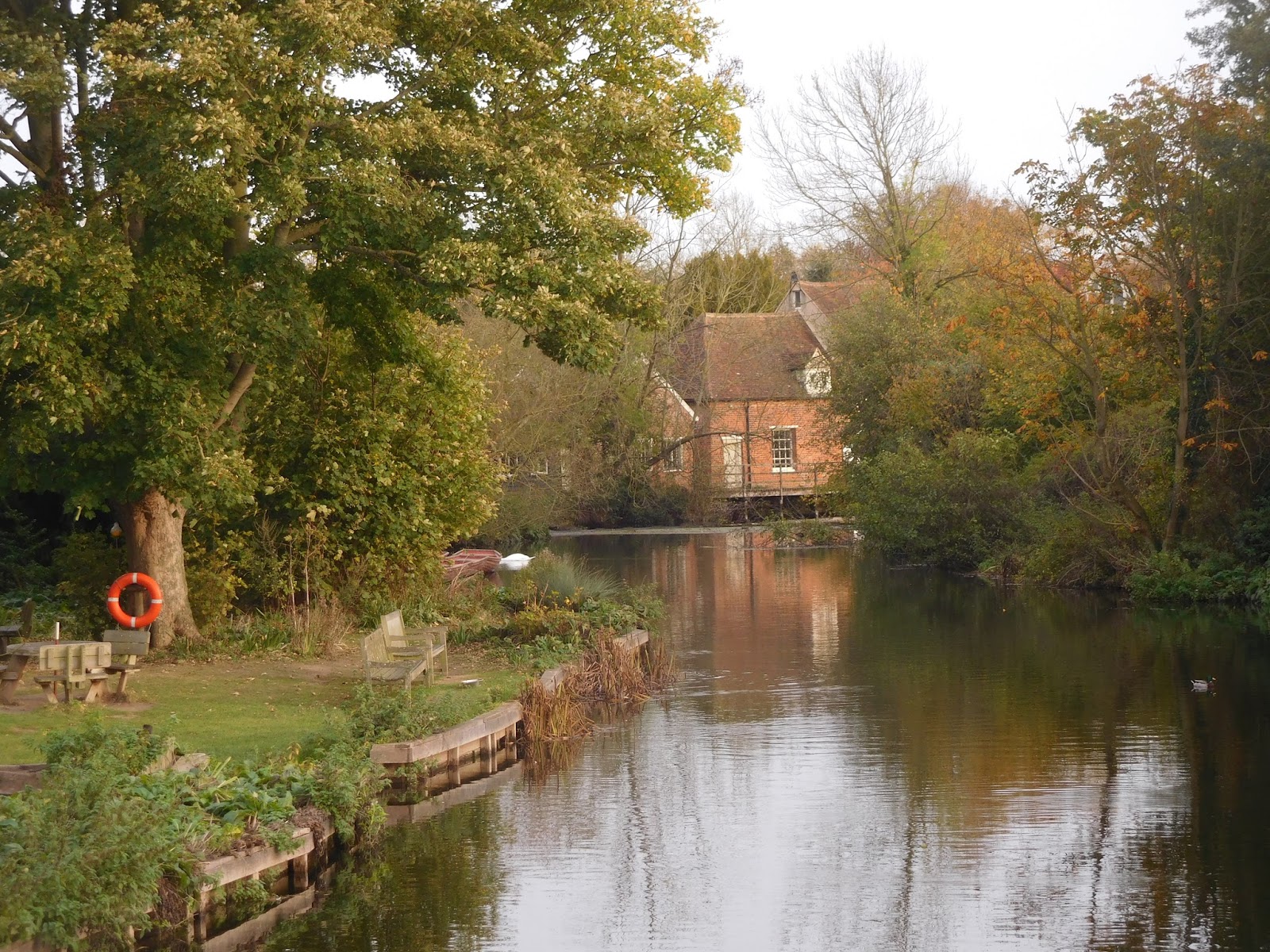
A mid-week afternoon was obviously the ideal time to visit.  A deep peace had settled over the scene.  This is Willy Lott's cottage, familiar from Constable's "The Hay Wain."

We had tea at the National Trust tearooms, watching a pair of swans with a well-grown cygnet cruising along the river.


Anything further from Oxford Street it is hard to imagine.

Wednesday, November 01, 2017

Birthdays


Over the years, my husband has made some remarkable birthday presents for me.  This was the first: a miniature chest, like a prentice piece, for a jewellery box.  This must have been about thirty years ago.


A box inlaid with veneers.  These were cut from the wood of an apple tree which did not survive the storm in '87.  It once grew in the garden of my old house.

Inside, a surprise


This time, this year, I knew that he had something on the go in his workshop, but I had no idea what it was.  He was very sneaky about obtaining the materials, and I did not guess what the project was.


And here it is!  This is a cutlery box for the set of Robert Welch cutlery which we bought when we retired.  This is American walnut - from a sustainable source  - and it is both simple and beautiful.  I love it!