Thursday, June 07, 2018

Wetherlam

Of course, we had been building ourselves up to tackling a Big One. - Wetherlam.   In view most of the time was the Old Man of Coniston, a mountain which we usually count as our first serious climb, almost thirty years ago. On that occasion we followed a very stiff route up the front for two hours only to find that many others had walked up the quarry road at the back and reached the summit that way.  But we still remember that airy ridge feeling as we walked round to Dow Crag feeling on top of the world  - and the wonderful relief of cups of tea back in Coniston after descending the Walna Scar road. Wetherlam is the next top along from the Old Man.


This time we drove to Tilberthwaite where we were interested to see this example of the work of Andy Goldsworthy, a sculptor who has reconstructed a whole series of ancient sheep folds. Inset in the centre of each side is a panel of slate mosaic - a circle in a square. This one certainly makes you think - about the interface between practical ingenuity, craft skills and art.


This is a landscape bearing many signs of an industrial past with disused quarries, mineshafts and levels everywhere.


We followed a steadily rising path to the hause reaching across to Wetherlam.


The route we had planned meant that we would return by the same track.


 The final ascent was a scramble over huge broken boulders, so extensive that neither of us could imagine descending by that means.


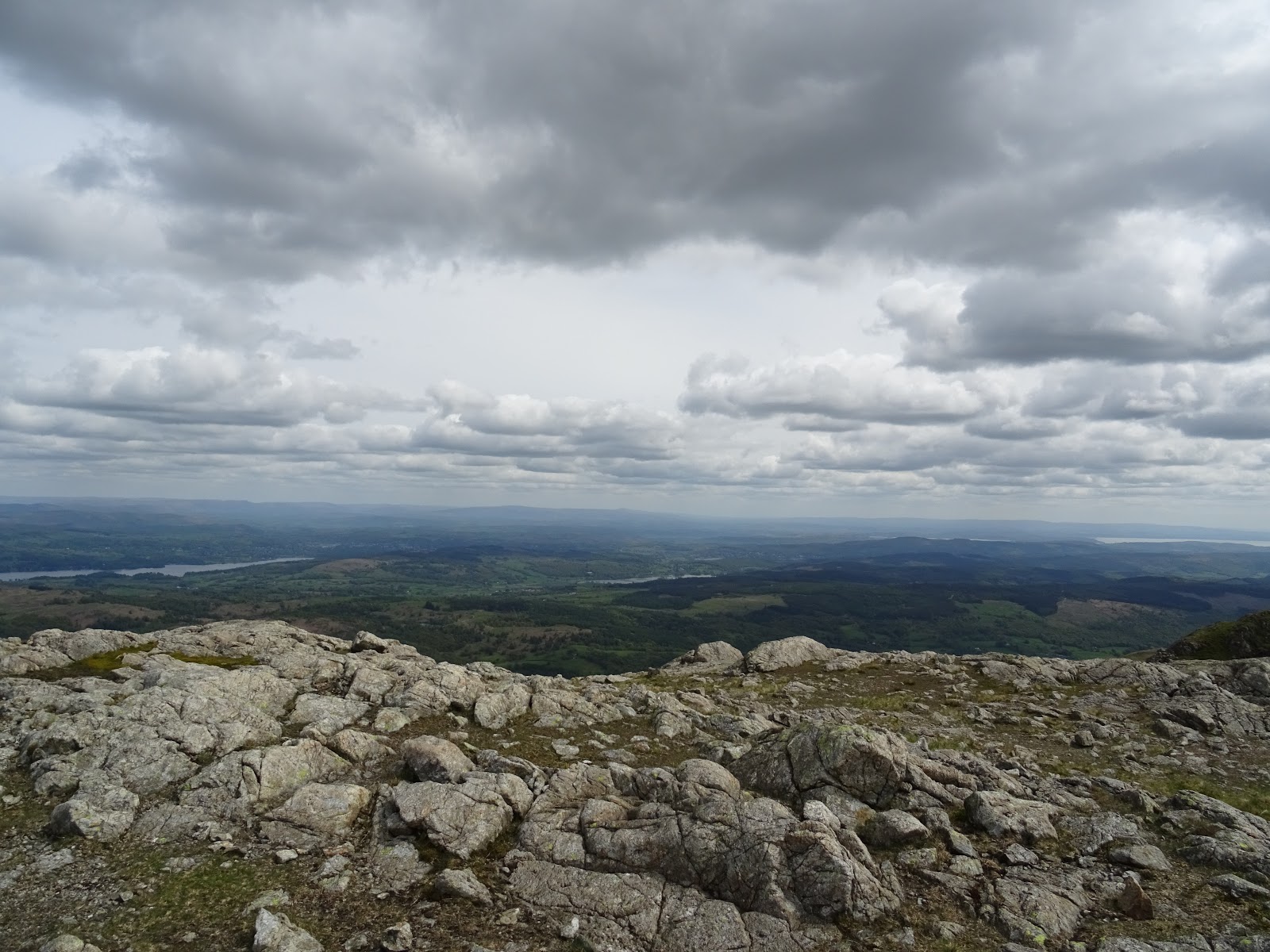
The summit was, as usual, breathtaking, with views in every direction, including right down the Fylde coast past Heysham and Blackpool Tower.


 We took stock.  We asked a number of those who were coming in from other directions about their route and identified a path down the other side with a longer walk back to the car.  This suited us.


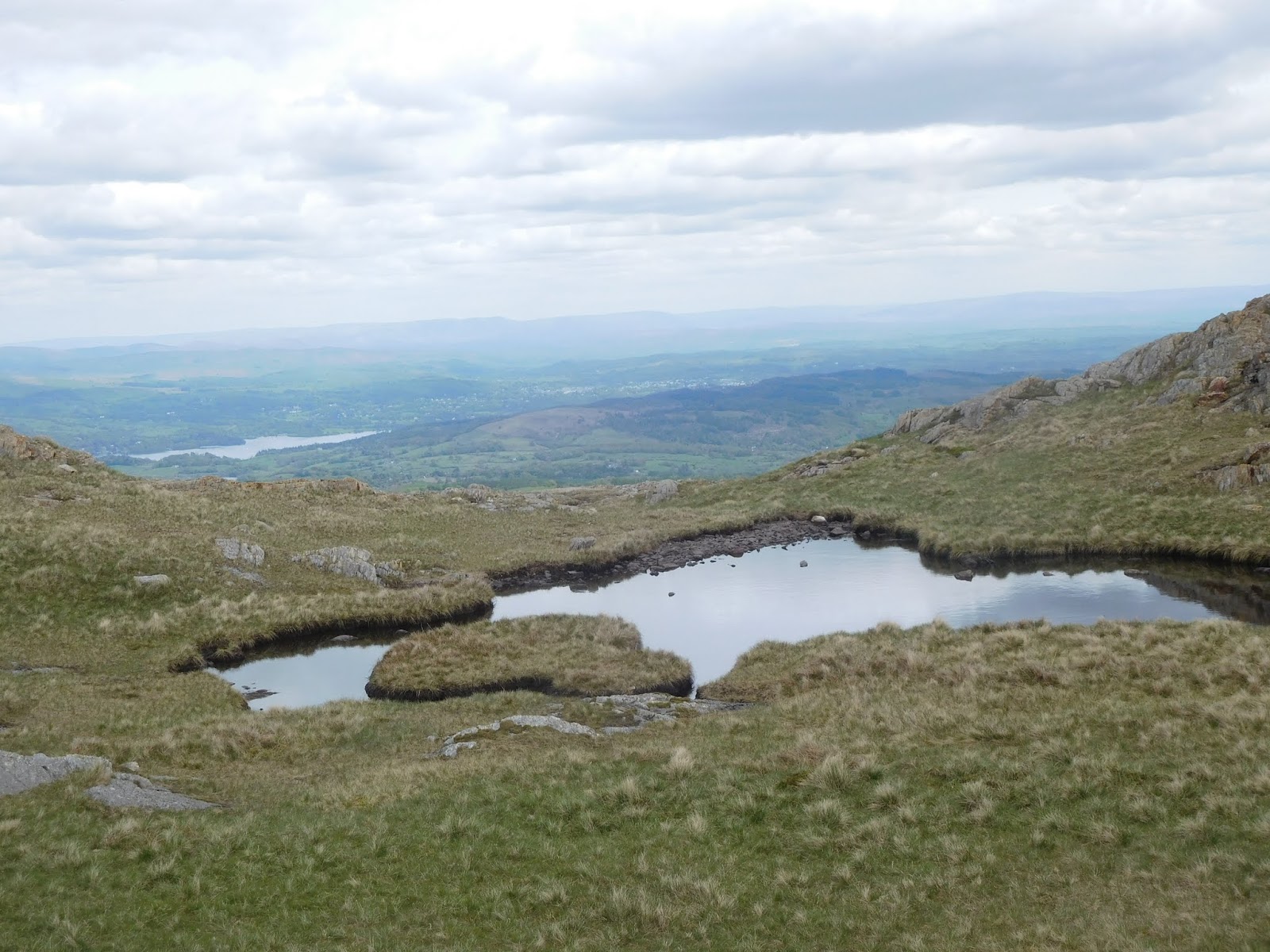
The ground dropped away, but not in the precipitous way of the boulder scramble.  And for some, this is simply their home turf.


Saturday, June 02, 2018

Rest Day


Mid-week - and another fine day.  We began by driving down to Sawrey and on to the ferry terminal.  A car ferry runs continuously across Windermere, cutting off a long road loop through Ambleside.

First stop was Blackwell, the Arts and Crafts house, always a treat to visit.


After lunch it was on to Holehird, a very special garden occupying a sloping site.


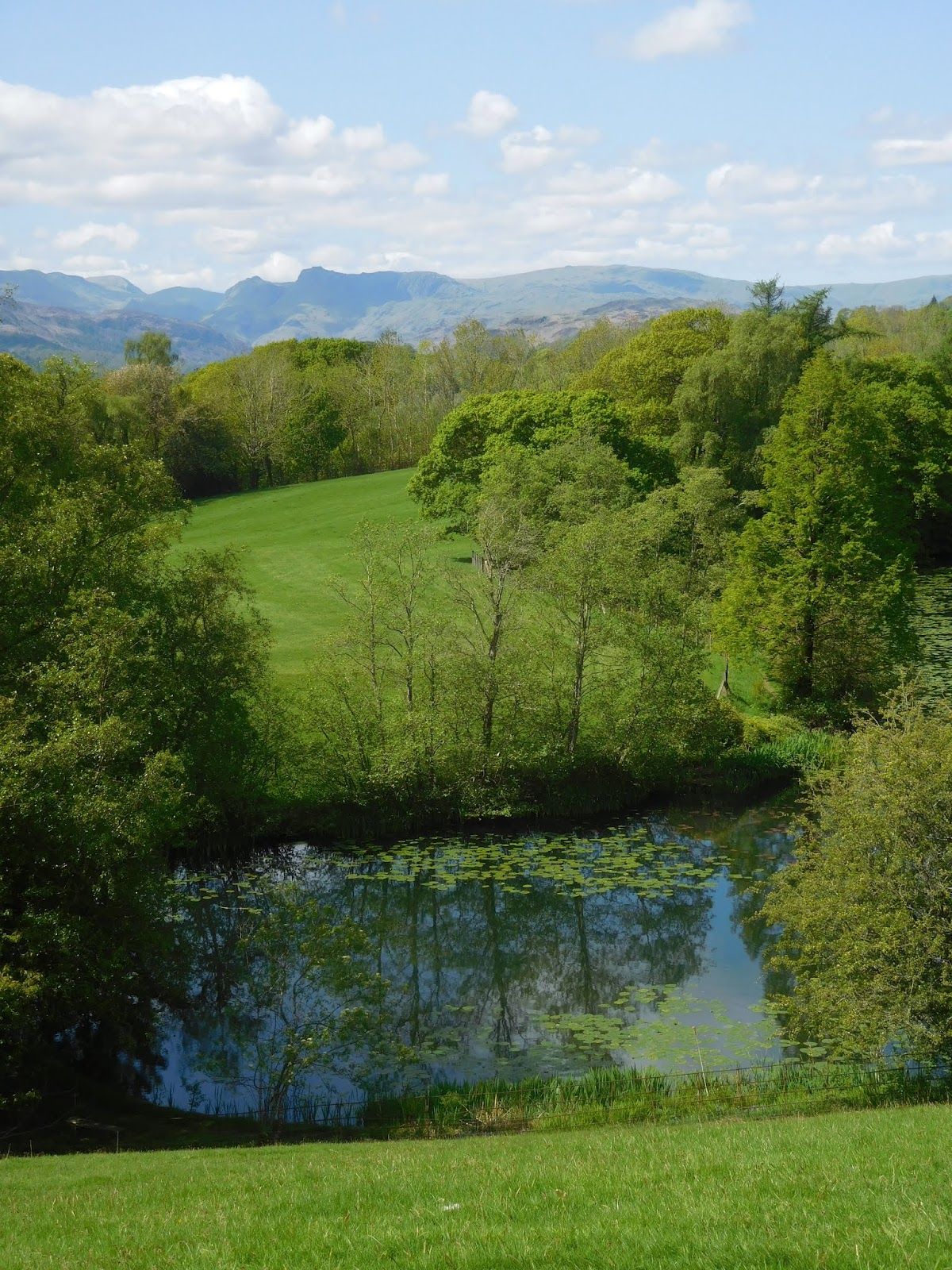
The views from here are spectacular.


So then we drove down the lake road to a parking place from which we could access Gummer's How.  On with the boots and a short stiffish climb to the summit.  Looking down to the end of Windermere.


Wednesday, May 30, 2018

Sunny Weather


For the first time ever we enjoyed a fortnight of continuous fine weather.  This was very helpful on a walking holiday, but also meant that rest days were few and far between.


We walked ourselves in on Latterbarrow and Hawkshead Moor, both walks that could be accessed from the house.


This antique piece of farm machinery is a cutter-bar, once in annual use on my parents' farm to mow the hay grass.  Mowing was followed by days, if not weeks, of turning the swathes, rowing them up. piling the dried grass into pikes in the field and then leading the pikes in to the barn with a pike-lifter.  Even then, each forkful had to be hefted by hand up on to the mows.  Hundreds of hours of back-breaking manual labour.

So, on the third day we set out for Claife Heights and the Sawreys, home of Beatrix Potter.  This was woodland walking leading out to views over Windermere.


On the path, playing dead and looking like an old twig, this slow-worm.


The views eventually opened out to reveal Windermere and Bowness, across the lake.


We felt pleased to be isolated from the crowds and noise of those streets.


Lush country led down into Far Sawrey and we followed the path to Near Sawrey, where the Potter industry was in full swing.  Timed tickets were needed to access Hill Top and people had clearly come from across the world to visit.  We had already decided to take a short-cut up the road to Hawkshead, but then we noticed that enticing thing, a bus stop.  A bus was due within the next ten minutes and we very much enjoyed the views of Esthwaite from the bus window

Saturday, May 26, 2018

Hawkshead


When people ask where we are going on holiday the answer is, as usual, Cumbria.  I realise that this does sound a bit unimaginative.  But the whole thing takes on a different perspective when walking is the main activity.  Between five and ten miles is our limit for the day, so there are many areas of Cumbria yet to be explored at this rate.

Hawkshead is a small town in what used to be Westmorland - at least it was regarded as "Town" as opposed to "Country" by Beatrix Potter, whose territory this is.  It was a short hike across the fields from our holiday cottage, The Cragg.  Now, it is a bit of a tourist trap, but still has some its historic buildings, and, just as important, its teashops.

This is the school attended by William Wordsworth in the late eighteenth century.


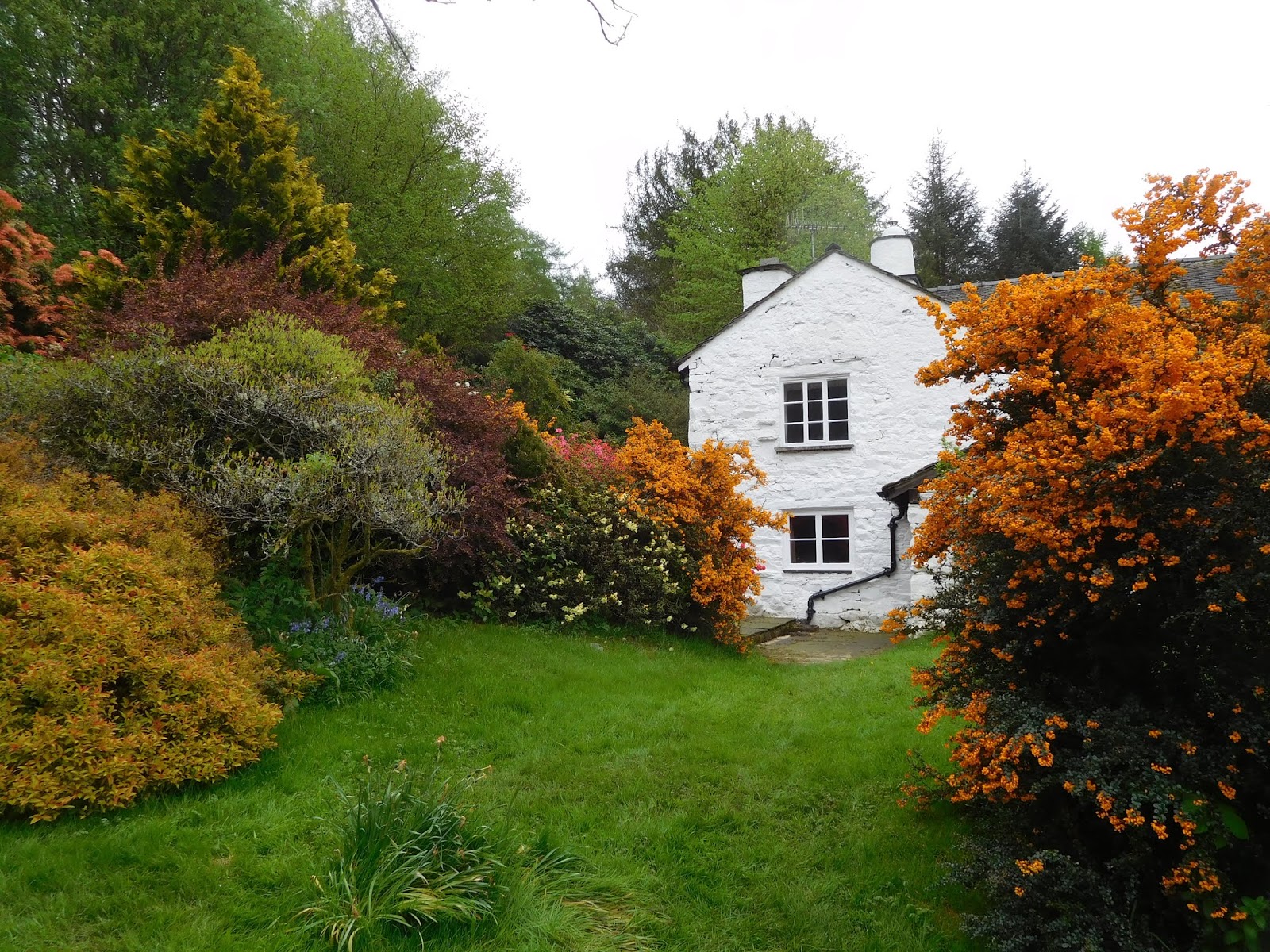
And this is The Cragg, a traditional Westmorland farmhouse with stone flagged floors, an Aga and extensive woodland gardens full of rhododendrons, azaleas and birdsong.  It always amazes me that properties like this can be rented for relatively modest sums.  Or you could stay in a Holiday Inn.

We spent many hours enjoying the sunshine in the garden, watching the relentless labours of a group of long-tailed tits who had a nest in a dense bush.  We saw three individuals sharing the task of feeding the young.


All through the property were original features:

This is Westmorland panelling, used for interior walls.  The thin planks are simply slotted into the ceiling beams and there is your wall.


Built in cupboards... Of course you need exterior walls two foot thick to accommodate these.


Spice cupboards, this one dated 1695.

Early walks took us out across the fields surrounding Hawkshead.  Another distinctive local feature is the use of slabs of slate to construct walls, rather than the drystone typical of elsewhere in Cumbria.


This is rolling lowland farm country, heavily wooded.
 

And it was bluebell time, of which more - much more - later.


Tuesday, April 24, 2018

Braxted Park

Last week we went for a guided tour of an historic property under the scheme "Invitation to View".


Braxted Park is a late eighteenth century house set in its own extensive grounds, surrounded by a wall which is four and a half miles long.  The current owner gave us a talk about the history of the house and what it takes to raise the income to maintain such a property in the present day.

In the past the house had been owned by a series of people named Du Cane and, improbably, by a Mr Darcy.  More recently, the owner's grandfather had acquired the house to use as a base for entertaining clients and providing office and lab space for the electronics company, Plessey, which he had founded.

The current owner had set up a golf course and managed the property as a wedding venue.  Over a hundred weddings were held there last year. All this, simply to fund the maintenance of the house and grounds.

We were given a guided tour: a beautiful ballroom with Adam ceilings, an orangery used for civil ceremonies and everywhere garden settings suitable for the taking of photographs.


From there we walked down through the grounds to the ornamental lakes where there is a curious structure, like an ice-house, but not actually an ice-house.


Just over the edge of the parapet a goose rose from her nest revealing this huge clutch of eggs.


It was an interesting way to spend a Monday.

Sunday, April 22, 2018

Bad timing


Some time last year I spotted a couple of bags of an oatmeal coloured yarn in a charity shop.  It was labelled as if it had possibly been a second of Rowan yarn - Scottish Tweed.  I couldn't pass it up although it was just a bit gingery.


I found a pattern in one of those collections of "Woman's Weekly" patterns.  I remember thinking that the design does nothing for the model.  Later I realised that the picture does not even show the saddle shoulder which is the design's main point of interest.

I knitted both fronts and the back up to the armholes and started on the sleeves.  Then I joined in a new ball and began to feel that it was of a slightly different thickness to the rest.  The project seemed doomed and it stalled.  The bag sat in the corner of the living room for a year.


Perhaps I should finish it and send it off to Knit for Peace, I thought.  I reminded myself of the pattern and resumed. 

After assembling the pieces, I had to make some decisions about the edgings as the original had a straight ribbed band which would not do.  Also, I needed to lose an inch or two, rather than adding any width - that's the cardigan, not me, at least on this occasion.  I decided to use a narrow I-cord edging for the front edges, incorporating buttonholes.  This would then wrap over to fasten.  For the collar sections I used short rows to create a ribbed band and finished it with I-cord.


I put the finishing touches to this lovely, all wool jacket, just as the April heat-wave hit - not ideal wear for this weather.  Still, it will keep, provided the moths do not get to it.


Friday, April 20, 2018

Confident sewing

Nancy commented recently on how I seem able to plunge straight in to sewing tasks.  There is no trick to this, other than fifty years of practice.

However, if you were thinking of starting out, I do have a few tips.  Buy a very basic sewing machine.  I learned to sew on my mother's hand cranked machine which did not even do reverse.  My current machine was bought in 1978 and can do reverse and even various types of zig-zag.  The key point is that the machine is not intimidating.

Then, practise on fabric which does not matter.  Good fabric can cost much more than a readymade garment and you have no guarantee that the end-product will be wearable.  Charity shops are a good source of reusable fabric - duvet covers, sheets, even full skirted dresses.  You can make all your learning mistakes on these.

Make something you can use and enjoy - something straightforward, needing no pattern.  So, cushion covers are a good bet.  The first garment I ever made for myself was a little gingham skirt. One seam, the top turned over to form a channel for elastic and there was a little skirt.  I hand-sewed it at school in the top juniors and I remember my mother being quite shocked because I had made it without being asked to learn any new skills.  But I did learn that you can make wearable clothes for yourself.

Buy only patterns you will want to use many times.  In the 60s there was a magazine called "Petticoat" which offered a basic pattern for a shift dress.  Each fortnight they showed you how to adapt the basic pattern to make a different style.  These were the days when talented young people were opening boutiques to market their own design mini-skirts.  Anything seemed possible.  My friend bought the pattern and we spent many happy hours pinning and cutting and sewing, all on my mother's ancient machine.  The point is that if you make the same pattern several times your confidence grows.

There's no harm in being ambitious.  Quite early on my friend and I made ourselves trouser suits.  My mother, our technical adviser, blenched when she saw the lovely wine-coloured corduroy that my friend planned to use.  Over the whole weekend we tailored the jackets, setting in sleeves and making bound buttonholes.  My friend knitted a white jumper to go with hers and looked stunning in it.  I wore mine twice, once on a trip to the local theatre.  I remember it being impossibly dressy, enhanced with marcasite buttons.  We learned a huge amount from the project, though I imagine that neither of us ever made anything that complicated again.

So, what can this be?


We have recently upgraded the bedroom furniture at our cottage, including a bedding box to be used as a support for open suitcases.  This is a pad to protect the top of the bedding box.  It is made of Donegal tweed with a layer of fleece blanket as wadding.  Comes into the category of useful rather than beautiful, perhaps.


Wednesday, April 11, 2018

April in Cumbria


A post-Easter break in Cumbria, after a very busy Easter weekend volunteering.  In fact, of the ten days just before we left I worked  nine, culminating in Easter Sunday and Easter Monday.  The world and his wife were certainly out to tea on those days.  

Sample coffee-shop scenario:  Couple approach the counter with some urgency.  Must be looking for the toilets, I think.  But no: it is 2018.  He says,"Do you have almond milk?"  and looks quite put out when we don't.  I blame the supermarkets.

So, yes - baby lambs


Banks sparking with celandines


And snow...


at no great height, on one of our favourite walks, Sale Fell.  We were surprised to find that this snow did not melt but evaporated as the morning wore on.

The Skiddaw massif, and some of the strange ridge and furrow features highlighted by the snow.

Unusually for us, we ate lunch at one of the classic Lake District beauty spots, Ashness Bridge, along with a crowd of others.


We were very surprised to see a young woman actually in the water with a tripod set up, so determined to capture the ultimate image that she essentially spoilt the view for everyone else for a good half hour.

On our way north we went up the A1 and across the A66, a high level route which crosses the Pennines.  The road was closed just before Brough because of an earlier accident so we detoured via Kirby Stephen, a very pleasant little market town.

  "Must come here again," I said to my husband.  Be careful what you wish for.

On our return, we set off briskly with a seven hour drive ahead and were making good time as we passed Brough on our way up the A66.  Suddenly, the traffic came to a dead halt.  There had been an incident of some sort a few hundred yards ahead of us (we never did discover what it was).

I've always wondered what the term "atrocious weather conditions" actually means: now, I know.  We were there in that jam for about an hour and a half, while it blew a gale outside.  Eventually the traffic cops began to turn all the cars, on to the carriageway leading back towards Brough, leaving the very many heavy goods vehicles to wait for the road to be cleared. And so we got to see Kirkby Stephen again, rather sooner than we expected.


Saturday, March 24, 2018

Reupholstery

Remember this?  Last summer we bought  two chairs at a local auction.  They are Ercol chairs in a style we now know to call "Mid-Century".


The frames were sound, but the covers had seen better days.  New cushions from the company itself are available - for over five hundred pounds per chair.

We decided to continue the duck-egg theme since these are for the renovated front room in our Cumbrian cottage.  I found the fabric on an e-bay shop site  - it's intended to look like wool tweed but should withstand some wear.

First, I removed the old covers and unpicked them to use as pattern pieces.  I saved the zips to use again.  I cut out the pieces.


Assembling the seat cushions was a simple matter: insert zip, assemble complete side panel strip, stitch panel to top and bottom in turn.  Prise open zip and turn through.


The process for the back cushion was more complex, as the piece for the back and the piece for the front were completely different shapes yet had to be sewn together.  This is to accommodate the 3-D shape of the back cushion.


It seemed like an impossible task - and yet, it worked.  I pinned  and tacked the pieces to be sure that they would fit.

The final manoeuvre was to stitch the small curved base in place between the front and the back.  Fortunately, this went without a hitch.

So this is what they look like now:


You'll notice that the smaller chair has a buttoned back, as in the originals.  It took some pondering and some useful you-tube videos before we worked out how this was done, but we managed it this morning.  It does distort the check pattern, so the other chair may remain as it is.  We'll see.