Sunday, April 10, 2011

Forget me nots


After my father's death, sixteen years ago, I was helping my mother to tidy the garden.  I dug up a clump of forget me nots and brought them south to my own garden.  Never was a flower better named.  For several springs after that, they engulfed the whole garden.  Now, I have them tamed to specific areas, where they drown out all rivals.


This is certainly an amazing season for blossom.  Here, the two espaliered pears facing each other in our walled garden.  At the base of this one a clematis, Madame Grange, is making another bid for life.  The harsh winter seems to have kick-started everything rather than killing it off.


A viburnum in full flower, threaded through with a clematis Montana.  the second picture shows some of the many insects attracted by its heady scent.

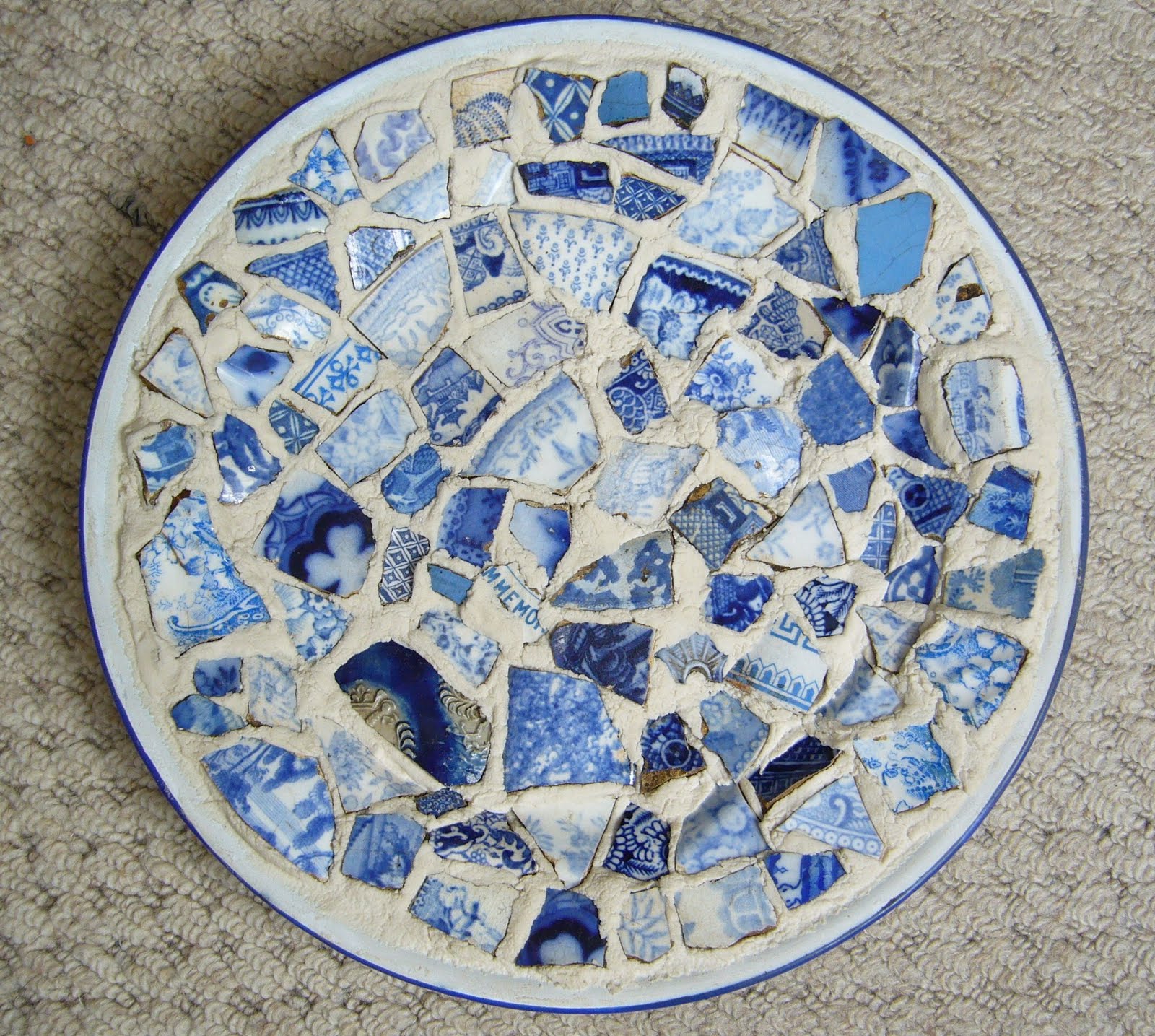
Finally, an image of our allotment plate. As a child, I lived in a farmhouse which had been in my father's family for more than one generation.  My great-grandfather, who was described in his obituary as a "dalesman of the old school," was  bookish, perhaps because he had crippled himself as a yourng man. The story was that he was scything the grass in the orchard when he cut his own Achilles' tendon.  There being no doctor to hand, his mother sewed him up with a sewing needle and thread.  Thereafter he walked with two sticks.   The attic at our farm was full of books which he had collected, and which amazed us as children. 

Also up there were two plates made by embedding fragments of broken china into cement on a tin plate base.  When we kept finding pieces on our allotment, it occurred to me that I could make such a plate myself - this is the result.

Tuesday, April 05, 2011

Stately Home


Last weekend to the Cotswolds to visit my father-in-law's widow.  We try to stay over in Stratford as it's a long day's driving otherwise.  This, the revamped Shakespeare Memorial theatre, with the curious tower, somewhat like a medieval Italian city state.  In the foreground, a glorious magnolia, dripping with blooms.


A further sample of my husband's craft,  this tea caddy was made for his mother's sixtieth birthday, more than twenty years ago.  He was very pleased to be able to shade the marquetry using hot sand heated in a metal tray to singe the individual  pieces.


On our way, we called at Upton house, home of the Samuels family, of Shell Oil.  The ambience is that of a house party in the thirties, although the collection of pictures is quite impressive, and worth millions.  We were able to view the paintings without the inevitable press of people in the National Galleries.

In the billiard room, we were surprised to see an item of "kit" that we recognised: we have one in our dining-room.  I asked if we could see the interior and we were very entertained to see the room steward don a pair of white gloves before opening it up for us.  We will have to get a pair to use with ours!


This is a "Star" record cabinet - ours.  Note the Art Deco shaping to the lower edge.  My husband inherited it and set about converting it to hold a tuner and a turntable on which he plays his 78s.  The lid lifts up on a hinge to allow this.   Who knew it was the choice of millionaires?


Pansies and pear blossom in the garden.  Such cheerful flowers, pansies, with their curious markings, and in such brilliant combinations of colours.  We encouraged the buying and planting of trays of these in the Cotswold garden too.

Sunday, March 27, 2011

Spun yarn


A second royal sampler, this time simpler in its sentiments, but dense with symbolism.  Note the orb and sceptre, along with the symbols for the various nations, and the abbey itself - quite an ambitious design.  Given how old this already is, the lightness and brightness of the colours is quite surprising.  Does it capture the optimistic mood of the 1950s?  Well, certainly there was a less cynical view of the monarchy just then than there is now. A case of too much information, perhaps.


This may not look like much, but it is the first yarn I have ever spun, using a drop spindle and knitted as singles.  I was quite surprised by how even the finished piece looked, given the unevenness of the yarn.  The lighter colour is part of the Suffolk fleece I bought some years ago, while the dark is a Shetland sample. 


And here, two skirts, made from the Linton tweed fabric bought from the factory shop in Carlisle in February.  I have already worn the black and white one which is light and airy.  I still think it looks like tower blocks as seen from a ring road.  The speckled section is a raffia type yarn, with lots of protruding ends forming a pile.  Consequently some of the bands were less stable than others in the sewing, although it made up easily enough.  I imagine wearing this with black tights and a solid colour jacket. 

The red has been made up for my elder sister, at her request.  It is a mix of black and red threads to give a rich deep red, but it is  loosely woven.  I could envisage it snagging quite easily in wear.  Did Chanel worry about issue like these, I wonder?

Today, to the allotment, to plant leeks and parsnips, our onions already in.  Such a bright sunny day that we were able to  eat lunch on the patio, as we were on Friday.  In between, Saturday was raw and cold again.  Watching Mike Leigh's "Another Year" last night gave a whole new layer of meaning to the allotment visit. 


Friday, March 18, 2011

Commemorations

Yesterday, to the funeral of my husband's father; a bitingly cold day with a grey mist.  A small gathering of family and representatives of the public life he once led: a dignified end,  a quality which serious illness often erodes.

In our garden, though, flowers of different kinds are in full bloom.  The lovely, clear mid-blue of grape hyacinths.


Daffodils, against a background of budding pear branches.  If Wordsworth were to visit Essex he would be overwhelmed by the jocund company: thousands of daffodils in every public space and road verge.


And the pure white of a hellebore, gifted to us by our neighbour.


The approaching Royal Wedding is bringing with it the usual odd range of souvenirs.  I have a small collection of samplers from different periods.  Imagine the feelings of the embroidress in this case.  The design must have been from a magazine,  intended for the coronation of Edward V111.  Notice the stamp appliqued to the fabric, and the row of flags of the Empire.  Then the shock of the Abdication - what to do?  So she ( one can only imagine it was a she) added her own text to the border. A nation's disappointment, indeed.


Friday, March 11, 2011

Spring...

Ever thought how nice it would be to have a little stream running at the bottom of your garden?  The gurgling noises, the constant movement, moisture feeding your plants without you lifting a hand?


This little spring  popped up about a month ago just at the corner of our allotment - that is our seedbed in the picture, or it would be were it not waterlogged.


Quite a little stream is running along the channel cut for it.  Apparently the drainage ditch must be blocked, the water table has risen to within a spade's depth of the surface and the spring has made itself visible for the first time in many years.  All the upper half of our plot is soggy, which is probably doing our blackcurrant bushes no good at all.


New growth on our rhubarb, grown from seed three years ago, one of a block of eight.  We are still eating rhubarb frozen from the crops last year.  We also have two of a different variety which cooks to red rather than green, which we bought from a charity stall in Ludlow some years ago.


Brilliant blue skies and the fresh green of a weeping tree over the river.  Is this a willow?  I'm not sure.  On the other side of the bridge there certainly are willow plantations, planted by Surridges, for making cricket bats.  The uncle of a friend of mine spent his working life at the company based in Witham.


An interesting comparison.  On the left, Regia sock yarn designed by Kaffe Fassett.  Lovely clear blues in shimmering patterns, set off by a curious khaki splodge. Cost:over eight pounds for a pair.    On the left, sock yarn by King Cole: same sort of turquoise and a purply colour, distributed more mechanically across the piece.  Cost: about half what the Regia costs.  It will be interesting to see how they wear, but also, given that I generally wear socks with black trousers and clogs, whether I continue to be aware of the difference in daily use.

This week's words, following alphabetically  from "Clarty" - dirty or sticky.  "Clatting" meant telling tales or grassing someone up, as Essex would have it.  "Clab" could be either a noun or a verb, meaning something plastered on, as in butter on bread, or at least, I think that is what it meant.  I haven't heard some of these words in forty years.  My parents were not really dialect speakers themselves and they certainly did not think speaking broad would bring with it any advantages for their children, so it was discouraged.  Now, I find these words have all the charm of the endangered or newly extinct specimen  in nature.

Thursday, March 03, 2011

Signs of Spring


For those of you still under several feet or inches of snow, some green shoots, the first a delphinium which may live - or die - to regret this spurt of new growth.


 More promising are these buds on the espaliered pear, although the blossom needs to wait a while.  This, in a week when the temperature has fallen again, so that it is actually painful to be outdoors without mittens.


Those of you who have been reading my blog for a while will know that I enjoy a bargain almost above anything.  Clothes for which I have paid the full price almost never become my favourites, while something picked up at Oxfam will be never off my back.


Here a little treasure trove of items acquired over the years in Essex, some three hundred and fifty miles from Cumbria.  First, the woven mohair scarf, in such wonderful deep-dyed colours.  Someone obviously found it too tickly to wear next to the skin.  It was brand-new when I found it in a charity shop.


Then, this little dish made in Borrowdale by Lakeland Rural Industries.  Once there was a thriving art metalwork industry based at Keaswick.  Even in the early Seventies, items made in stainless steel were on sale.  This is descibed as Hand-beaten and bears the characteristic markings of that process.


Finally, the larger bowl by John Harrison, a craftsman in metal based at Penrith.  Again, this was in a charity shop in Essex.  It has a mirror finish, so shiny that you can see our stained glass windows reflected in the surface.

This week's words: My younger sister gave us a Voucher for Christmas.  It's a voucher for meat from Heritage Meats at Yew Tree Farm, Coniston.  The web-site offers cuts of pork, beef and Herdwick lamb and mutton, using the word "Hogget".  My father kept a flock of sheep on our small fell-farm, but he chose Cheviots, on the grounds that they are  larger animals with light coloured wool.   No one ever suggested processing the wool at home; fleeces went into a large wool-sack and off to the Wool Board.  Even the daggets were bought by the travelling scrap metal merchants.
So there is a repertoire of words for sheep: hogg, gimmer, wether, twinter, yow, tip.  "Smit" was the red marking pigment, used to identify the sheep as ours: two pops on one side.  "Ratch" is a verb, meaning to go in search of forage.  In our house it was also used for looking in drawers or cupboards which were not one's own!

Friday, February 25, 2011

If the Hat fits....


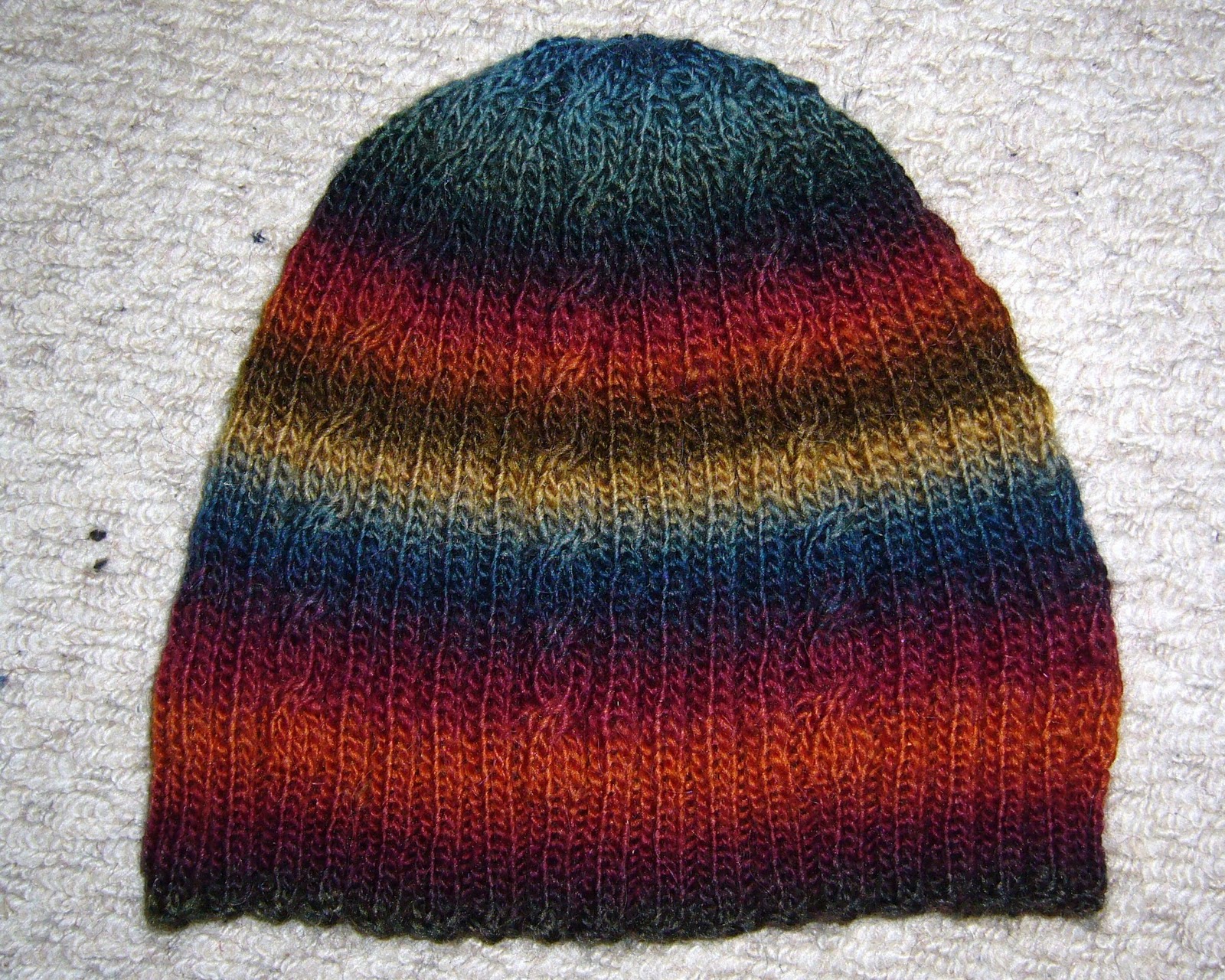
Finally, a hat which I feel comfortable with.  This is Crystal Palace Mini Mochi, in  a very lively colourway.  It looks like a thin lopi yarn without much twist and is a little splitty, but it certainly feels luxurious.  The key to fitting my over-sized head seems to lie in the ribbing, which has plenty of give.  I started on 3.25 needles and increased to 4.mm, also increasing for the cables.  Perhaps I have come to the end of a run of hats, just as the weather becomes spring-like and the first sharp greens appear on the trees.


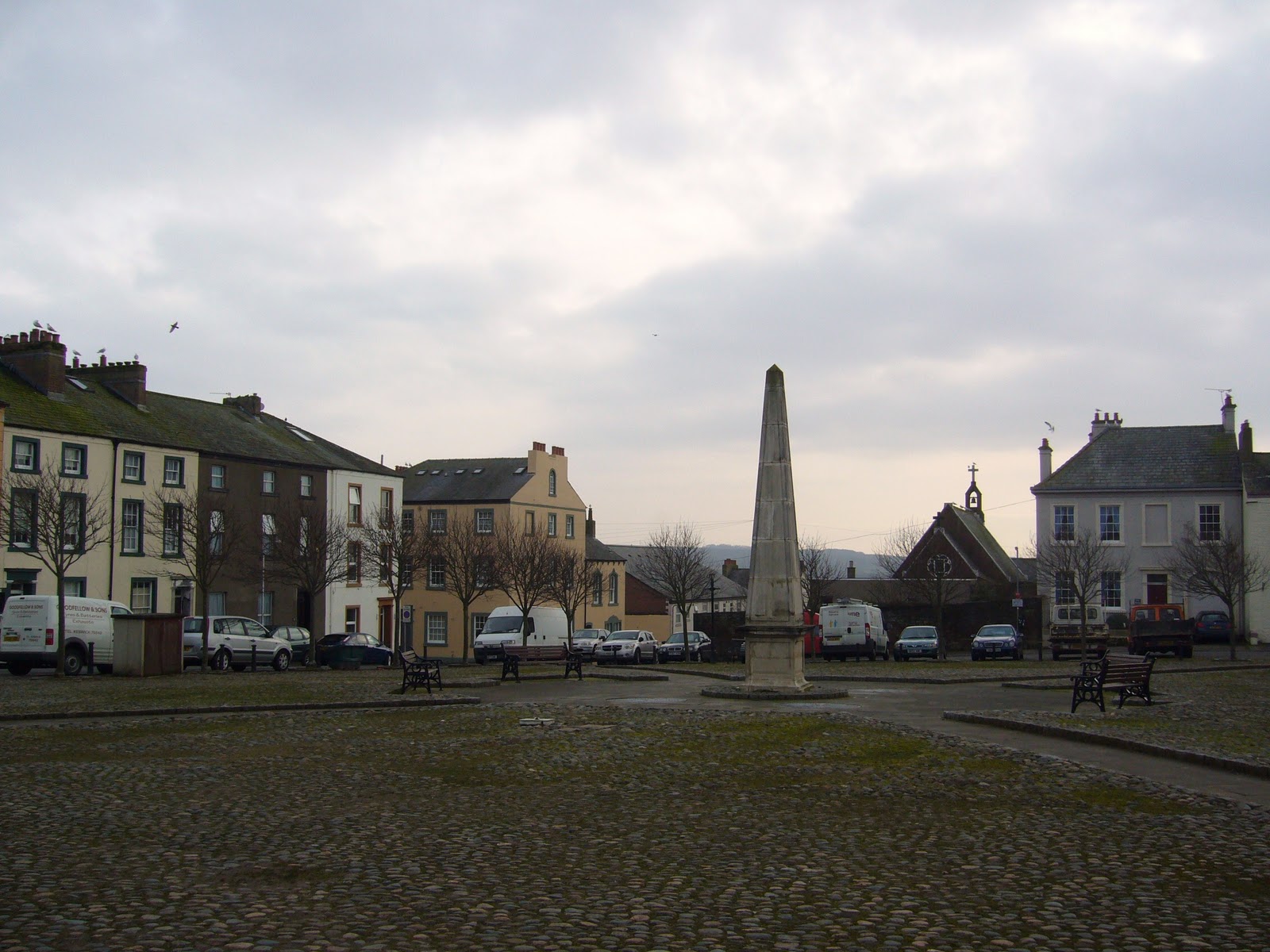
More images of Maryport, this time of Fleming Square.   Maryport was not developed until the end of the eighteenth century, when it became a major port for the export of coal and then iron ore.  Fleming Square is a lovely open space surrounded by impressive Georgian houses.


Here the cobbles of the square and  the central obelisk can be seen.  Just yards from here are unparalleled views over the Solway to the Scotch hills, and a Roman Museum full of world-class Roman artefacts from the mile fort at the top of the hill.


A curious little group of statues down by the harbour, and, just visible, a new venue called the Wave centre, hosting concerts and community events.  These things are clear evidence of regeneration, whether they are quite to one's taste or not.  Like much of West Cumbria, Maryport has gone though a long decline with prominent high street properties standing empty.  Once it was possible to walk clear across the harbour on the decks of the herring boats, an old lady in the nursing-home told me.   Those days are long past.


More Cumbrian dialect: many words seem onomatopoeic: "scrow", for example.  The high incidence of words with that initial sound is apparently due to Norse influences.  Thus "scop" - throw and "scree" - loose stones on a steep slope.  And "scratting" and "scraffling", both of which I recall used in the context of struggling to make a living.  Interesting how they evoke a whole way of life.


Tuesday, February 22, 2011

A taste of Cumbria


To West Cumbria, to visit family.  First, to Carlisle, and more wonderful Georgian houses.  Here a whole street with perfectly preserved fan-lights and door pilasters.  I particularly love the chequered brickwork - and the way the car matches the door!  However, though this looks smart as paint, the street adjoins one of those seriously run-down areas that blight northern towns.


Visiting Linton Tweeds, I find myself drawn to this graphic black and white weave - suggestive of high-rise blocks.  I am also drawn to the two for one offer on skirt lengths.  That is two different metres of tweed for fifteen pounds.  Linton have an interesting  client base, having supplied Chanel herself.  Check them out at Linton on-line

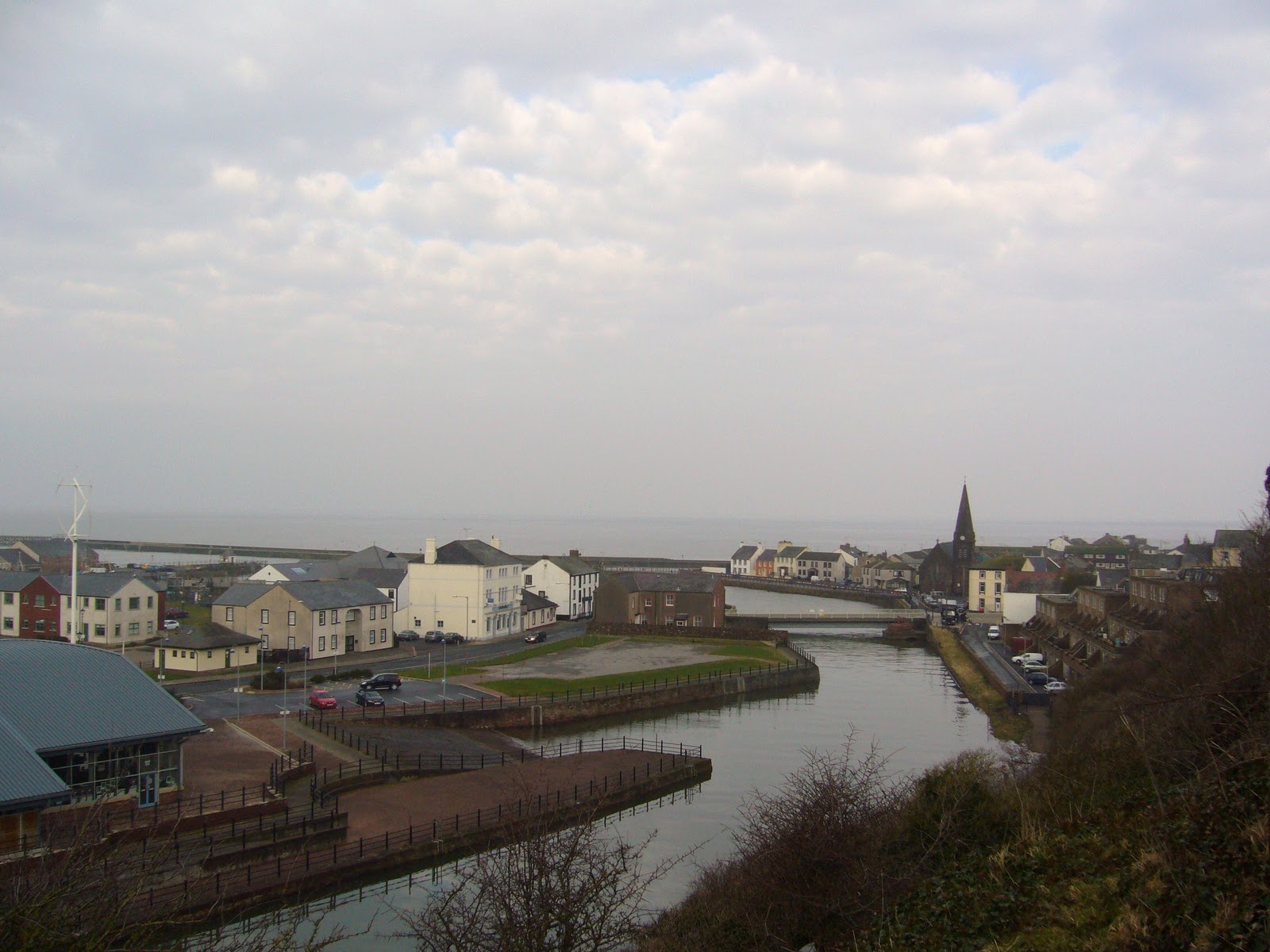
Then to Maryport, where my mother has lived for many years in a nursing-home.  A view first of Mote Hill with the flood plain awash and then of the harbour from Mote Hill.  Ancient peoples used the hill as a strategic lookout over the River Ellen, long before the arrival of the Romans. 


These views show the tide in and high water.  It is quite a different scene at low water, with acres of mud.

Some ten miles north of Maryport is Beckfoot, where I took my shore walk.  Looking north, an uninterrupted view of the Solway, with not another person in sight.


Amazingly, Enid from Wigan left a comment to say that she knew my mother's expression - "like a padding-can,"  for an untidy room.  I am fascinated by the incidence of very broad Cumbrian - for example, a checkout girl using "Yan" for "one" to another worker.  I do feel the curators of the British Library exhibition might easily have located some more vivid samples by not interviewing the people, but by eavesdropping on conversations between native speakers.   Another common Cumbrian expression: "clarty" -  sticky.

Some knitting:  a little hat in J&S jumper-weight, owing something to Kate Davies' most recent design, largely because I was in Cumbria and my reference book in Essex.  It fits me, but again suggests a swimming hat more than anything.


Finally, this week's culinary offering.  I like nothing better than to go into my kitchen and  put together something tasty from almost nothing.  This is what comes of combining two stale hot cross buns, buttered and lightly spread with orange marmalade, with two eggs beaten with a little milk and sugar.  Baked for about 35 minutes, it rises to a light, orange flavoured pudding, which is lovely with a blob of vanilla ice-cream.


Friday, February 11, 2011

A Bit of Culture

This week to the British Library, to meet my sister for lunch and to visit the exhibition on the English Language.  I would like to say that this was fascinating, and they had certainly tried hard, with original early books and artefacts, alongside recordings of various types of speech.  However, nothing quite matched that shock of the raw one sometimes happens upon in hearing English actually spoken in its regional variations within England.  One time in a Lake District pub, overhearing three hound-trailing supporters discussing the relative merits of various dogs - there's a little world with its own language.  Another time, going just that bit further up the A1 and finding ourselves unexpectedly at sea in a service station,  asking the girl on the till to repeat things because we had no idea what she had said.

At the end of the exhibition there was the chance to contribute a sample of one's own English, choosing a word we used.  My sister chose "Slarky", which means "Smeared, as in a window, or windscreen."  I chose my mother's expression "like a padding-can."  This meant an untidy room or a scrow.  I have never heard anyone else say this, so I am not sure if it is Cumbrian dialect.

After lunch, I took the opportunity of popping in to the British Museum, with a view to seeing some of the 100 Objects, and indeed I did see a couple of them: the stone belt weighing five stones which was part of a ritualised ball game, and a carved stone pipe in the shape of an otter.


What caught my eye, however, was a golden funerary wreath from the Hellenistic art section, its delicate oak leaves and acorns as abundant and shiny as when it was made.

And this carved panel:


 from Hadrian's villa at Tivoli.


Finally, an Anglo-Saxon cross in red sandstone, from Lowther in Cumbria.


This week's knitting: another version of Knotty but Nice from Knitty Winter 2009.  I knitted this flat in DK, adding one extra pattern and fudging the cable by turning one back on itself at the edge.  This fits very closely and will be ideal for cycling, although it has to be said that it looks a bit like a swimming cap in wear.  I did use a larger needle for the cable section, but it still pulls in dramatically.

This week's recipe: recently, I harvested most of our leeks.   Trim the leeks but keep whole.  Boil until tender.  Meanwhile make a cheese sauce with butter, flour, milk and grated cheese, adding a teaspoonful of English mustard to add piquancy.  Wrap each leek in a slice of cooked ham and place two of these per person in a shallow dish.  Pour over the cheese sauce.  Reheat in the oven.  This was particularly frugal since we live a few yards from the Coop supermarket who pride themselves on discarding a minimum of food as waste.  To this end, they discount items heavily as they approach their sell-by date.  Packs of perfectly good ham were 20p, having started at £3.  That's what I call discounting.


Thursday, February 03, 2011

Spring Fever

Yesterday, a thin wind, blowing right through you, but today, a blue sky, sun and the urge to inspect all the shoots of Spring in the garden.  I like the idea of getting going on the allotment, but I know that it is folly.  Potatoes planted too early have a tendency to have their tops frosted; last years earlies never recovered.


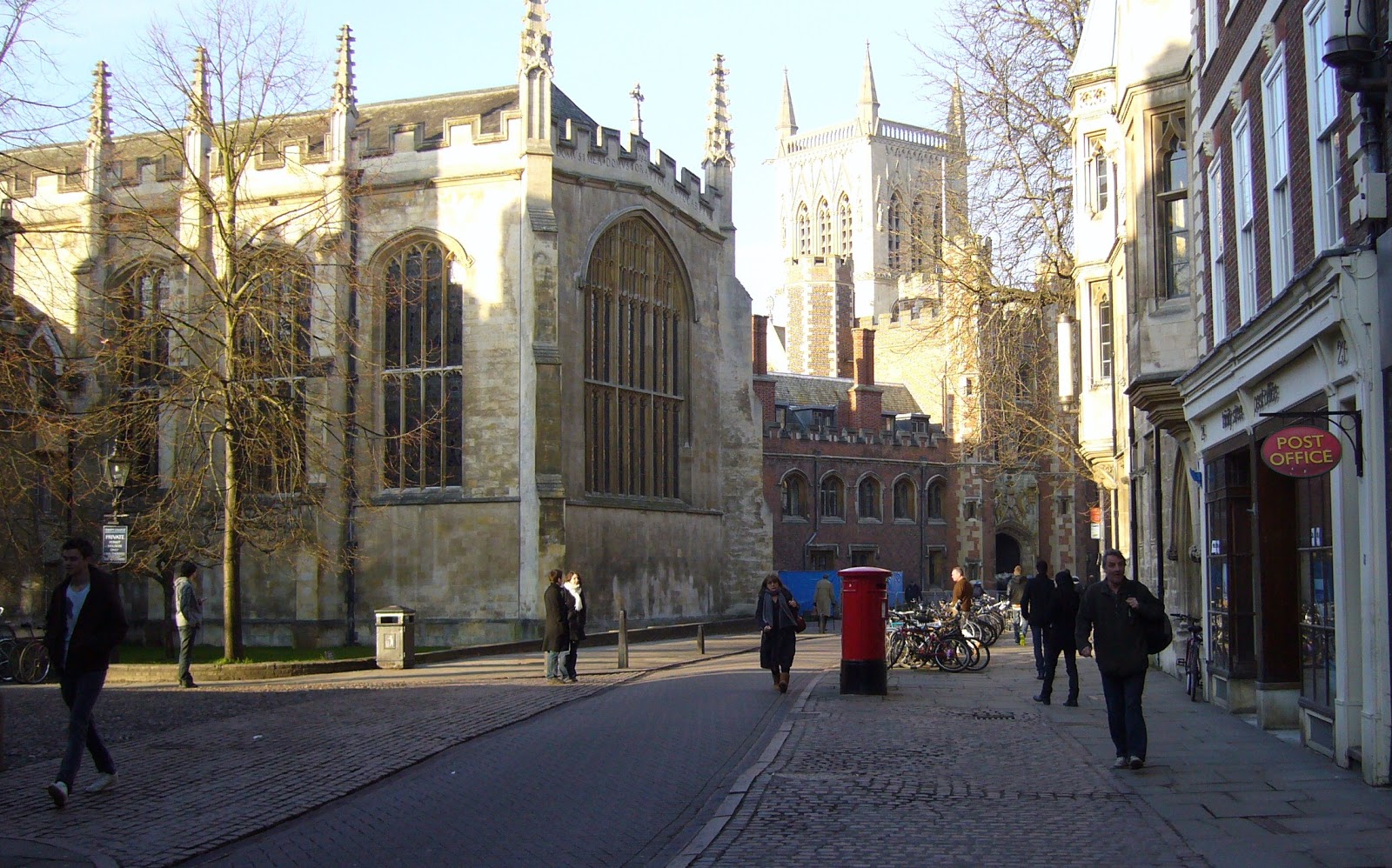
And where is this?  Occasionally, I enjoy a little light shopping and grazing in Cambridge, an easy hour's drive from here with a good Park and Ride.  In another lifetime, I was invited to  entrance interviews at Newnham.  I had left my home in Cumbria earlier in the week to go to Oxford for interview, but then had to take the coach across country to Cambridge.  I recall pottering around the open market in the middle of Cambridge with another interviewee feeling like a seasoned traveller and completely at home.


I still prefer the spaciousness of Cambridge, and the lovely little details which surprise at every turn.  Of Newnham, I remember only the very long corridors, more like a hospital than anything else.


And King' College Chapel, lovely in the sunlight.  I like to lunch at Michaeljohn, a dual use church with a great cafe at one end. 


More hat-work.  My husband was taken with my new titfer and requested a cycling hat for himself.  This cabled hat is Knotty but Nice from Knitty, Winter 2009.  He prefers plain colours and this needs to chime with a dull green scarf he has.  A number of people have commented on the swatch of J&S I posted.  It often surprises me how their colours blend together so well, even those without the same dyed fibres within the mix.  "Peerie" patterns are the small patterns lasting a few rows each.  I suppose that I was aiming at a wave effect and something fern-like for the green.  All I did was choose them from the book, though.  I suspect the swatch would make a perfectly acceptable hat, but there is not really enough "Pop" in the colours.


Food for cold weather: one of my favourite supper dishes is a casserole of pork-chops, first served to me by my elder sister.  Dice and gently fry two onions in a little oil.  Press both sides of two pork chops into some dried sage and onion stuffing mix and brown them in the frying pan.  Place them in the casserole with the onion. Add some stock and cook for about forty minutes in a moderate oven.   Braised like this, the stuffing swells and the seasoning is so nicely balanced no other ingredients are needed.  Serve with potato and greens. Very tasty.