Thursday, February 03, 2011

Spring Fever

Yesterday, a thin wind, blowing right through you, but today, a blue sky, sun and the urge to inspect all the shoots of Spring in the garden.  I like the idea of getting going on the allotment, but I know that it is folly.  Potatoes planted too early have a tendency to have their tops frosted; last years earlies never recovered.


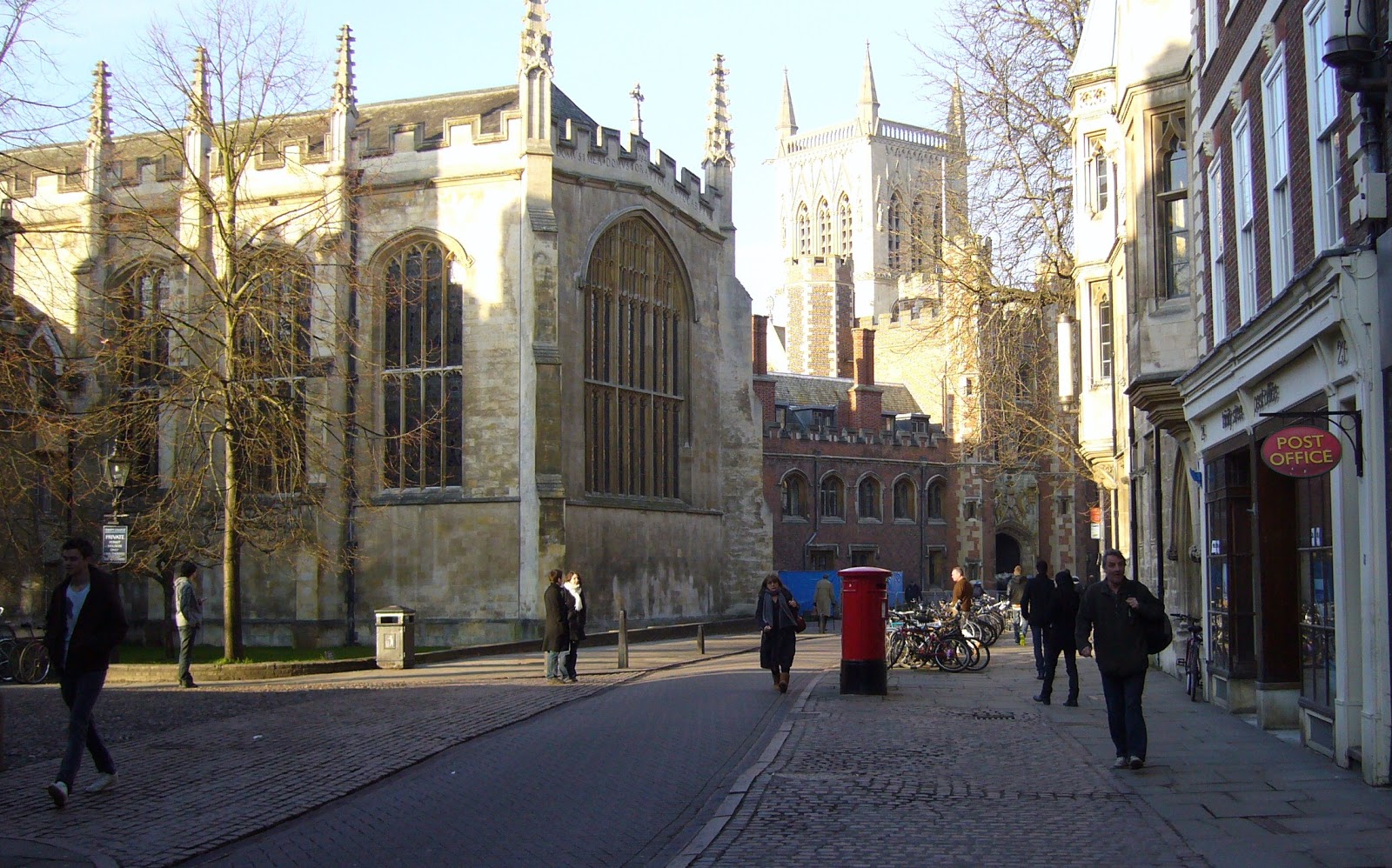
And where is this?  Occasionally, I enjoy a little light shopping and grazing in Cambridge, an easy hour's drive from here with a good Park and Ride.  In another lifetime, I was invited to  entrance interviews at Newnham.  I had left my home in Cumbria earlier in the week to go to Oxford for interview, but then had to take the coach across country to Cambridge.  I recall pottering around the open market in the middle of Cambridge with another interviewee feeling like a seasoned traveller and completely at home.


I still prefer the spaciousness of Cambridge, and the lovely little details which surprise at every turn.  Of Newnham, I remember only the very long corridors, more like a hospital than anything else.


And King' College Chapel, lovely in the sunlight.  I like to lunch at Michaeljohn, a dual use church with a great cafe at one end. 


More hat-work.  My husband was taken with my new titfer and requested a cycling hat for himself.  This cabled hat is Knotty but Nice from Knitty, Winter 2009.  He prefers plain colours and this needs to chime with a dull green scarf he has.  A number of people have commented on the swatch of J&S I posted.  It often surprises me how their colours blend together so well, even those without the same dyed fibres within the mix.  "Peerie" patterns are the small patterns lasting a few rows each.  I suppose that I was aiming at a wave effect and something fern-like for the green.  All I did was choose them from the book, though.  I suspect the swatch would make a perfectly acceptable hat, but there is not really enough "Pop" in the colours.


Food for cold weather: one of my favourite supper dishes is a casserole of pork-chops, first served to me by my elder sister.  Dice and gently fry two onions in a little oil.  Press both sides of two pork chops into some dried sage and onion stuffing mix and brown them in the frying pan.  Place them in the casserole with the onion. Add some stock and cook for about forty minutes in a moderate oven.   Braised like this, the stuffing swells and the seasoning is so nicely balanced no other ingredients are needed.  Serve with potato and greens. Very tasty.


Friday, January 28, 2011

Living off the Fat of the Land


So, if I was swatching in muted colours of J&S jumperweight, how is it possible that the finished hat looks like this?

On Saturday I went to the AGM of the Mid-Essex Spinners' and Weavers' Guild.  Someone brought in two large crates of yarn which she wanted to clear out.  I picked out a ball in this deep periwinkle blue, and another in cream, in roughly the same weight.  Another ball, this time a laceweight, in the same periwinkle - 50p, said the person on the sales table, for the three.  Working on the principle that it is better to use random harvests straight away, I made a swatch.  It was odd yarn, varying in thickness, but looking mostly like a 4 ply.  The cream was a little heavier, but that just seemed to add texture to the motifs.


Making up the pattern as I went along, I found it helpful to pull all the stitches off the needles a couple of times to try the piece around my head.  Then I thought a touch of red would lift the design, and I found instructions for the little braid.  It was new to me.  The main motifs are from Sheila Mcgregor's "Traditional Fair Isle Knitting", which I come back to every time.  I was pretty sure that it would be too tight after the main motif, but in fact it is an exact fit and the ribbing  provides a snug covering for the ears.

So what did I need a new hat for?  My husband and I are not overly keen on exercise, certainly not on sport, but we enjoy cycling and walking.  We have taken to including a cycle round some of the network of lanes which can be found in this part of Essex - traffic free, through rolling countryside, and providing that  glow of  well-being and self-righteousness which calls for a hearty lunch.


My husband, on his bike outside Great Tey church., a curious structure in which the tower dates from the12th  Century, one wing from the 13th and the other from the 14th.  On our first ride this year we were astonished to see a herd of twenty wild deer standing right in the middle of an open field very near to this church.  Essex is a very heavily populated county, its major roads often congested, yet the lanes are deeply rural still.

Arriving home from our rides, we have really enjoyed the  home-made soup we had left on the hob, ready to reheat.  I was shown how to make this by my younger sister five years ago, and since then we have eaten gallons of it.  Using one onion, two carrots, a potato, plus whatever else you have - some stalks of celery, a slice of swede - and a vegetable stock cube, it is also very thifty.  The secret is to sweat the diced vegetables in a tablespoonful of oil before adding the stock, then mash the soup with a potato masher after it has simmered for about thirty minutes.  Recently I have added a small amount of mixed lentils with the stock, which seems to add body to the mix.  It is always the same, but always different.


And this is a skein of laceweight cashmere, bought from Hip-knits on a sale day.  It was an insipid pale blue, so I have over-dyed it with a cold water dye.  Much improved, I feel.

Thursday, January 20, 2011

Swatches


So many people seem to be able to design their own patterns - not just start and see how it works out, as has usually been my way if I am not using a published pattern.   I do find it hard to visualise on graph paper, for example, but adapting a basic shape by using different combinations of colours must be within my capacity.

Above is my stock of J& S jumper weight, all of it dating from before 1990 or thereabouts.  I remember sitting on a train travelling to Cumbria and using the shade card to select a batch of colours for a new project.   I was hoping to replicate the brown Kaffe Fassett Jagged Tooth waistcoat which I had knit for my mother.


I sent off the order full of enthusiasm, but was amazed by what was sent.  One of the blue tweed yarns had solid flecks of colour rather than the blended mix I was hoping for.  Some of the muted browns were muddy, not just muted.  There was something lifeless about them which I had not noted as a feature of my previous purchases from J&S.  Of course, it was also still fantastically cheap, so I was not unduly concerned, but I did not send for any more and abandoned the project. 

In 2000 we visited Orkney and Shetland on our honeymoon.  We certainly realised why tightly knit woollies were popular - and this was August.  We had each taken a thin jumper and a thicker, walking jumper but, on the first morning, we put both on topped with anoraks before we went to explore Jarlshof.  I bought only a few ounces of laceweight from J&S.

However, now I look at this box of yarn and think that there must be the wherewithal for a hat in here.  Some of the muted browns are a blend of brown with blue or brown with green, so perhaps the lighter shade could be picked out?


So, definitely light and dark stripes, but perhaps a different peerie pattern?  or vertical stripes?  There is always the danger that the finished item will say "tea cosy", rather than "hat."  Add to that the fact that I only wear a hat for practical purposes, since I look ten years older without my hair showing.  I'm clearly not there yet on the design issue.


This is what I have actually been knitting: some more scratch mittens in subtly larger sizes.


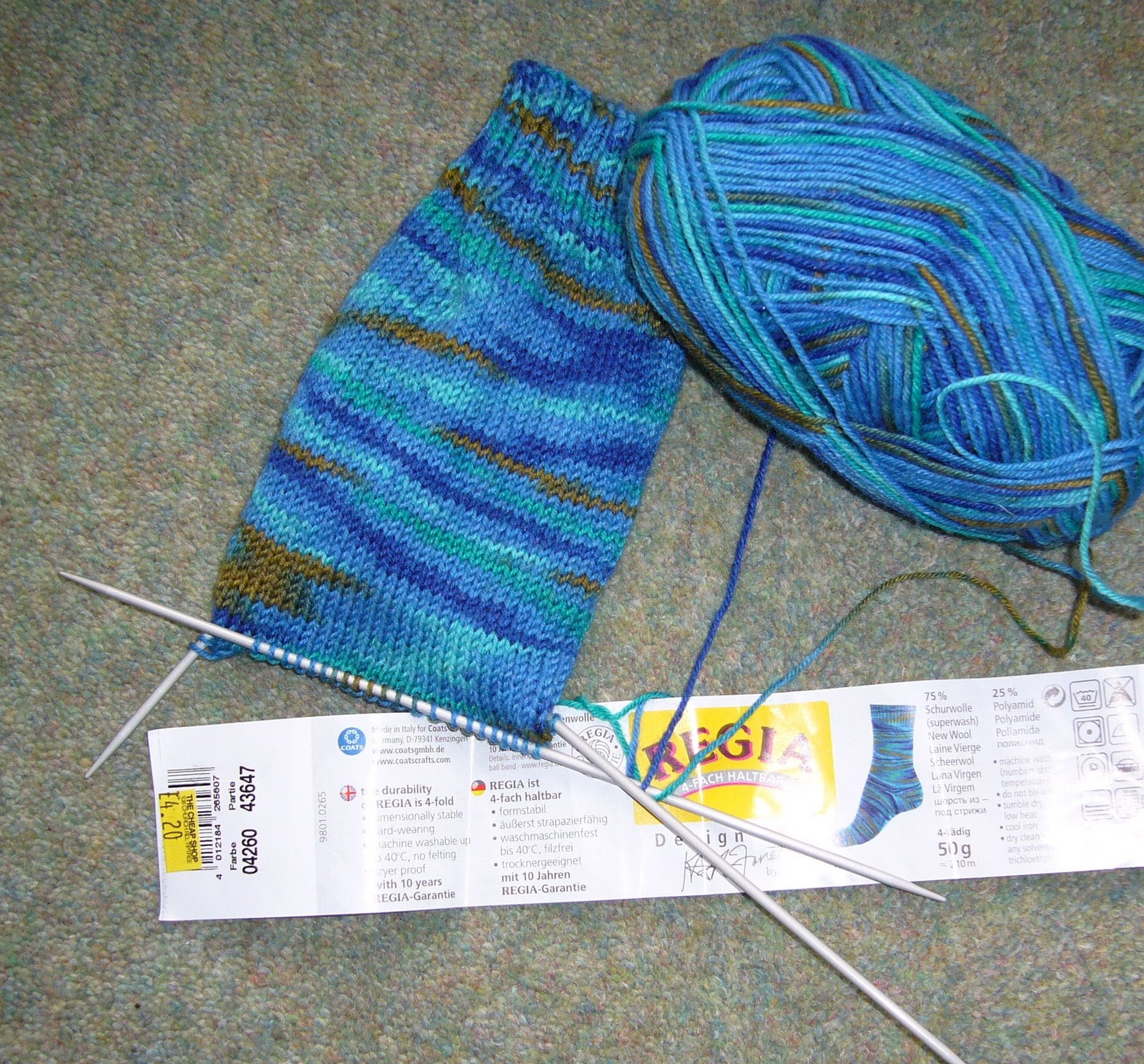
And a pair of socks in Regia by Kaffe Fassett.  Very cheering on a dark day.

Thursday, January 13, 2011

Arts and Crafts


These are miniature scratch mittens which fit the tiny hands of the latest arrival.  The 10p coin is for scale.  The pattern was on a preemie site as I had no concept how small to aim for, although the baby is not unusually small, just new-born.

This is not all the knitting I have done since finishing my shawl, but it feels like it.  I am itching to start a big project, or possibly more than one, so that I have something challenging  and something soothing. 


Here is another Eleanor Cowl pre-blocking.  It certainly became quicker to knit on the second and third times, when the logic of the pattern became more evident.  I cast off before the last half-pattern on this one.


This is my husband's most ambitious project to date.  We use it as a sideboard, hence the drinks.  It was designed to echo the other significant piece of furniture in our dining-room, an Arts and Crafts sideboard.


We bought this some years ago as a dresser - the glazed top acts as a china cabinet in another room.  We understood it to have been in a conventWhich was closing down in a neighbouring village.  the convent building was in the Arts and Crafts style so the dresser may well have been in there since it opened.  It has no maker's mark, but shows the distinctive features one would expect of the period.


Below, the dresser , and above, my husband's work, with that distinctive curve.  The shape of the panels, the profile of the beading and the routing on the edge pieces all echo the original.


Below, the original metalwork handles, and, above, the handles I sourced in Homebase - a remarkable find.


The inside of the cabinet, showing its real purpose.  It is lined with green baize and contains some of my husband's collection of 78rpm records, alongside some more later LPs.

Saturday, January 08, 2011

A Thing of Beauty


These are my two finished Eleanor cowls from Knitty 2010 - to save you searching if you have come across from Jean's blog.  The top one is in Yarnsmith's Pure Alchemy, a hand-dyed yarn produced by Becky who belongs to the Mid-Essex Spinners and Weavers.  That sharp, acid green goes very well over navy or black, as I used it before for a Swallowtail Shawl. 

The pink one is in Jaeger merino 4ply and I increased the stitch count to allow one more pattern repeat.  I don't think that the fit of a cowl is crucial but it should not be too snug or it would be impossible to get on.

This is my new shawl blocking.


And here it is being worn.  Unfortunately, no willowy young person was available for the photoshoot.


This is the Aeolian Shawl from Knitty 2009, designed by Elisabeth Freeman and made in laceweight silk in a colourway called Riverrun.  I am very pleased with how this has turned out.

Thursday, January 06, 2011

Cabin fever


This is my husband's largest piece of woodwork, and also one of the earliest examples we have.  He made it while still a bachelor, constructing one single bed, but buying the wood for the other half, so that it would make a very large double.  He was clearly someone who thought long-term. 

Now he is considering removing the foot-boards, which serve no structural purpose, but make changing the sheets an athletic enterprise. 

Behind the bed can be seen some more of our beams, including the broader one which excited the historic buildings people.  This beam is "jowled", which means that it shows evidence of having had a cross-piece jointed into it at one time. 


At last I have finished the Aeolian Shawl, seen here in its pre-blocked state.  I certainly take my hat off to the designer, Elisabeth Freeman, but also to those who have knitted it more than once and incorporated the beads, which I omitted.  The early parts went well, but the very deep edging was taking at least half an hour per row, and there were about fifty rows.  Simply casting off took several hours.  That said, it did take the edge off some long car journeys.  Listening on my new MP3 player to "The History of the World in 100 Objects," while knitting this, brought on a trance-like state.


Here it is being blocked.  The silk has less give in it than wool, but the transformation is still astonishing.  Below is the skein of yarn, purchased at the i-knit Weekender in September.


In the interests of full disclosure, these were the scarves I knitted for various unsuspecting family and friends this year.  This is Starlight Revue by Austermann, bought in  a fit of enthusiasm at Ally Pally this year.  It's a ladder yarn with a metallic thread, and in the right light it glistens in a jewel-like manner.  It does look festive on a plain black top, or I hope that is what the giftees felt. As a knitting experience it is not pleasant - big needles, scratchy, unrelenting yarn, no skill involved.


Finally, what looks like a sign of Spring.  Odd to think that this succulent decided to flower as temperatures dropped to their lowest levels. 

Wednesday, December 22, 2010

Table Turning

Like most of the UK, our holiday plans have been radically altered by the severe weather.  Watching the  scenes of traffic benighted on the M6, we decided to stay put, rescheduling some of our visits for next week.  After all, it is seven hour's drive to Cumbria, through bands of snow and freezing fog - seven hours on a good day. 

Earlier in the year I had suggested to my husband that he motivate himself to work through a tedious patch of his big project by setting himself a deadline - why not have it ready for Christmas?  He has spent some long hours in his shed this week and yesterday moved to the assembly phase.

The table in our dining-room was second-hand when I bought it for £15 in 1984.  It had seen hard service, but had the advantage of an extra leaf which could be put in for bigger parties.  It is so old, it had almost become a fashionable item - solid wood, with a g-plan vibe to the design.  However, the top was badly marked, and the legs not totally steady.

Unlike the replacement.  This is the result of much research into Arts and Crafts models, the Gordon Russell Museum in Broadway, Blackwell in the Lake District  - every joint carefully checked out.  No glue has been used in the construction, and screws only in fixing the top.

Oak table

Note the pegs at the top of the legs, and the button on the cross bar.

Pegged joints


This is several hundred pounds worth of English oak.  It can be taken down, which is fortunate as it is too big to move through the doorway of the room and had to be assembled in situ.

I love it.  We will be christening it on Christmas Day.


Another Eleanor cowl from Knitty.  Such a satisfying piece of lace to knit, with different sized needles to give the flare at the bottom.  This was a merino 4-ply, so I added an extra pattern repeat.  It used almost all of one 50 gram ball.

Friday, December 17, 2010

Woad, Weld and Madder

Sounds like a firm of solicitors, but in fact these are three of the dyes a member of the Mid-Essex Guild of Spinners and Weavers used in the making of the gift I received from the Secret Santa.  She had done a demonstration dyeing session at West Stow Anglo Saxon Village and had a pile of small amounts of yarn in interesting colours.  This is what she made of some of it - it's a pot-holder.

The red is madder, the orange turmeric, the blue woad and the green weld overdyed with woad.


At rthe event, the wrapping was meant to be as creative as the gift.  To wrap the cowl I made, I put together a bag made of silk patchwork scraps, with a little pocket of tie silk which happenened to have Christmas trees all over it.  Unfortunately, I did not take a picture before I gifted it.  The parcel I got was tied with green ribbon with this madder-dyed flower attched.


This little group of miniatures were not made by my husband, but by my father.  In his retirement, he derived much pleasure from retreating to his garage where he had a work-bench set up.  Two of these items have huge symbolic meaning. 

The small box is a sailor's "Diddy-box".   In 1939, my father, who had already left Cumbria to work in Northampton, decided to "join up" for seven years.  He chose the Navy because his Uncle Nat had served in the Navy.  He sent my mother a postcard with a drawing of a pair of bell-bottom trousers on it  - she was supposed to work out the significance of this for herself.  They married in 1940, but it was 1947 before they were able to set up home together. 

Soon, they were able to buy the farm of the same Uncle Nat, who was just ready to retire.  They bought it "Lock, stock and barrel", and I don't doubt that a barrow just like the one above was part of the equipment included.  My father certainly "mucked out" with a barrow each morning for many years.  The muck was shifted out to the midden where it stayed until he loaded it by hand onto a cart, and put it out in heaps on the fields.  Then, again by hand, he spread each heap out.  Whenever we do this, as a leisure activity, on our allotment, I think of the toil which went into making a living.  Now, of course, farmers use mechanical scrapers and slurry tanks

Friday, December 10, 2010

Icy Blast


Cold weather gear.  Every year this padded jacket, christened by my husband "The Yak-Herder", comes into its own.  It was bought from a tiny boutique in Maldon but is made by Phool.  When I bought it, along with a heavy black cardigan with a double front, I remember thinking that I might not actually get much wear out of either of them.  But, both have been reliable companions.


Similarly, this merino Nordic knit.  It was there waiting for me in a charity shop, Brand New With Tags, as they say on e-bay.  Someone clearly thought it OTT in the cold light of day once back in Essex.  But I just love those reindeer trooping around the top and bottom, and the merino lived up to its reputation, smooth and snuggly.

I was fascinated by the comments left on my last entry.  I always used to think of our house as already standing at the time of Shakespeare, indeed, at the time of  Chaucer.  This used to amaze and thrill me.  It is possible that the space we live in was already in occupation as the central section between two cross-wings.  It would have had an external stair-turret and the fireplace would not have been where it is today; instead, there would have been a central, open fire.  Our roof timbers are said to be smoke-blackened.  It would have been open floor to ceiling with a lower roof-line than currently.  So then, later, the roof would have been raised in order to divide the space into two floors.

Alternatively, it is possible that there were two houses with a space between, and that in, say, 1635, the space was roofed over to make a third house.  However, what is certain is that timber framed properties can be stripped down to the timbers and completely reconstructed and reconfigured, so who knows? 


This is the Eleanor Cowl from Knitty Deep Fall 2010, and a very satisfying knit it has proved.  I'm not completely convinced of the utility of a cowl, but they seem to be everywhere.  This one is destined for the Secret Santa at the Spinners' and Weavers' Guild.  It is knitted from Yarnsmith's Pure Alchemy, the same colourway as my Swallowtail shawl.

Saturday, December 04, 2010

Snow Days

Snow day: school closed!!  Oh, wait...It's my day off anyway.  But somehow, the insane excitement of sledges and snowballs fills the air - after all, I don't have to struggle through the traffic to work today.

Last week, to a big  public meeting on the project organised by the village Heritage society.  This project aims to establish the dates of properties in the centre of Coggeshall.   Our house is part of that centre.  The project has some very well-qualified people giving up their time in early retirement, and has secured funds from the Lottery to employ a dendrochronologist, to date timbers.  Our house has been selected.

Dating timbers is a tricky business.  Elm will not date.  Oak has to be of a certain girth and, preferably, with the bark attached.  The timbers have to be accessible and boreable.  North of the village is Monks' Wood, and it is thought that much of the timber for the village centre came from there, so there is oak rather than elm.

When our house was surveyed, we began to look at details with new eyes.  We had always enjoyed the exposed timber in our dining-room, but had never thought of it as belonging to the house next door. 


The large capital at the head of this upright has some moulding to it.  This, we learn is Jacobean, rather than late mediaeval. 

In fact, the part of our house which arouses most interest is the loft, which is unconverted, although it has ancient floor-boards.  Timbers which can be dendroed were found, along with evidence of a previous large bay-window.  Was the roof lifted, and original timbers reused?  Or were these timbers formerly in another property?  Always the question is: had this been the central section of a hall-house, with the neighbouring properties all part of the same structure?

The survey seemed to raise questions rather than answer them.  However, timber in another house just along the street was dated to 1386, the earliest in the village so far.  It seems odd to say this, but we were actually disappointed to discover that our roof timber dated to 1635, the summer of 1635.  We were very pleased to be included in the project, nonetheless.